 Family Called Her A Failure For 12 Years
Chapter 3
The Silence of the Auditorium
You could have heard a pin drop on a carpet of velvet.
Thousands of pairs of eyes—parents, graduates, instructors, and high-ranking officers—snapped away from the stage and locked onto the dark corner near the rear pillar. The contrast was jarring. Up front, Daniel stood frozen in his pristine white uniform, his hands still half-raised from his aborted introduction. A few yards away, my father stood like a statue carved from disbelief, his hand still awkwardly suspended in mid-air.
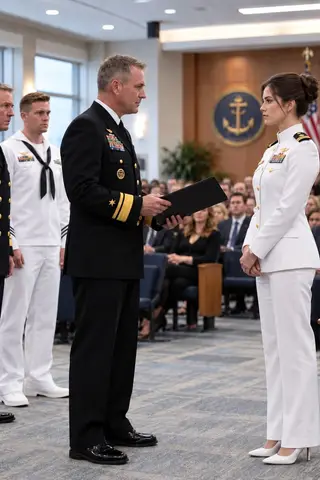
And right in front of me stood General Thomas Carter, the commander of Joint Special Operations, standing at a rigid position of respect.
"General," I replied, my voice steady, measured, and entirely devoid of the nervous flutter that usually accompanied civilian encounters with top brass. I didn't salute—my civilian status and current deep-cover protocol didn't require it in public—but my posture mirrored his exact alignment.
General Carter’s eyes dropped briefly, moving down toward the left lapel of my gray blazer where the secure phone rested against my chest. A flicker of grim satisfaction crossed his weathered features.
"Did Washington confirm the extraction?" he asked, his tone low, clipped, and loaded with operational urgency.
"Confirmed fifteen minutes ago, General," I answered smoothly, letting my words hang in the heavy air. "All personnel accounted for. Bird is wheels-up over the second checkpoint. Clean exit."
A collective, barely audible gasp rippled through the rows of spectators nearest us.
Extraction? What extraction?
Who is she talking about?
Isn't she the dropout?
My father’s face drained of color, turning from a healthy, proud pink to a sickly, chalky gray. His mouth opened, but no words came out. For twelve years, he had told everyone—his golf buddies, his retired naval colleagues, his wife, and himself—that his daughter was a washed-out failure who couldn't handle the pressure of military life.
Yet here was a four-star general, a living legend of the military command structure, treating me not like a spectator, but like the person holding the operational keys to the kingdom.
Daniel took two heavy, unsteady steps down the aisle, his eyes wide with a mixture of shock and blind panic.
"Wait—General, sir," Daniel stammered, forgetting every rule of military decorum in his desperate confusion. He pointed a trembling finger toward me. "There’s... there’s some kind of mistake. That’s my sister. She... she dropped out of the Navy twelve years ago. She’s a civilian. She doesn't have clearance for—"
General Carter didn't even turn his head to look at Daniel. He merely raised a single, weathered finger, and the sheer authority in that silent gesture cut my brother off mid-sentence as effectively as a knife.
"Captain Hayes," General Carter said, finally glancing toward my father with a gaze so cold it could freeze fire. "Your son is a fine tactical operator. But he is looking at a very small piece of a very large board."
The general turned his attention back to me, his expression softening into something resembling grim respect. He reached inside the tailored breast pocket of his dark dress coat and withdrew a heavy, sealed manila folder stamped with thick red lettering: EYES ONLY / DIRECTORATE OF SPECIAL PROJECTS.
"Washington needs your sign-off on the final phase, Director Hayes," General Carter said quietly, extending the folder toward me.
The word hung in the air like a thunderclap.
Director.
Not dropout. Not failure. Not the family mistake.
Director.
The End









