 Family Called Her A Failure For 12 Years
Chapter 1
The Weight of a Visitor Badge
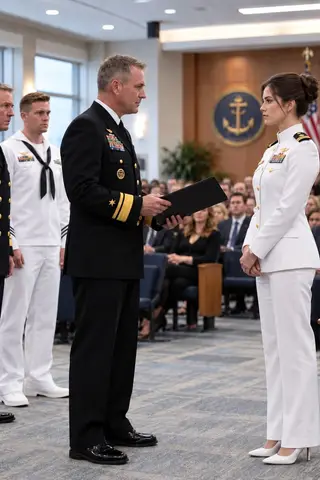
The gray blazer felt heavier than it had when I pulled it out of my closet back in Washington. It wasn't the fabric; it was the sheer psychological weight of stepping back into a world I had intentionally left behind. Around me, the grand naval auditorium buzzed with the electric energy of celebration. Hundreds of people—proud parents, siblings, girlfriends, and retired officers—filled the tiered seating, their laughter and chatter creating a dull, continuous roar that echoed off the high vaulted ceilings.
Cameras flashed like synchronized lightning storms. Everywhere you looked, crisp white dress uniforms snapped into sharp salutes, and gold tridents gleamed under the heavy overhead stage lights. It was the culmination of months of brutal, unforgiving hell—Hell Week, BUD/S training, tactical insertion courses, and psychological filtering that weeded out all but the absolute most resilient candidates.
And right at the center of it all was my brother, Daniel.
He stood tall, broad-shouldered, and flanked by his newly minted teammates, looking every bit the poster boy for naval supremacy. His uniform was immaculate, every ribbon aligned to microscopic precision, his boots reflecting the polished floorboards like mirrors.
I stood near the rear wall, half-hidden by a concrete pillar and the shadow of a heavy velvet drape. I wore flat shoes, dark slacks, and a simple, unadorned gray blazer. Clipped to my left lapel was a temporary visitor badge, laminated in cheap plastic, bearing a barcode and a generic serial number.
In their eyes, that badge was my permanent identity.
To my family, I wasn’t a guest of honor. I wasn't a fellow service member. I was an afterthought—a distant spectator allowed into the sanctuary of their triumph purely out of reluctant obligation.
My mother, Beatrice Hayes, sat three rows down from the front, dabbing at her eyes with a lace handkerchief. Her face radiated a proud, tearful glow that she had reserved exclusively for Daniel for as long as I could remember. Beside her sat my father, retired Navy Captain Robert Hayes. Even in civilian tweed, my father sat with military posture, his shoulders squared, his chin tilted up with the fierce, possessive pride of a man who believed his bloodline was a personal monument to American naval might.
For twelve years, they had perfected a single narrative.
Samantha couldn't cut it.
Samantha lacked the discipline.
Samantha walked away when the mud got too deep.
Every holiday dinner had been an unspoken trial. Every family gathering was a subtle competition where Daniel’s achievements were placed on a pedestal, and my existence was treated as a cautionary tale. They spoke of my departure from the Navy with hushed, pitying tones, as if I had broken a fragile heirloom instead of making a calculated, highly classified career pivot.
"Look at him," my father’s voice boomed softly a few rows ahead of me, cutting through the ambient noise as he shook hands with a retired commander. "That's my boy. Straight through the pipeline. Third generation Hayes in the Teams. True steel."
True steel. The phrase echoed in my mind, tinged with a familiar, dull ache.
I shifted my weight, letting my hand brush against the inside pocket of my blazer. Resting snugly against my ribs was a secure, encrypted satellite phone. Its screen was dark, locked, and completely invisible to anyone passing by.
Just minutes earlier, right as the auditorium band struck up a triumphant brass fanfare for the graduating class, the phone had pulsed against my chest with a silent, rhythmic vibration. It was a single, compressed data packet routed through three secure relays in Virginia and routed directly to my personal terminal.
I had looked down at it for barely three seconds.
EXTRACTION CONFIRMED.
ALL PERSONNEL ACCOUNTED FOR.
No names. No operational parameters. No clearance level visible to anyone standing within a hundred miles of this auditorium. Just confirmation that a shadow war thousands of miles away had reached its conclusion without a single American casualty—and that the directives I had signed off on at 0300 hours that morning had saved a dozen lives.
I pressed the power button, plunging the screen back into darkness, and slipped my hand away.
Across the wide expanse of the polished floor, Daniel broke away from a knot of congratulating relatives. His eyes swept across the crowd, scanning the sea of proud faces until they locked onto mine near the back pillar.
The warm, victorious smile on his face shifted. A familiar, razor-thin smirk curled the corner of his lips.
He didn't walk over, but he didn't have to; his voice carried cleanly over the murmurs of the crowd.
"Didn’t think you’d actually show up, Sam," Daniel called out, loud enough for his immediate teammates to turn and look. His eyes raked over my simple gray blazer and the cheap plastic visitor badge. "Must feel pretty weird watching someone actually finish what they started, huh?"
A few of his teammates chuckled, a low, rumbling sound of casual camaraderie. They didn't know the history, but they knew the language of superiority.
My father heard every word. He turned his head halfway around, looked straight at me standing by the pillar, and then slowly turned back around. He said nothing. He offered no reprimand, no correction, no defense. His silence was louder than any insult Daniel could have spoken. It was an absolute endorsement of my irrelevance.
For a brief second, the old insecurity threatened to claw its way up from my stomach—the stinging desire to scream the truth, to rip open my blazer and show them what I actually did, to shatter their precious illusion with a single sentence.
I didn't fail, Dad. I got recruited.
But discipline isn't just about holding a rifle or marching in formation; it's about knowing when to keep your cards close to your chest. Let them celebrate their moment. Let them bask in the shallow waters of their arrogance.
Because the real storm was about to hit.
The End









