 Column B
Chapter 4
The Room Below
They did not wait for the key. Two firefighters took the basement door off its hinges with a halligan bar while Ruiz pulled on her breathing apparatus.
“You stay up here,” she told Birdie.
Birdie stayed at the top of the basement stairs with the meter in her hand and watched the numbers in the open doorway go past four hundred, and listened to the boots move across the concrete below, and to someone calling, “Fire department, call out!”
Then Ruiz's voice on the radio. “Got one. Male, elderly, responsive to pain. Bringing him out.”
They carried him up in a blanket between two of them. He was small and very thin and wore a knitted hat and two cardigans and a pair of fingerless gloves. They laid him on the frozen sidewalk and Birdie was on her knees beside him before the paramedics had their bag open, because nineteen years at a triage desk had not taken the rest of it out of her.
He was breathing, fast and shallow. His pulse was quick under her fingers. His eyes opened at her voice and wandered and closed. The oxygen mask went on, high flow, and she held it to his face with both hands while they got the stretcher.
“Sir. Sir, can you tell me your name?”
His lips moved inside the mask. “Hora,” he said. “Zdenek Hora.”
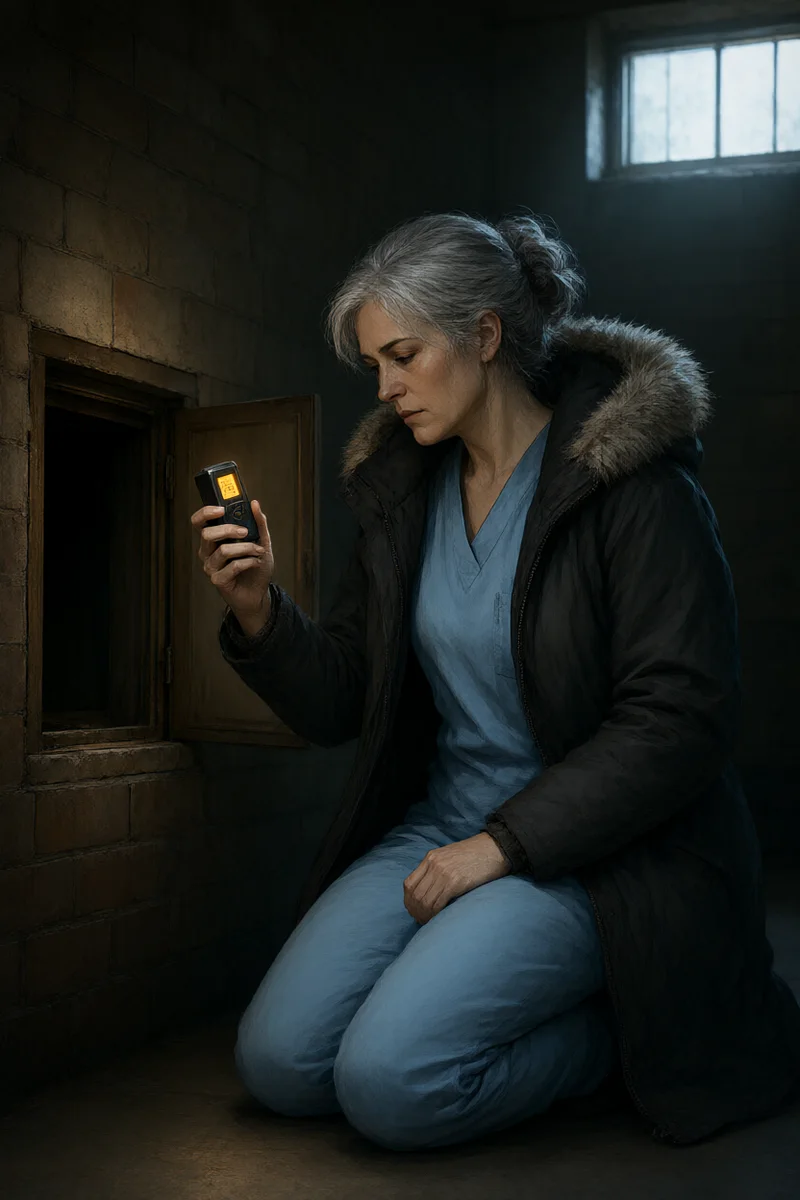
Ruiz came up the stairs pulling off her mask, her face wet with sweat in the cold. “He had a room,” she said. “Back corner of the basement, behind the old coal bin. Plywood walls. A cot, a hot plate, a kerosene heater going full blast under a tin hood he'd made himself. The flue for it was a dryer hose stuck into the bottom of that old dumbwaiter shaft.” She shook her head. “He was venting his heater straight up into five apartments.”
“He didn't know,” Birdie said. It was not a question.
“I don't think he had any idea. Room's got no window. The building heat doesn't reach down there, it's freezing, and the manager says nobody lives there.” Ruiz looked at the gaunt man on the stretcher. “Somebody's been taking rent for that room, though. There was a receipt book on the cot.”
The paramedics loaded Hora into the second ambulance. He needed hyperbaric oxygen, the big pressurized chamber that forced carbon monoxide out of the blood, and the nearest one was at the university hospital across the river. Birdie went with him. She told the paramedic she was his nurse, which was not technically true, and the paramedic took one look at her face and did not argue.
On the way, as the oxygen did its work, Mr. Hora came up out of it a little at a time. His eyes found the ceiling, then the window, then her.
“The children,” he said through the mask. His accent was thick, Central European, the consonants all in the wrong place. “Upstairs. Are the children all right?”
“They're fine,” she said. “They're out. How do you know about the children?”
He closed his eyes. A tear ran sideways from the corner of one into his ear.
Later that morning, outside the hyperbaric unit, Birdie's phone rang. It was Senait Haile, calling from St. Columba, where Dawit's blood level had come back at eighteen percent, and he was on oxygen, and he was eating toast.
“Dawit asked about the man,” Senait said. “The one in the basement. I said nobody was in the basement, and he started crying.” She paused. “He says it's Mr. Hora. He says Mr. Hora fixes all the radiators in our building when they bang, and comes up the back stairs at night, and that all the kids on our side know him. He says Mr. Hora made them promise never, ever to tell.”
The End









