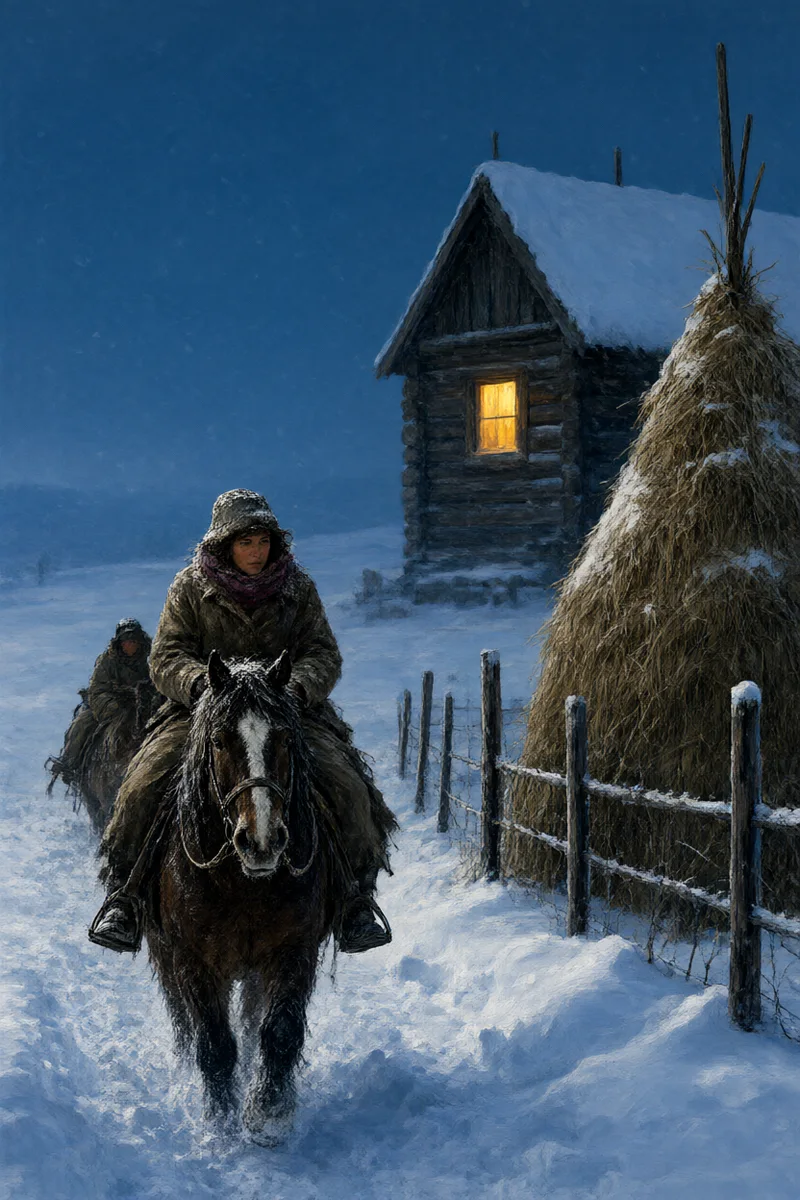
 The Hard Winter
Chapter 5
Chinook
The sheriff was a heavy, slow man named Dutton, and he took a long time getting off his horse. He walked along the wall of the house and looked at each square of hide in turn, the way a man looks at pictures in a church.
“These yours, Mrs. Coyle?”
“They were my husband's calves. They were wearing Mr. Ingersoll's brand when they died against my fence.”
Ingersoll laughed. “Ridley cut those himself. He was fired for insubordination. He'd say anything.”
“He might,” said Dutton. “Hide won't.” He turned one over, then another, with a thick gloved finger. “I've seen a good many altered brands. I never saw one altered from the flesh side.” He looked at Ingersoll. “Who bossed your fall roundup?”
Ingersoll did not answer quickly enough. Dutton nodded as if he had.
“I'll want to talk to Gaither,” he said. “I'll want to talk to the Stock Association, and they'll want to talk to your owners in Edinburgh. Nineteen head of stolen stock at twenty dollars a head comes to three hundred and eighty dollars. That's more than three hundred and fifty, by my arithmetic.” He held out his hand for the leather folder. “I'll keep this note till that's settled, I think.” Ingersoll gave it to him. There was nothing else he could do.
That night the wind changed one last time. Leah woke to the sound of water dripping from the eaves, which she had not heard since October. She went out on the porch in her nightgown and shawl, and the air was warm, actually warm, blowing in long soft gusts out of the southwest. A chinook. The snow was going gray and soft under it as she watched.
Cass came out of the shed where he had slept every night since January. He stood at the bottom of the porch steps with his hat in his hand.
“It'll be gone in two days,” he said. “The roads will open.”
“Yes.”
“That means a man could ride to Lewistown.”
“It does.”
He turned the hat around in his hands. Around and around. She had learned, by now, what he did with his hands when he was trying to say something.
“The quarter section east of yours is open,” he said. “The one with the spring. I looked at the plat in Dutton's office this afternoon. If a man filed on it, his fence would run right along yours. He could share the mower. Cut both meadows. He'd be around to fix things when they broke.”
“Things break all the time out here,” said Leah.
“That's what I thought.”
She came down the steps to him. The snow was slush under her bare feet and she did not care.
“Cass Ridley,” she said, “you have been fixing things in my barn for seven weeks. My children have decided you belong to them. If you file on a separate quarter just to sleep in a separate shed, I will think less of you.”
He looked at her in the soft dark. The eaves dripped. Somewhere out on the bottoms a stream that had been frozen since November began, very quietly, to run.
“One claim, then,” he said.
“One claim,” said Leah, and took his hat out of his hands so he would stop turning it.
The End









