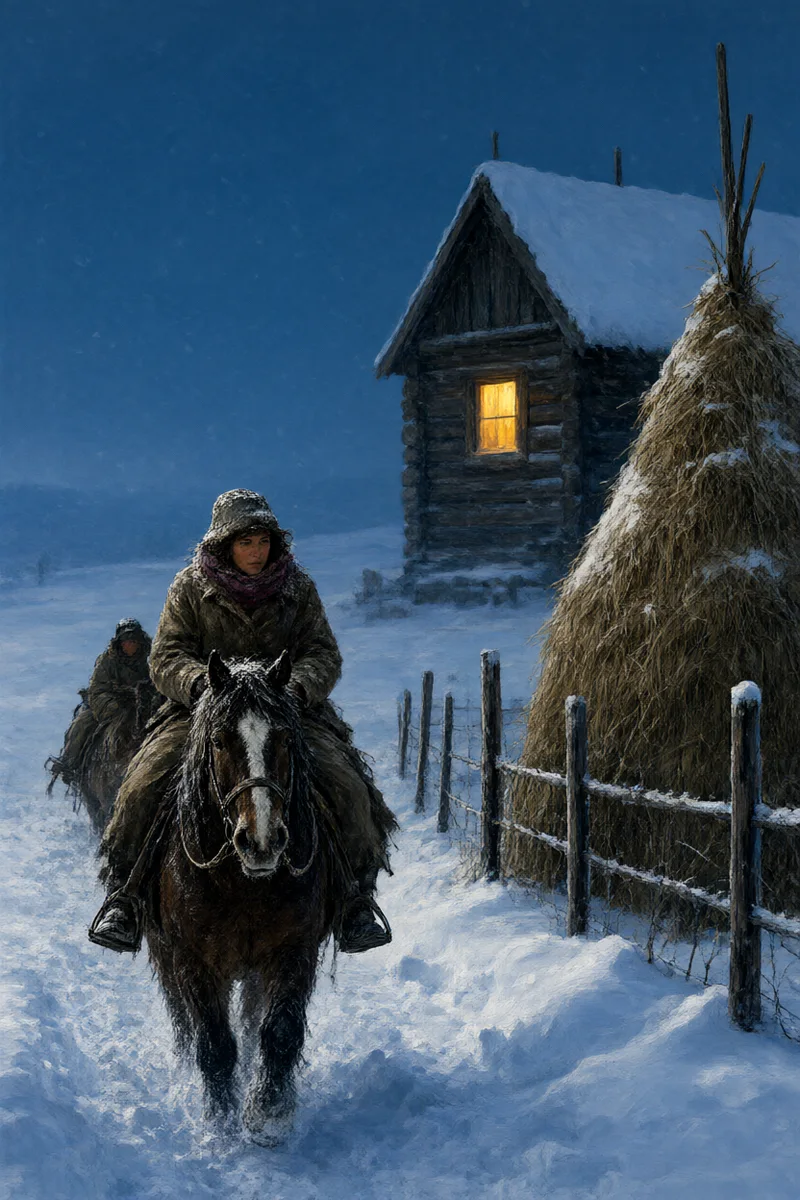
 The Hard Winter
Chapter 3
Fine Print
“The note isn't due for seven weeks,” Leah said.
“The note isn't,” Ingersoll agreed. He had a pleasant, reasonable voice, the voice of a man reading out a grocery list. “But your husband pledged the land, and the land includes its crops. I've four thousand head on the Flatwillow starving to death, and I'll not stand by and watch my security rot in a fence while they do. You'll be credited ten dollars a ton against the debt.”
Ten dollars a ton. Eight hundred dollars for hay that was keeping her children alive, credited against a debt of three hundred and fifty, with no cash left over and nothing to feed her own animals by February.
Before she could say so, Cass walked past her to the fence.
Ingersoll looked at him for the first time, and something passed over his face, quick and sour.
“Ridley. I thought you'd gone south.”
“I got lost.” Cass held up the note. “You ought to read your own paper, Mr. Ingersoll. It pledges the northwest quarter of section twelve, the dwelling and improvements thereon. It doesn't say crops. It doesn't say hay. It says the mower, which is in the shed, and which you're welcome to.”
One of the riders laughed and stopped himself. Ingersoll did not laugh.
“You'll find the sheriff reads it differently.”
“Then bring the sheriff,” said Leah. She was surprised by the steadiness of her own voice. “Until you do, you'll get off my land.”
They went. It took a long time to turn three wagons in that much snow, and nobody helped them.
Cass did not leave that day. He did not say he was staying. He simply unsaddled the horse, and went out to the shed, and began fixing the hinge on the cow stall that had been broken since Will died.
In the weeks that followed, a kind of life arranged itself around him. He hauled water. He taught Jem checkers and lost on purpose and then, when Jem caught him at it, stopped losing on purpose. He read aloud from the one novel in the house, a battered romance about a Venetian count, in a flat Missouri voice that made Nan laugh until she cried.
In the evenings he and Leah sat at the table with the note between them and did arithmetic. If she sold twenty tons to the small ranchers on the creek, who were paying in promises, she might have a hundred dollars by March. It was not enough. Nothing they could think of was enough.
“I could sell my saddle,” Cass said one night.
“You could keep your saddle.” She did not look up. “You'll want it, when you go.”
He was quiet a long moment. “I hadn't been thinking about going.”
She did look up then. The lamp was low and his face was half in shadow. Up in the loft Jem turned over in his sleep, and she went back to the figures. She added the same column twice and got two answers.
Near the end of January the wind changed again. It came straight down from the north with a long, rising scream, and the snow came with it, so thick that the barn disappeared from the window.
And under the scream of it, sometime after midnight, Leah woke to another sound. Lower. A thousand voices. Bawling.
She went to the window. She could see nothing. Then she heard the crack of a fence pole giving way, and another, and another, and Cass was already pulling on his boots.
“Ingersoll's herd,” he said. “They're drifting ahead of the storm. They're coming through the fence for your hay.”
The End









