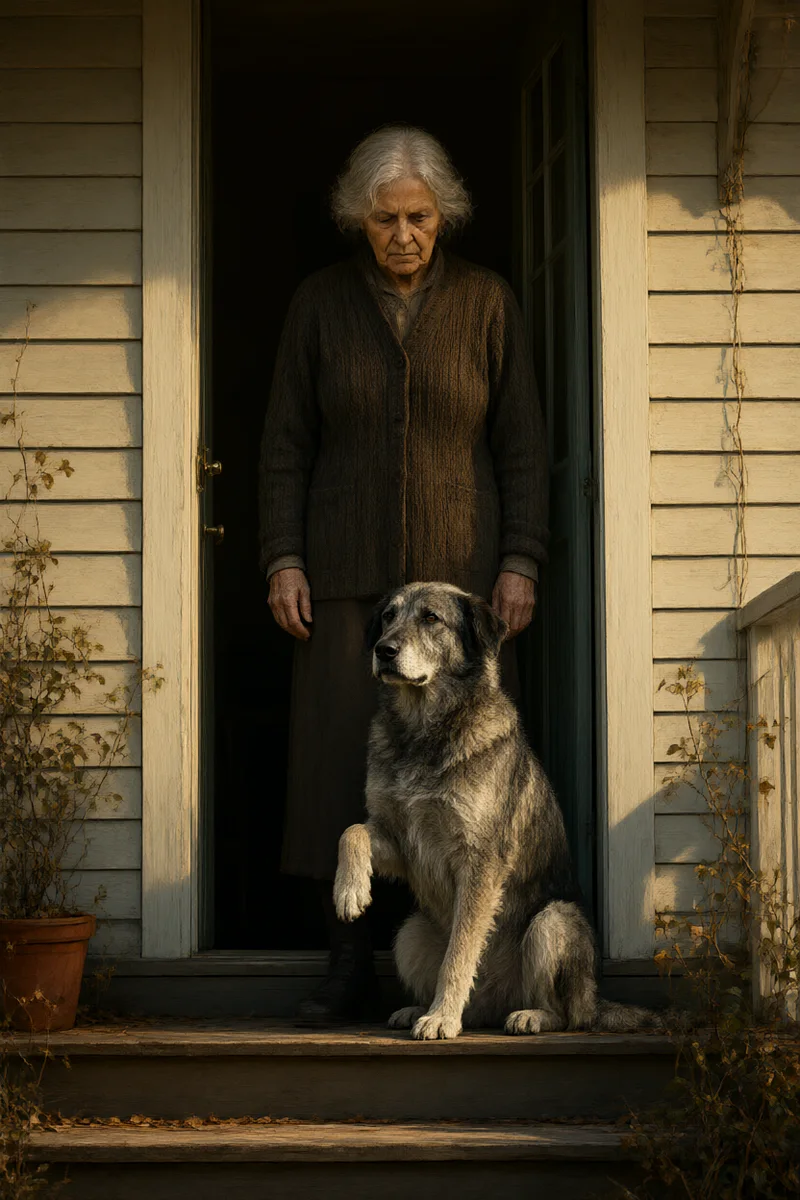
 The Dog on Larch Street
Chapter 2
The Long Way Round
She drove to Canal Street with the dog in the back seat and the tag in her fist and climbed the outside stairs fast enough to remind her knees that they were seventy-one.
The young man answered in a white kitchen jacket. He was on his way to a shift, or coming back from one. He looked at the dog and then at the tag in her hand and did not pretend to be confused.
“You can't do that,” Ottilie said. “You can't engrave a person's address on an animal.”
“Turns out you can. It was eleven dollars.” He rubbed his face. “Look. Ma'am. He's going to keep going there. It doesn't matter what I do. I used to be home mornings to stop him. I'm on doubles now. I've tried the chain. I've tried a crate. He chewed through the crate. He walks two and a half miles across town, in the dark, across the Mill Street bridge, to sit on that porch.”
“Why on earth would he do that?”
The young man looked at her for a moment, as though deciding whether she deserved an answer.
“Because it's his house,” he said. “It was my mother's house. Bernadette Cullen. She died last November. He was hers. I had to sell it. There were bills, and I'm a line cook, and the roof needed doing, and—” He stopped. “You bought it. Congratulations. It comes with a dog.”
His name was Raff. He was twenty-seven. He was moving at the end of the month into a shared room in a house by the hospital, where there were already two cats and a landlord who had said no to anything else, very clearly, in writing. He told her all this standing in the doorway with his arms crossed, in a tone that suggested she had personally invented landlords.
“Then take him to the shelter,” Ottilie said.
“You take him to the shelter,” said Raff. “I can't.” And for just a second his face did something young and terrible, and then he shut the door.
So Ottilie took the dog home, because it was nine at night and raining, and intended to take him to the county shelter on Monday morning when it opened.
She learned things about him over the weekend that she had not wanted to learn.
He would not eat from a bowl on the floor. He ate if she set the bowl on the bottom step of the back stairs. He slept in the hall with his back against the front door. At seven forty every morning he went to the front window and stood with his front paws on the sill and his ears up, both of them, even the bent one, and watched the street. At five fifteen every evening he did it again. When nothing came, he got down and lay by the door.
“She's not coming,” Ottilie told him on Sunday evening, more harshly than she meant to. “Nobody's coming. Get used to it. I had to.”
On Monday she drove him to the shelter. It was a low cinderblock building with a chain-link run along one side and a lot of barking. She parked by the door and turned off the engine and sat there, with her hands on the wheel, putting it off.
Moss climbed over the console into the front passenger seat. He had never done that before. He sat up straight, facing her, his back to the window, his gray chin level with hers. And he lifted his right front paw, and held it in the air between them, and waited.
Ottilie stared at him.
She had seen a dog do that before. Not once. Thousands of times. Every weekday morning for the better part of ten years, at seven fifty-two, through a sliding window two feet from her own.
The End









