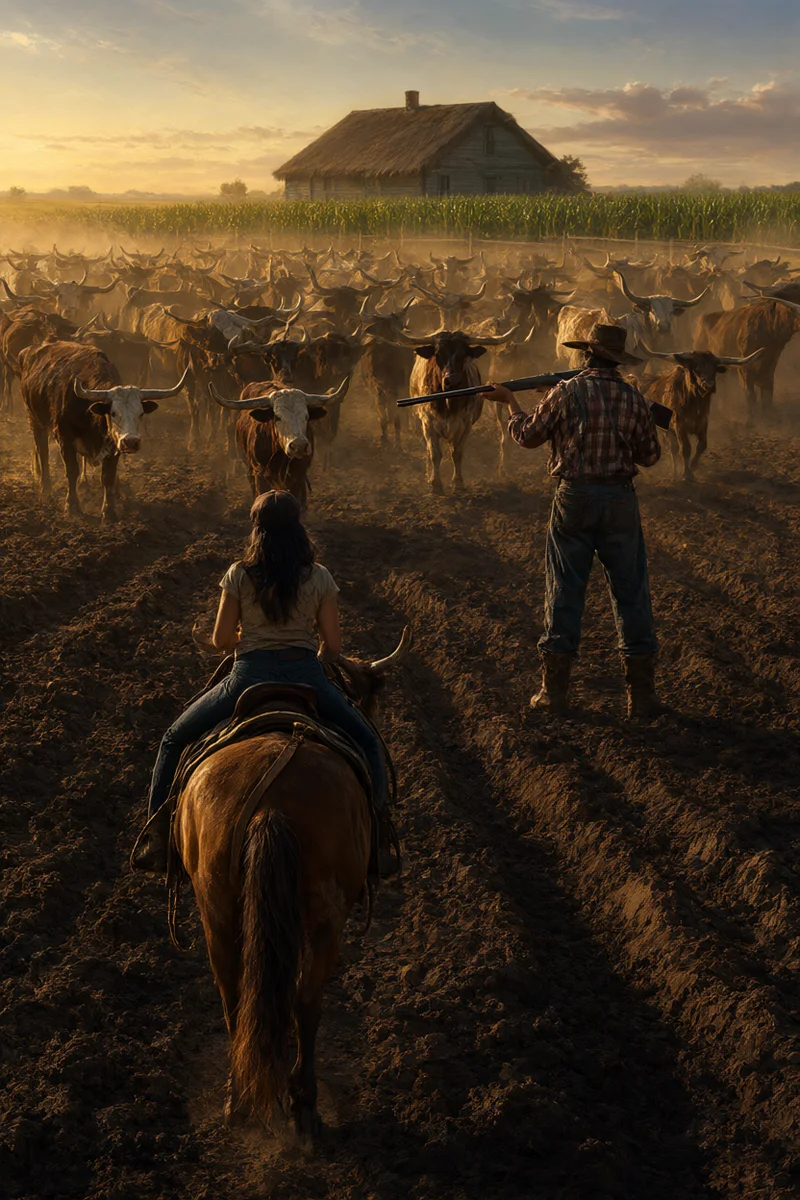
 The Deadline Furrow
Chapter 4
More or Less
Penhallow named his new price over supper, at Jens's table, because Jens had invited them both and Penhallow was not a man to refuse a free meal.
Eleven dollars a head. He said it with regret, as though it were being forced from him by circumstances. The market was soft. Texas cattle were under a cloud. He was taking a risk.
Eleven times one thousand and sixty-one was eleven thousand six hundred and seventy-one. The note in San Antonio was twelve thousand. Odile could do that sum in her sleep. She had done it in her sleep, for sixty-one nights.
“And if I won't sell to you?”
“Then you'll find another buyer in Ellsworth.” He buttered a biscuit. “Though I believe you'll find that everyone in Ellsworth has heard about the fever ticks by now.”
Jens put his fork down. He had not said a word all through supper. Odile had almost forgotten he was there.
“May I see the contract, Mr. Penhallow?”
Penhallow looked at him with amusement, a farmer asking to see legal paper. He took it out and passed it across the table, and Jens tilted it toward the lamp and read it slowly.
“I farmed in Värmland until I was twenty,” he said, without looking up. “The grain merchant I clerked for in Chicago bought and sold on paper like this. I read a great many contracts for him.” He turned the page. “He taught me to look for two words.”
Odile stopped breathing.
“Here,” said Jens, and put his finger on the line. “Eleven hundred head of merchantable beeves, more or less.”
Penhallow's biscuit stopped halfway to his mouth.
“More or less,” said Jens. “Every cattle contract I ever saw in Chicago said it, because nobody delivers an exact count after a thousand miles. The custom is five percent. Forty-three short of eleven hundred is less than four.” He folded the paper and handed it back. “The contract stands, Mr. Penhallow. Nineteen dollars. On the tenth of August. I'd be glad to say so to a judge in Ellsworth.”
Penhallow did not finish his biscuit. He left soon afterward, and very politely, and he did not say good night to anyone.
Odile sat with her hands flat on Jens's table for a long time.
“A grain clerk,” she said finally.
“For three years. I was very bad at it. I kept looking out the window.” He smiled at her. It changed his whole face. “You can stop looking at me like that. I've done nothing except read.”
“You turned back a man with a gold watch chain by reading,” she said. “I've seen men do less with guns.”
She did not sleep much that night. She lay in her blankets by the wagon and watched the stars wheel over his roof, and thought about Texas, which was a long way south.
It began to rain a little after midnight. It rained, steady and heavy, for four days, and the herd stood in it with their heads down and went nowhere.
On the morning of the seventh of August, three days from Ellsworth, the herd came down to the crossing of the Smoky Hill River, and Odile reined up at the edge of the bank and looked at the water.
It was not a river anymore. It was a brown flood, bank to bank, carrying whole trees.
The End









