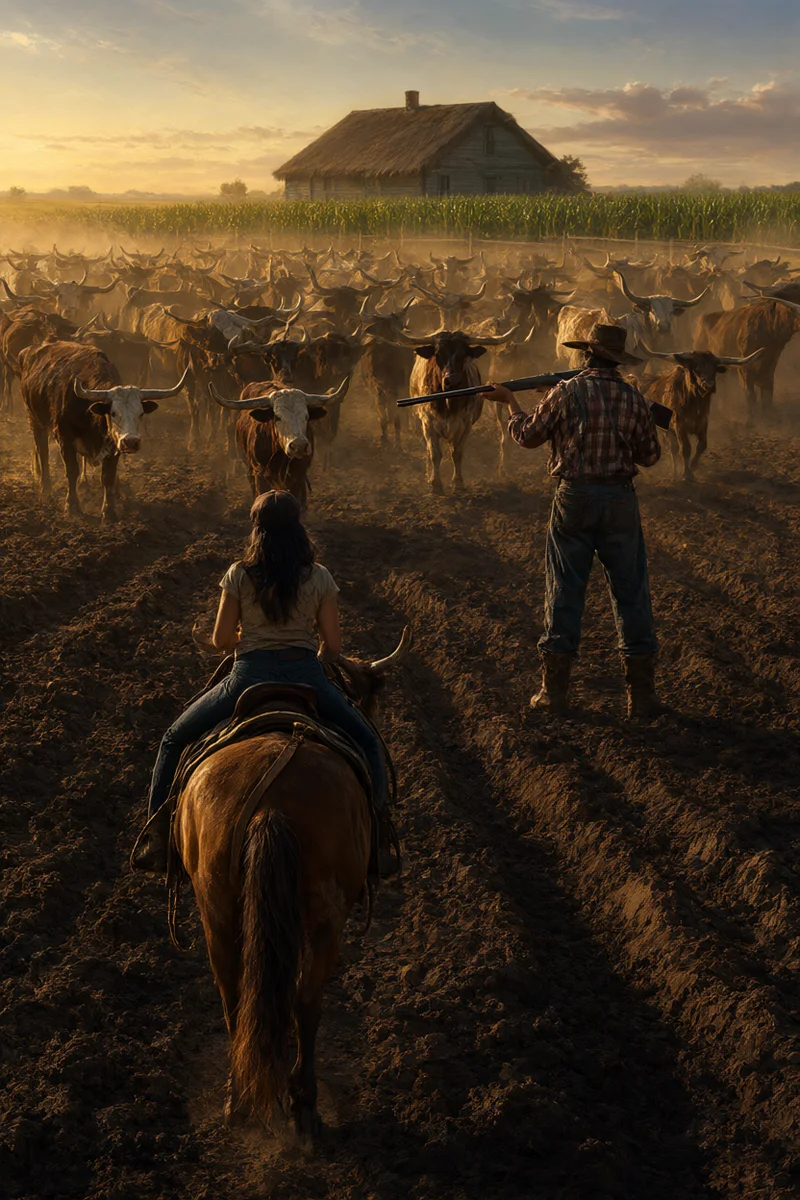
 The Deadline Furrow
Chapter 1
The Furrow
The furrow was the first thing Odile Faure saw. It ran across the prairie as straight as a ruled line, fresh black earth turned up against the grass, from the bend of the creek to the far horizon.
The men were the second thing. Eleven of them, standing behind it with shotguns and hay forks, in the patched overalls and flat straw hats of farmers. Behind them, the green of a cornfield, and the low sod roof of a house.
Behind Odile, eleven hundred and four head of longhorn cattle came over the rise with a sound like weather.
“Hold them, Teo,” she called, and her segundo, Teodoro Salas, who had been her father's segundo for twenty years and had never once in those twenty years wanted to take orders from Lucien Faure's daughter, swung his horse and passed the word back. The point riders turned the leaders. The herd slowed, spread, began to graze.
She rode forward alone and stopped at the furrow.
The tallest of the farmers stepped across it to meet her. He was young, with straw-colored hair and a sunburned neck and the long, patient hands of a man who did everything himself. He held the shotgun broken open over his arm, which she noticed, and thought better of him for.
“Ma'am,” he said. “You'll want to turn west. There's no Texas cattle crossing this county.”
“I have a contract to deliver this herd at Ellsworth on the tenth of August.” She heard her own voice, flat and hard, her father's voice. “That's nine days. Going west around your county adds four.”
“I'm sorry for it.” He did sound sorry. “But last summer a herd came through here from the Nueces. A month after, every milk cow on this creek was dead of the Spanish fever. Forty-one cows. Mine among them. We had children drinking water that winter.”
“My cattle aren't sick.”
“The Texas ones never are. That's the trouble with them.”
Odile had been with the herd for sixty-one days. Her father had broken his leg at the spring gather on the Cimarron and gone home to Texas in a wagon, cursing, and she had come up by stage to take his place because there was nobody else. Every dollar on the Faure ranch was grazing behind her. There was a note for twelve thousand dollars at a bank in San Antonio, due in September, and this herd, at nineteen dollars a head, was the only way to pay it.
“What's your name, sir?”
“Jens Nyquist.”
“Mr. Nyquist, I have eleven riders and eleven hundred cattle. You have eleven men and a plow line. I don't want to go through you. But I will.”
He looked past her at the herd, and then back at her, and she saw something in his face she had not expected. Not anger. Pity.
“You don't know, do you,” he said.
“Know what?”
“Who asked us to stand here.” He reached into the bib of his overalls and took out a folded handbill and held it up to her. NOTICE TO SETTLERS. TEXAS HERD APPROACHING. LOOK TO YOUR STOCK. At the bottom, in smaller letters, it said Compliments of A. Penhallow, Cattle Buyer, Ellsworth.
“A man rode through here with a stack of these three days ago,” Jens said. “I read it twice. I clerked three years for a grain merchant before I farmed, and I read everything twice. He said a big herd was coming up, full of fever. Said he'd be grateful if we'd turn it.”
Asa Penhallow was the man who had signed her contract.
The End









