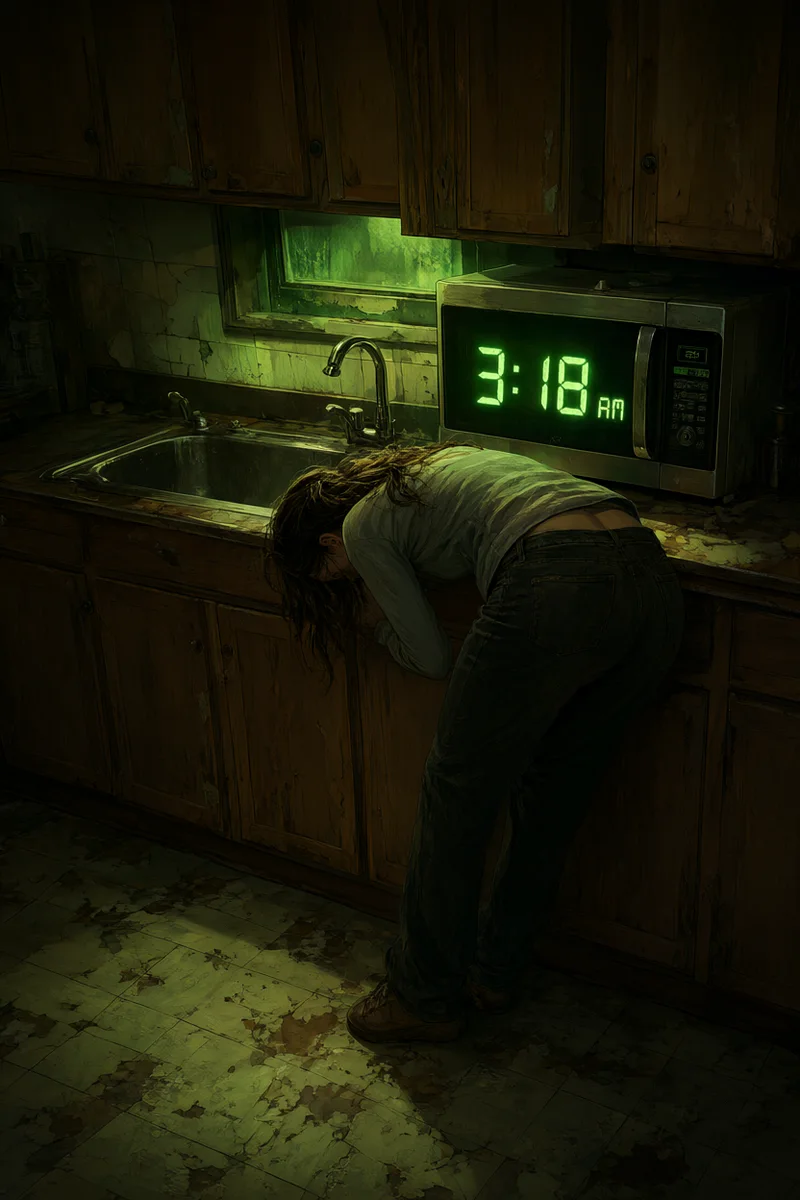
 Dad Called Her Vomiting "Pure Drama" at 3 AM
Chapter 2
The Emergency Room Intake
The sliding glass doors of St. Jude’s County Hospital parted with a mechanical hiss, washing us in bright, antiseptic-smelling fluorescent light at 4:04 a.m. The waiting room was mostly empty, save for a security guard dobbing his head behind a high counter and an elderly man coughing in the corner.
I half-carried Emily to the triage desk, where a tired-looking triage nurse named Brenda looked up from her computer screen, her eyes immediately assessing Emily’s pale, sweat-soaked face and the awkward, bent-over posture with which she moved.
“Name and date of birth?” Brenda asked, her fingers hovering over the keyboard.
“Emily Vance. March 14th, 2011,” I answered, sliding my arm securely around Emily’s waist to keep her upright.
“What brings her in tonight, mom?”
“Severe abdominal pain, persistent vomiting for three days, dizziness, and she fainted about twenty minutes ago before we left the house,” I said, the words tumbling out in a rush of anxiety.
Brenda stopped typing, looked up sharply, and studied Emily’s face. She stood up, grabbed a bright orange plastic wristband from a dispenser, and deftly fastened it around Emily’s skinny wrist.
“How long has she been vomiting?” Brenda asked, her tone shifting from routine intake to acute professional alertness.
“Three days,” I said.
Brenda paused, her pen hovering over the paper intake form. She looked up from the monitor and gave me a long, piercing look that lasted an extra, uncomfortable second. There was judgment in that look—the silent, heavy question every medical professional asks when a parent brings a child in at the eleventh hour. Why did you wait so long?
I didn’t look away. I met her gaze head-on, feeling a hot flush of shame rise up my neck.
“I’ll give you every answer you need, even the ones that make me look like a monster,” I said, my voice dropping low so the security guard wouldn't hear. “My husband refused to bring her. He said she was faking for attention. I waited because I was afraid to cross him. Emily begged me not to wake him up because she was scared of what he’d do. And I… I spent fifteen years making ordinary decisions based on how angry he might become if I didn't fall in line.”
Brenda’s expression softened instantly. The harshness vanished from her eyes, replaced by a deep, heavy wave of professional empathy. She reached across the counter and touched my hand.
“You’re here now, Mom,” Brenda said gently. “Let’s get her back.”
Within five minutes, we were wheeled back into Exam Room 4—a small, sterile cubicle smelling of sanitizer and paper sheets. A young resident physician with tired eyes and a stethoscope draped around his neck, Dr. Hayes, entered briskly, washing his hands at the wall sink.
“Alright, Emily, let’s see what’s going on,” Dr. Hayes said with a reassuring smile, pulling up a rolling stool. “I understand you’ve been having some bad tummy trouble.”
Emily nodded weakly, lying back on the examination table as I smoothed her hair away from her damp forehead.
“Can you point to where it hurts the most?” Dr. Hayes asked.
Emily slowly raised a trembling hand and pointed her index finger toward her lower right abdomen, just below the hip bone.
“Okay. I’m going to press down gently here. Let me know if the pain gets sharp, or if it hurts more when I let go,” Dr. Hayes instructed.
He placed his warm fingertips flat against her abdomen, pressing down in the upper quadrants first, moving methodically downward. Emily bit her lower lip, her breathing shallow. But the moment Dr. Hayes’s fingers depressed the lower right quadrant—McBurney’s point—Emily let out a piercing, agonized scream that echoed down the hospital corridor, her entire body arching off the examination table.
“Whoa, okay, I’m right here, I’m letting go,” Dr. Hayes said immediately, lifting his hands as Emily collapsed back onto the pillow, sobbing softly into her arm.
Dr. Hayes stood up, his face grim. He turned to me, his professional demeanor sharpening into absolute urgency.
“That’s classic rebound tenderness,” he said quietly, stepping toward the door. “Combined with three days of vomiting and low-grade fever, we’re looking at acute appendicitis—potentially complicated or perforated. I’m ordering an immediate stat ultrasound and comprehensive blood work. Nurse, get me IV access and a broad-spectrum antibiotic started right now.”
As he turned to leave, Dr. Hayes stopped, his eyes dropping to the hem of Emily’s gray T-shirt, which had ridden up slightly during her spasm of pain.
“Wait a minute,” Dr. Hayes muttered, stepping back toward the table. He gently pulled the hem of her shirt up another inch.
My breath caught in my throat. Spread across Emily’s lower ribcage and left flank were several dark, irregular bruises—some yellowish-green at the edges, others a deep, ugly purple. They were shaped in narrow, distinct arcs, completely unlike the random scrapes and bumps a fifteen-year-old girl might get from gym class or a playground fall.
“Emily,” Dr. Hayes asked, his voice dropping an octave, losing all clinical detachment. “Did you fall? Did you hit your side on something hard?”
I stared at the bruises, my mind spinning into a sickening freefall. I had lived in that house every single day, yet I had never seen those marks. I had been so conditioned to look away, so focused on keeping the peace, that I had missed the violence unfolding right under my nose.
I looked frantically at Emily, waiting for her to explain, waiting for her to say she fell off her bike or tripped over the coffee table.
Instead, Emily turned her head hard against the pillow, pressing her face tight against the wall, and began rhythmically, frantically picking at the loose adhesive corner of the paper hospital sheet, her shoulders shaking with silent, desperate sobs.
Dr. Hayes straightened up, looking from Emily’s averted face to my frozen, horrified expression.
“Mom,” Dr. Hayes said firmly, placing a hand on my shoulder. “I need to speak with you outside the room for a moment. And I’d like to speak with Emily alone after that.”
Every maternal instinct in my body screamed at me to refuse, to stay glued to her side, to protect her from the world. But I knew why he was asking. The bruises didn't lie. The fear in my daughter's eyes didn't lie.
With shaking legs, I followed Dr. Hayes out into the brightly lit hallway, the heavy hospital door swinging shut behind us.
Before Dr. Hayes could even open his mouth to speak, my cell phone—which I had left on vibrate in my pocket—began to buzz violently against my thigh. It didn't stop. Buzz, pause, buzz, buzz.
I pulled it out. The screen lit up with a terrifying banner: 15 Missed Calls from Michael.
And right beneath them, a new text message flashed across the screen in stark, menacing letters:
“You are going to regret taking her there, Sarah. Bring her home right now or don’t bother coming back yourself.”
The End









