 Dad Called Her Vomiting "Pure Drama" at 3 AM
Chapter 1
The Three-Day Nightmare
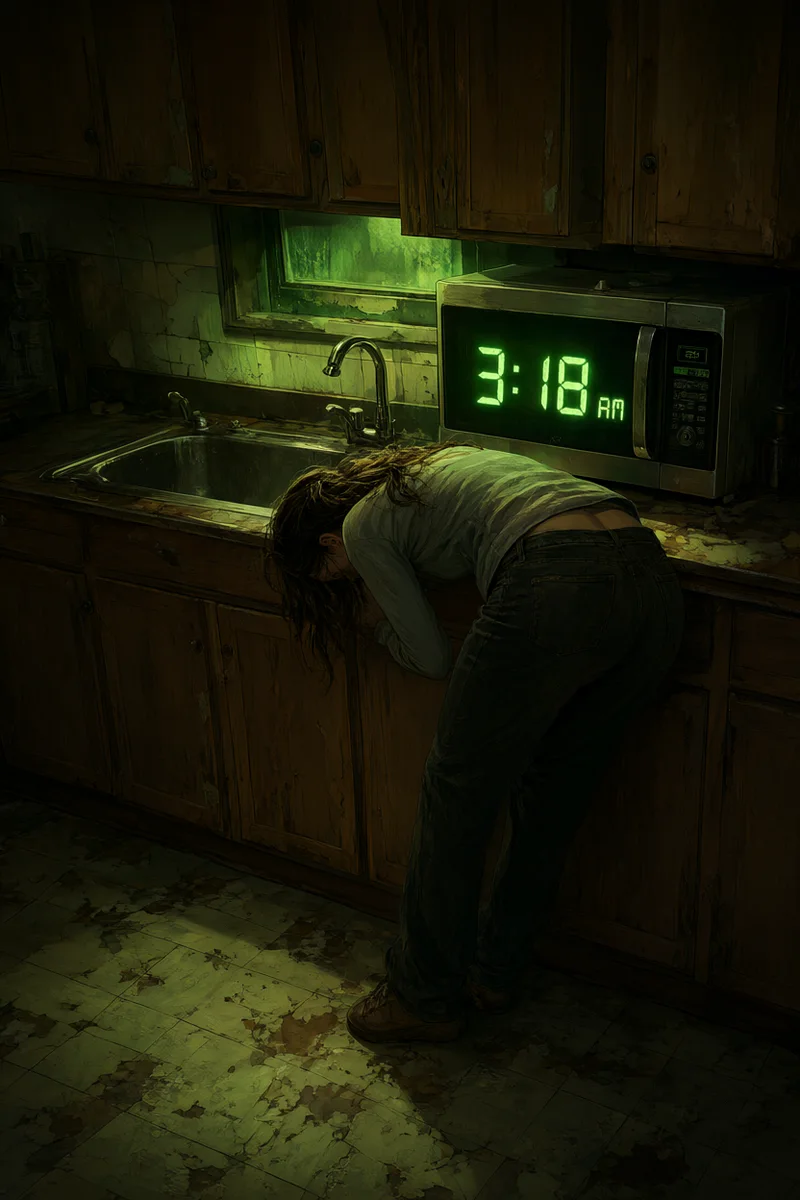
The digital clock on the microwave glared 3:18 a.m., casting a sickly green hue across the peeling linoleum of our kitchen. Emily was bent double over the stainless-steel sink, her small frame convulsing as another wave of dry heaving racked her body. A pale, sour smell hung thick in the air, mixing with the sharp scent of bleach I’d used an hour earlier.
Michael stood in the doorway, his broad shoulders blocking the hallway light, his arms crossed tightly over his chest. He was wearing his gray flannel pajama pants and the expression of profound martyrdom he reserved for any inconvenience that disrupted his sleep.
“If you take her to the ER over her little drama, don’t expect me to pay a dime,” Michael said, his voice flat, carrying that cold, calculated resonance that always made the hairs on the back of my neck stand up. “She’s got a big chemistry test tomorrow. Or did you forget that school actually matters?”
I didn't look at him. I couldn't. Instead, I rinsed the white washcloth under the tap for the third time, wringing out the lukewarm water until my knuckles turned white. My hands needed something to do; if they weren't moving, I felt like I would shatter into a thousand jagged pieces against the counter.
“Michael, she hasn’t kept a drop of water down since Sunday afternoon,” I said, trying to keep my voice steady, though it wavered like a dying candle flame. “She’s burning up. Feel her forehead—”
“I’ve felt enough, Sarah,” he interrupted, stepping closer and snatching the digital thermometer off the counter where I had laid it. He glanced at the LCD screen, snorted softly, and set it facedown with a sharp clack. “100.4. That’s not a fever, that’s a minor bug. She ate too much junk food at the mall with her friends. She’s looking for attention because she didn't study for her finals.”
Emily let out a low, whimpering groan from the sink, clutching her lower right abdomen with a white-knuckled grip. Her long brown hair, damp with cold sweat, clung to her pale cheeks.
“Dad… please,” she whispered, her voice cracked and barely audible. “It hurts… it really hurts to walk.”
“Cut the act, Emily,” Michael snapped, his tone hardening into steel. “You’re fifteen years old, not five. Stop putting on a show for your mother every time you want to get out of a test. Go take a Motrin, drink some ginger ale, and get back in bed. And Sarah, if you drag her out into the cold at four in the morning over teenage hysterics, you’re on your own with the bill and the embarrassment.”
Without waiting for an answer, he turned on his heel, his bare feet slapping heavily against the hardwood floor as he marched back down the hall toward our bedroom, leaving the door open just enough to let a thin strip of light cut across the darkness.
I stood there in the suffocating silence, breathing in the sour air, and watched my daughter slide slowly down the cabinet until she was sitting directly on the cold tile floor. Her knees were pulled up to her chest, and her small, cracked smartphone was clutched in her hand like a lifeline.
Ever since Sunday, when the pain had first started after church, something had felt fundamentally, terrifyingly wrong. At first, Emily had blamed the cafeteria tacos. Then she skipped dinner, walking through the living room like an old woman, bent forward with her fingertips dragging along the drywall to keep her balance. But what terrified me more than the vomiting was the psychological shift in the house. Whenever Michael walked into the room—to get a glass of water, to check his phone, to complain about the thermostat—Emily would instantly freeze. She would stop talking mid-sentence, her breathing would shallow, and her eyes would dart toward the floor as if she were bracing for a blow.
I had asked her repeatedly if something happened at school, if she was being bullied, if a boy had hurt her. Each time, she shook her head so fast that strands of damp hair stuck to her lips, whispering, “No, Mom, nothing.”
And Michael had reinforced his dominance with every glance. He treated her pain as an insult to his household management, a personal affront to his authority. “She’s dramatic,” he had told me twice before he went back to bed. “Just like her mother.”
I sat down on the closed toilet lid in the small half-bath near the kitchen, staring at my reflection in the medicine cabinet mirror. My eyes were ringed with dark circles, my skin gray with exhaustion and chronic fear. I thought about the last fifteen years—the subtle erosions of my confidence, the way I had learned to measure my tone of voice before speaking, the way I managed Michael’s unpredictable tempers by silencing my own instincts. Every major decision in our lives, from what car we drove to how Emily was disciplined, was filtered through a single terrifying question: How angry is Michael going to get?
A sudden, sharp thud echoed from the hallway, followed by a soft gasp.
I jumped up so fast the toilet lid rattled.
I rushed out into the dim corridor. Emily was lying flat on her side beside the bathroom door, right next to the edge of the shower curtain where water was still dripping with a slow, maddening plip, plip, plip. Her phone had slipped from her hand and was pressed tightly against her chest like a shield.
“Emily!” I cried, dropping to my knees and sliding my hands under her shoulders.
Her eyelids fluttered open, dark shadows bruised beneath them. She tried to sit up, but a sharp gasp cut off her breath, and she clutched her right side, tears finally spilling over her lashes. As I reached out to pull her damp hoodie over her shivering shoulders, her cold hand shot out with surprising strength and caught my wrist in a tight, desperate grip.
Her fingers dug into my skin. Her eyes, wide and terrified, searched mine in the dark.
“Mom,” she whispered, her voice a fragile, trembling breath against my ear. “Don’t tell Dad.”
Something inside me—a wall of fear, hesitation, and compliance that I had spent a decade and a half building—cracked wide open. The sound of that crack was louder than Michael’s voice, louder than the dripping faucet, louder than the voice in my head telling me to keep the peace.
“I’m not telling him anything,” I whispered back, my voice firming up with a cold, terrifying clarity. “We’re going.”
While Michael’s heavy, rhythmic snoring echoed down the hall from the master bedroom, I moved with the silent efficiency of a ghost. I crept into the kitchen, grabbed the emergency cash stash—two hundred-dollar bills and some crumpled tens—that I kept tucked between two folded dish towels in the back of the pantry. I grabbed Emily’s thick gray zip-up hoodie, helped her slide her trembling arms into the sleeves, and wrapped a woolen scarf around her neck.
We didn't turn on the kitchen light. I unlocked the back door, wincing when the deadbolt made a metallic click that sounded like a gunshot in the quiet house, and guided her step-by-step down the concrete back steps. The October air hit us like a wall of ice, sharp and biting against our skin, but Emily didn't complain. She leaned heavily against my side, her breath coming in shallow, ragged gasps, as we walked out into the dark driveway toward my aging sedan.
The End









