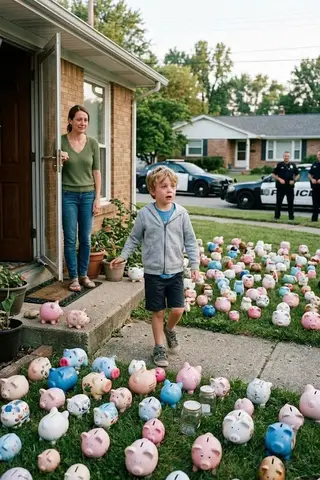
 Cops Block the Street and Surround the House With Dozens of Piggy Banks After a Boy's Good Deed Goes Viral
Chapter 3
The Heavy Truth
The weight of the blue piggy bank caught me completely off guard. It felt dense, sluggish, and heavy—far heavier than any ceramic container filled with spare change and copper pennies should ever feel. It was as if the interior was packed with solid lead or dense stone rather than pocket money.
I looked down at the smooth metallic surface, my fingers tracing the painted outline of a smiling cartoon whale stamped across its side.
“Officer, I don't understand,” I whispered, my voice shaking slightly as I stood on the porch, surrounded by hundreds of identical banks. “Where did all of these come from? Who put them here? And why are the police involved? Did someone break into a bank and dump the loot on my lawn?”
The officer—whose name badge read Detective Miller—held up a gloved hand to stall my rising panic. He glanced back toward the cruiser where another officer sat typing furiously on a laptop mounted to the dashboard.
“No one broke into a commercial bank, ma'am,” Detective Miller said, his tone measured and professional. “At least, not in the way you're thinking. But let's start with what you're holding. Unscrew the bottom plug, or if there isn't one, use whatever you have to crack it open. We need absolute visual confirmation on the contents of just one of these containers before we can proceed with the rest of the protocol.”
My heart hammered against my ribs like a trapped bird. Protocol? What kind of protocol involved an army of piggy banks and local law enforcement before seven in the morning?
I stepped backward into the doorway, carrying the heavy blue whale into the warmth of our foyer. Detective Miller followed closely behind me, stepping over the threshold and scanning the interior of our house with sharp, analytical eyes. Oliver was still sleeping soundly upstairs, completely oblivious to the surreal circus unfolding outside his window.
“Do you have a hammer?” Detective Miller asked quietly, keeping his voice low so as not to wake the house.
“In the kitchen utility drawer,” I replied, my hands still trembling slightly as I clutched the heavy whale.
I walked quickly into the kitchen, the detective hot on my heels. I yanked open the drawer, shoved aside a tangle of screwdrivers, tape measures, and loose rubber bands, and pulled out a sturdy claw hammer with a rubberized grip. I laid the blue piggy bank down on the center of the kitchen island, feeling entirely like a surgeon preparing for an impossible operation.
“Are you sure about this?” I looked up at the detective, seeking some shred of reassurance. “This looks like it belongs to a child. Or... or a lot of children.”
“Just do it, ma'am,” Miller urged gently, though his eyes carried an unmistakable glint of intense curiosity mixed with deep reverence. “Trust me.”
I gripped the handle of the hammer, raised it a few inches into the air, and brought the metal claw down sharply against the ceramic tail of the blue whale.
CRACK.
The sound echoed sharply through the quiet kitchen. The tail shattered instantly, splintering into a dozen metallic shards and sending a cloud of fine ceramic dust into the air. But as the pieces fell away, nothing came rolling out onto the marble counter.
Instead, a thick, tightly packed block of material filled the cavity.
I dropped the hammer, reached out with my thumb and forefinger, and pulled at the edge of the block. It slid out of the broken whale with a soft, sliding rustle.
It wasn't coins. It wasn't crumpled single-dollar bills.
It was a neatly wrapped stack of crisp, banded one-hundred-dollar bills, wrapped tightly in bank paper bearing the stamp of the Federal Reserve and a local financial institution.
I stared at it, my brain refusing to bridge the gap between what I was seeing and reality. I picked it up, flipped it over, and peeled back the paper band. Every single bill was authentic, fresh, and stamped. I pulled out the rest of the contents. Beneath the stack of hundreds lay a folded, handwritten note written in shaky, elegant cursive on heavy parchment stationery.
My hands shaking violently, I unfolded the paper and read the words aloud in a breathless whisper:
“Dear Oliver,
You gave me your all when I had nothing left. You taught an old woman that the world is still full of fierce, blinding light. The community heard what your mother and you did for me on a cold, dark night. They wanted to return the favor. Every single bank on your lawn contains the savings, the donations, and the hearts of every soul in this town who refuses to let kindness go unrewarded.
With eternal love and gratitude,
Adele.
P.S. Your magical grandmother says your dinosaur is replaced tenfold. Go buy your Lego set.”
Tears burst hot and fast from my eyes, streaming down my cheeks as I stared at the note, then down at the dense stack of hundred-dollar bills. I looked up at Detective Miller, whose stern expression had completely melted away, replaced by a warm, watery smile that reached all the way to his eyes.
“Ma'am,” Detective Miller cleared his throat softly, wiping a stray moisture drop from the corner of his eye. “That's not just one bank. We ran a preliminary census from the cruisers out front. There are exactly four hundred and twelve piggy banks spread across your front lawn. And every single one of them is packed, top to bottom, with cash donated by the residents of this entire county.”
I dropped back against the kitchen counter, my knees suddenly turning to water. Four hundred and twelve banks. An entire town's worth of gratitude, unleashed by a six-year-old boy who simply refused to let his neighbor freeze in the dark.
And out on the street, the flashing red and blue lights weren't there to arrest us—they were there to stand guard over a miracle.
The End









