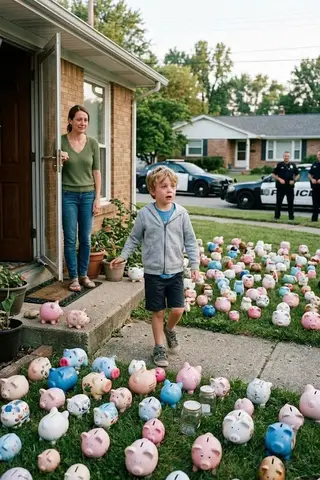
 Cops Block the Street and Surround the House With Dozens of Piggy Banks After a Boy's Good Deed Goes Viral
Chapter 1
The Cold Reality Across the Street
The crisp October air bit sharply at the edges of the quiet suburban neighborhood, wrapping the streets in an early autumn chill that felt more like winter. Inside our warm, brightly lit home, the smell of cinnamon and roasting chicken offered a comforting contrast to the gloom settling outside. But across the street, the little yellow house stood like a dark ghost against the twilight. No porch light flickered to welcome the evening. No soft, warm glow from the television danced across the drawn blinds. No kitchen lamp illuminated the window where Mrs. Adele usually sat reading her worn paperbacks.
For three consecutive nights, that house had remained entirely dark.
I had noticed it, of course. Everyone on the block had probably noticed it, moving briskly past with their heads down, caught up in the frantic rush of modern life, bills, and school schedules. But my six-year-old son, Oliver, had been watching with an intensity that completely bypassed my radar. Oliver was a force of nature. He did not possess a single passive bone in his tiny body. When he loved someone, he loved them with every ounce of his soul, a fierce, unconditional devotion that left no room for half-measures. And when he decided something in the world was fundamentally wrong—like an injustice, a hurt feeling, or a cold room—he possessed a stubborn, unyielding refusal to accept that grown-ups would simply let it stay that way.
He didn't run to me with a barrage of anxious questions, nor did he throw a tantrum about the dark house. Instead, he simply observed. He sat cross-legged on the living room rug, his chin resting in his small palms, staring out the window at the pitch-black windows across the asphalt.
Then, he made his move.
I was at the kitchen counter, wiping down the marble surface after dinner, when I heard the heavy, ceramic clinking of coins sliding against each other. I turned to see Oliver dragging his prized possession out from the depths of his bedroom closet. It was a bulky, hand-painted ceramic dinosaur piggy bank, an emerald-green behemoth that he had painstakingly fed every single coin he had earned, found, or been gifted over the entire span of his six-year life. Birthdays, lost teeth, pulling weeds from the neighbor’s garden, saving his allowance—every single cent he owned lived inside the belly of that dinosaur.
He lugged it across the wooden floorboards, his small face scrunched up with fierce determination, and set it down heavily on the kitchen island with a dull thud.
“She doesn't have enough money for her lights, Mom,” he said, his voice entirely steady, devoid of childish whine or hesitation. “She's cold. And she's by herself.”
Mrs. Adele was eighty-one years old. She lived entirely alone in that little yellow house, a solitary figure in a world that often forgot people of her generation. She had no close family nearby; her children lived out of state, swallowed by busy careers and distant lives. To the rest of the neighborhood, she was simply the quiet old lady who kept her curtains drawn. But to Oliver, she was a landmark of absolute joy. Whenever he walked past her picket fence, she would magically produce a wrapped butterscotch candy from the deep pockets of her cardigan, handing it over like a sacred offering. In Oliver's pristine, six-year-old worldview, sharing butterscotch candies made her an official, certified magical grandmother. And you do not let a magical grandmother freeze in the dark.
I looked down at the dinosaur, then down at my son. I knew exactly how much effort went into filling that bank. We had counted those coins together on rainy Sunday afternoons, stacking them into neat little paper rolls.
“Oliver, buddy,” I knelt down so I was eye-level with him, placing my hands gently on his small shoulders. “Do you understand what you're offering? That's your money. Your savings. If you give it away, it's gone. You won't be able to buy that Lego set you’ve been talking about for months.”
He didn't blink. He didn't look down at the bank to reconsider. He just locked his serious, hazel eyes onto mine and nodded once, sharply.
“All of it,” he whispered, as if sealing a binding legal contract with the universe.
My throat tightened, a sudden wave of overwhelming emotion threatening to choke me. How do you tell a child not to be generous? How do you teach them the cynical, calculating nature of adulthood without crushing the radiant, golden empathy that makes humanity worth saving? You don't. You step back and let them teach you how to be human.
“Okay,” I managed to say past the lump in my throat, blinking back a sudden tear. “Let's go.”
We walked out the front door, stepping down the porch steps into the cool autumn night. The pavement felt unusually cold beneath our sneakers. Hand in hand, the giant ceramic dinosaur cradled securely in Oliver's two small arms like a precious newborn, we crossed the quiet street. The closer we got to Mrs. Adele's house, the more apparent the eerie silence became. No hum of a refrigerator, no ambient glow of a digital clock, no warmth radiating from the walls. Just a heavy, suffocating stillness.
Oliver reached up and pressed the old brass doorbell.
Ding-dong.
The hollow chime echoed hauntingly through the empty house. For a long, agonizing moment, nothing happened. I wondered if she had fallen, if she was too weak to answer, if we should turn around and call for emergency help. But just as I was about to reach for the handle to test the door, the lock clicked.
The heavy wooden door creaked open a few inches.
There stood Mrs. Adele, wrapped entirely in a thick, faded winter coat indoors, a knitted wool scarf wrapped twice around her neck, and woolen mittens on her hands. Her silver hair was slightly disheveled, and her face looked pale and exhausted in the dim light of the moon spilling onto the porch. The rooms visible behind her in the hallway were completely, devastatingly dark.
She blinked against the dim outdoor light, her cloudy blue eyes focusing slowly on us.
“Oh,” she murmured, her voice sounding raspy, thin, and shivering. “Oliver? Sarah? Is everything alright?”
Oliver didn't wait for me to explain. He stepped forward, pushing past the threshold just enough, and looked from her thick winter coat down to the absolute darkness lurking behind her. Then, he tightened both hands around his emerald-green dinosaur, as if drawing strength from it.
He didn't hesitate for a single second.
With a practiced heave, he flipped the dinosaur upside down. A cascade of heavy metal quarters, clinking dimes, shiny nickels, pennies, and a handful of crumpled, well-loved single-dollar bills spilled out of the rubber stopper at the bottom, falling directly into his small palms. He held the chaotic, glittering mound out toward her, offering it up like a royal tribute.
“This is for your lights,” he declared, his voice ringing with absolute, unshakeable authority. “You need it more than I do.”
Mrs. Adele froze. She stared down at the pile of coins and crumpled paper resting in the small, open hands of a six-year-old child. For a second, her lips parted, but no sound came out. Then, slowly, shimmering tears welled up in her cloudy eyes, spilling over her wrinkled cheeks and cutting dark tracks through the dust on her face.
“Oh, sweetheart...” she choked out, her voice breaking entirely. “No... no, I can't take this. This is yours. This is your future.”
“Yes, you can,” Oliver insisted, stepping closer and practically forcing the money into the folds of her woolen mittens. It was the kind of absolute, undeniable certainty that only a six-year-old child possesses—a certainty that leaves adults completely powerless to argue.
Her frail, spotted hands trembled violently when she finally accepted the weight of the coins. She clutched the money to her chest as if it were a fragile lifeline, her shoulders shaking with silent, wracking sobs.
Before we turned to leave, she leaned down, her joints popping softly in the quiet hall, and cupped Oliver's warm face in both of her cold, trembling hands. She pulled him gently toward her and whispered something softly into his ear.
I stood right there, mere inches away, straining my ears in the quiet night air.
I couldn't hear a single word.
Oliver's eyes widened slightly as she whispered, a look of profound, secret understanding passing over his features.
On the walk back across the street, the cold air felt different—lighter, somehow charged with a strange, invisible energy. I looked down at my son, curious.
“So, buddy,” I asked gently, nudging his shoulder. “What did Mrs. Adele whisper to you? What's the big secret?”
Oliver looked up at me, pressed a finger mysteriously to his lips, and shook his head with absolute gravity.
“It's a secret,” he repeated firmly.
And that was that. No amount of gentle probing, bribery with ice cream, or motherly interrogation could crack his ironclad code of honor. I figured that was simply the end of the story—a sweet, poignant moment of pure human kindness where a little boy gave up his worldly wealth to help a freezing neighbor in need. I walked up to our porch, feeling a strange mixture of immense pride and quiet sadness for the empty dinosaur sitting back on his bedroom shelf. I went to bed that night thinking I would probably spend the next few months secretly slipping extra quarters into a new jar, helping him rebuild his savings brick by brick, coin by coin.
I had no idea. I was completely, fundamentally wrong about what was coming next.
The End









