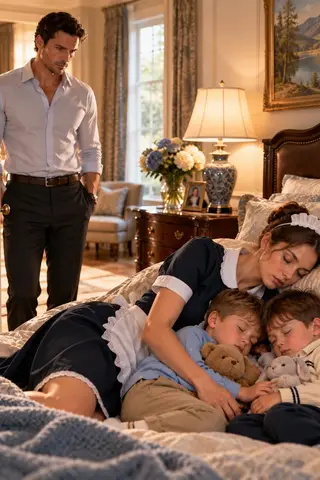
 Billionaire Father Finds New Maid Asleep in His Dead Wife’s Bed
Chapter 2
The Architecture of Grief
To understand why finding my sons asleep in a stranger's arms felt like both a miracle and an indictment, you have to understand how we had been surviving since the accident.
Lauren had died fourteen months earlier when a delivery truck with a snapped tie-rod crossed the median on the Saw Mill River Parkway and slammed head-on into her silver SUV. The vehicle rolled twice before coming to rest upside down against a concrete barrier.
My sons survived in their booster seats in the back, physically unharmed save for a few seatbelt bruises and a profound, invisible fracture in their young minds.
Lauren didn't. She was gone before the first ambulance cleared the traffic jam.
Afterward, I did what I always did when life became impossible: I tried to manage it like a corporate crisis. I applied logic, capital, and administrative delegation to an emotional hemorrhage.
Funeral arrangements were handled by a high-end concierge service. Lawyers secured trust funds and insurance settlements before the headstone was even carved. Board meetings at Morrison Dynamics were attended via encrypted video link from hotel rooms near the cemetery. Pediatricians were consulted for sleep aids; grief counselors were hired at three hundred dollars an hour to sit in our minimalist living room and try to coax speech out of five-year-olds who sat like stone statues staring at the floor.
And whenever my sons cried for their mother, I hired someone more qualified.
Five nannies came and went in rapid succession, like revolving actors in a tragedy no one wanted to star in.
The first was Mrs. Gable, a stern woman with a certificate in early-childhood education from Columbia and an uncompromising belief in strict bedtime schedules. She lasted three weeks before resigning after Jordan vomited on her designer shoes during a panic attack.
The second was Eleanor, who had worked for a retired senator’s family in Washington. She brought reward charts, sticker systems, behavioral modification plans, and an aura of icy perfection. She lasted ten days before telling me the boys were "pathologically unmanageable."
By the fourth and fifth nannies, the agencies were sending their toughest veterans—women who specialized in trauma, behavioral disruption, and high-net-worth dysfunctional households.
None of them lasted.
“Your boys don’t need a schedule, Mr. Morrison. They need stability, and quite frankly, they need a father who is actually in the house,” the fifth nanny—a sharp-tongued woman named Brenda—told me right before she packed her bags. She pointed a manicured finger at my chest. “You’re throwing money at ghosts. Every time they scream, you hand them another stranger with a resume. It’s breaking them.”
She was right, of course. But acknowledging it meant confronting the gaping, bleeding void where my wife used to be. And I couldn't afford to fall apart. Morrison Dynamics was on the brink of an initial public offering that would value the company at four point two billion dollars. If I dropped the ball, thousands of employees lost security. If I stopped running, the silence caught up with me.
So I escaped deeper into my work.
Numbers don’t scream for their mother at two in the morning. Spreadsheets don’t look up at you with heavy, tear-swollen eyes and ask why Mommy’s picture on the nightstand isn't moving anymore.
When Annie Reed applied for the housekeeping position through a local agency in White Plains, she didn't look like a savior. She looked like someone who had lived a hard, quiet life. In her late thirties, with work-roughened hands, quiet footsteps, and an expression of perpetual, watchful exhaustion, she had none of the polished gloss of the high-priced nannies.
Her resume was a patchwork of survival: she had cleaned corporate offices on the night shift, worked for four years in a suburban middle school cafeteria, and spent two years as the primary live-in caregiver for an elderly aunt with severe dementia until the estate was sold off by greedy cousins.
No prestigious credentials. No sophisticated childcare philosophy. No certificates from child psychology institutes.
Yet six days after entering my home, she had accomplished what five expensive, certified child-care professionals couldn’t.
My sons trusted her enough to let their guard down and sleep.
I stayed sitting on the hallway floor outside the master bedroom until the afternoon shadows lengthened across the oak floorboards, stretching into long, dark fingers. My mind raced through a dozen scenarios. Why were they in that room? Why had Annie taken them into Lauren’s sanctuary—a room I kept locked out of superstitious grief?
Finally, the heavy oak door clicked and swung inward.
The End









