 Billionaire Father Finds New Maid Asleep in His Dead Wife’s Bed
Chapter 1
The Locked Door
The brass doorknob turned in my palm with a chilling lack of resistance, yet the deadbolt—the one Lauren and I had installed when we moved into this sprawling estate in Westchester County—held fast. It was locked from the inside.
My heart slammed against my ribs like a trapped bird. By the time I reached the locked bedroom door, I was convinced my five-year-old twins were hurt—or worse. Fourteen months of silent terror, of waking up in the dead of night to the suffocating phantom scent of crushed glass and coolant from the Saw Mill River Parkway crash, had warped my nervous system into a continuous, low-grade emergency alarm. Every muffled thud in the house sounded like a falling shelf; every silence felt like the prelude to a catastrophe.
I forced it open, throwing my shoulder against the heavy mahogany panel with enough force to splinter the brass strike plate. The wood cracked, groaning as the lock sheared away from the frame. I stumbled forward into the master bedroom, ready for a nightmare—ready for blood, for shattered glass, for another unravelling.
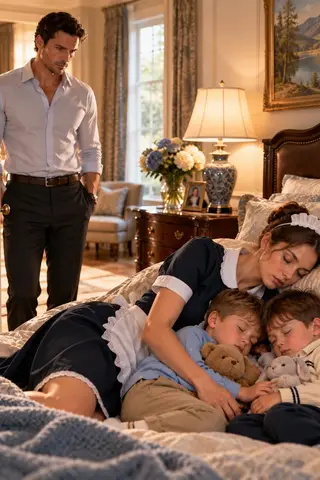
Instead, what I found was almost more shocking: our new maid was asleep in my dead wife’s bed, one of my sons pressed against her chest and the other clutching her apron. And for the first time since their mother died, my boys looked safe.
My briefcase slipped from my hand, the heavy leather-bound edges hitting the hardwood floor with a dull, echoing thud.
“Jordan? Justin?”
Neither moved.
Annie Reed still wore the gray housekeeping dress she’d arrived in that morning. Her dark hair had fallen loose across the white Egyptian cotton pillowcase, spilling in tangled waves that caught the fading late-afternoon amber light filtering through the sheer curtains. One black flat shoe lay beside the bed on the Persian rug, and the other had somehow disappeared beneath the mahogany dresser, kicked off during some unconscious struggle for comfort.
Jordan, the more sensitive and anxious of the two, was curled tight against her left arm, his face still swollen and blotchy from crying. Justin, the stubborn miniature rebel who usually expressed his grief by destroying household electronics, had his small fist twisted agonizingly tight into the coarse fabric of her gray apron, as if anchored to a lifeline in a raging sea.
But they weren’t screaming.
They weren’t trembling with those violent, breath-hitching shivers that had kept me pacing the hallway outside their nursery for over a year.
They were sleeping. Deeply. Peacefully.
For fourteen months, sleep in our house had meant nightmares, night terrors, cold sweats, and desperate, hoarse cries for their mother that tore at the lining of my chest. This was different. This was trusting sleep—the kind children surrender to only when they believe, with every fiber of their innocent bodies, that someone will still be there when they wake.
I should have been furious.
The master suite was off-limits. It was a museum of a life that had ended abruptly on a rainy Tuesday afternoon when a semi-truck crossed the median. Annie had been hired to clean my house—to dust the crown moldings, scrub the marble countertops, and maintain an illusion of order in an empire built on chaos—not climb into my bed and hold my motherless children.
I almost strode forward and woke her up right then and there. I almost demanded an explanation for her breathtaking unprofessionalism.
Then she shifted in her sleep. Her breathing hitched softly, and with a tender, automatic grace, she reached up and gently pulled the heavy cashmere blanket over Justin’s exposed legs, smoothing the wool down to his ankles.
My throat tightened so violently I thought I might choke.
Lauren used to do exactly that.
My wife, brilliant, warm, and endlessly patient, used to slip into the twins’ room at night and cover whichever little feet had escaped the blankets during their restless dreaming. I once teased her about it, standing in the doorway with a coffee mug in hand while staring at the thermostat.
“Lauren, nobody’s freezing in a seventy-two-degree house. You’re going to wake them up.”
She hadn’t gotten defensive. She had just turned her head, her green eyes shining in the dim nightlight, and smiled at me with that gentle, devastating wisdom that always made me feel like the most naive man in the room.
“David, children don’t wake because they’re cold. They wake because they want to know someone noticed.”
Standing in that doorway, fourteen months after the world had gone dark, I realized I’d forgotten how to notice anything at all.
I couldn’t bring myself to break the spell. Instead, I quietly pulled the bedroom door shut until it clicked softly into place, and sank down onto the hallway floor, burying my face in my hands.
I could negotiate billion-dollar tech acquisitions across three continents without raising my voice, yet I couldn’t give my own sons what an underpaid, unassuming housekeeper had somehow given them in six days.
Safety.
The End









