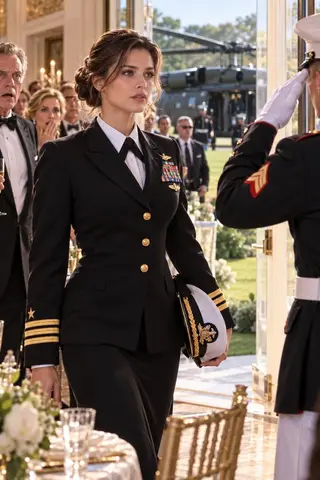
 After 22 years of being branded a family disgrace
Chapter 22
The Auction of Vanities
On a bitter Saturday morning in late January, the grand estate of Hayes & Sons was finally pried open to the public eye.
For fifty years, the high wrought-iron gates at the end of the wooded driveway had served as a barrier between Arthur Hayes and the common citizens he treated with cold condescension. Today, however, those gates were locked wide open with steel chains, flanked by large yellow signs posted by the United States Marshals Service: SEIZED ASSET LIQUIDATION - UNITED STATES DEPARTMENT OF JUSTICE.
Dozens of minivans, commercial utility trucks, and bargain hunters parked haphazardly across the manicured lawns where the presidential Black Hawk had once blown away silk tablecloths. Mud was tracked across the pristine white flagstone terrace. Hundreds of ordinary people wandered through the marble foyer, peering into the private library where Arthur had thrown my Naval Academy acceptance letter into the trash two decades ago.
Every item had a yellow barcode sticker slapped onto its surface: Lot 104—French antique dining table; Lot 212—crystal decanters; Lot 405—Arthur’s custom mahogany desk; Lot 518—Grant’s collection of vintage watches and luxury racing trophies.
I stood on the edge of the second-floor balcony, dressed in plain civilian clothes—a heavy black wool pea coat, dark jeans, and leather boots—watching the spectacle below. I had not come to buy anything, nor had I come to gloat. My official presence was required for precisely fifteen minutes to sign the title deed release for the estate's underlying municipal land grant back to the Commonwealth of Virginia.
A woman walked past Arthur’s open study, holding up a silver cigar cutter with the engraved initials A.H. "Five dollars," the auctioneer's assistant barked from a mobile podium near the fireplace. "Do I hear five dollars for the sterling silver accessories?"
Someone raised a hand. "Sold for five dollars to number seventy-two."
Fifty years of self-importance, generational arrogance, and relentless corporate intimidation had been reduced to a five-dollar trinket sold to a stranger looking for cheap silver scrap.
"Admiral Hayes?"
I turned to see a young Assistant United States Attorney, carrying a leather binder tucked under his arm. He looked at me with cautious deference, recognizing my face despite my simple clothing.
"The transfer documents are prepared, ma'am," he said respectfully, holding out a black ink pen. "Once you countersign this release, the entire parcel reverts to the state parks and regional historical reserve. The house itself is scheduled for complete demolition next month to allow for the expansion of the regional veteran rehabilitation facility."
I took the pen and signed my name across the heavy linen paper without a fraction of hesitation: Amelia Hayes, Admiral, USN.
"Is there anything from the house you wish to claim under family exemption before the auction concludes, Admiral?" the attorney asked, glancing back into the grand rooms filled with noise and commercial bartering. "Personal portraits? Family heirlooms?"
I looked around the sprawling, hollow estate one last time. There was nothing in this house that had ever belonged to me. The only things of true value I possessed—my honor, my resilience, and my purpose—had been forged on the salt-sprayed decks of warships thousands of miles from this poisoned soil.
"No," I replied softly, handing the pen back to him. "Tear it down to the foundation. And build something that actually serves people."
The End









