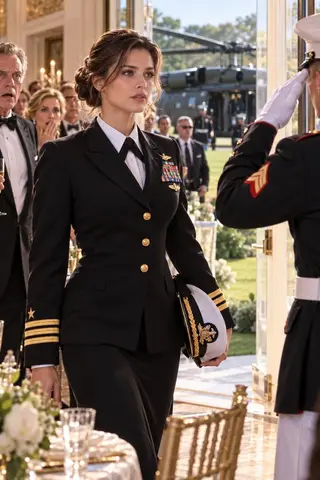
 After 22 years of being branded a family disgrace
Chapter 18
The Shadow over the South China Sea
Thirty-six thousand feet above the Western Pacific, the tactical data link hummed inside the Combat Direction Center of the USS Enterprise.
The room was pitch-black except for the glowing blue, amber, and crimson vectors projected across the three-story holographic display. The ambient temperature was kept at a chilling sixty degrees to prevent the immense banks of quantum cryptographic servers from overheating. Over two hundred technical specialists sat in tiered rows wearing headsets, speaking in the hushed, clipped jargon of professional naval warfare.
I stood on the command platform overlooking the deck, holding an insulated ceramic mug of black coffee, my service cover resting on the console beside me.
"Admiral," Commander Vance said, stepping up the metal stairs with a secure tactical tablet in hand. "Reconnaissance flight Ironclad-One just pinged an anomaly three hundred miles southwest of the Spratly Islands. It’s not commercial shipping."
"Show me," I said, gesturing toward the primary tactical sphere.
The display rotated smoothly. A tight cluster of eleven crimson blips pulsed in the center of the deep-blue maritime zone.
"Two guided-missile cruisers, six stealth frigates, and a replenishment oiler," Vance rattled off, his finger zooming into the high-resolution satellite imagery. "They’ve established an exclusion perimeter around a deep-sea mobile drilling platform right in the middle of international shipping lanes. What’s worse—their flagship is the Dragon-Head, Admiral Zhang’s personal command cruiser. They've just deployed active sonar buoys across the entire underwater trench."
"They're daring us to enter," I observed, taking a slow sip of the scalding coffee. "They want to test whether the new Pacific Commander is a political appointment or a tactical realist. They think because the domestic press in the States has been obsessed with the Hayes & Sons scandal, our operational focus is fractured."
"Admiral Zhang has already broadcast a standard maritime warning on the international distress channel," a tactical communications officer shouted from the pit below. "He claims the area is designated as a live-fire gunnery exercise zone and has warned all foreign vessels to steer clear by fifty nautical miles, or risk being targeted as hostile combatants."
A murmur of nervous tension rippled through the young analysts at the consoles. Fifty nautical miles would force commercial tankers carrying eighty percent of regional trade to reroute around Australia, effectively giving Beijing de facto control over the busiest commercial waterway on earth.
"Admiral?" Vance looked at me, his jaw clenched, waiting for the order. "Do we hold position outside the fifty-mile perimeter until the White House issues a diplomatic demarche?"
"Diplomatic demarches don't stop warships, David," I replied calmly, setting my coffee cup down with a light, definitive clink. "They only confirm weakness to a bully who has already decided to push."
I turned to the tactical watch officer. "Sound General Quarters across the Strike Group. Order the guided-missile destroyer USS Farragut and the cruiser Lake Erie to form a vanguard wedge. Bring our carrier speed up to twenty-eight knots. We will sail directly down the median line of international waters, cutting straight through their live-fire zone."
"Admiral," Vance warned, his voice low with calculated caution. "Their fire-control radars are hot. If we cross that perimeter, their targeting computers will automatically lock onto the Enterprise."
"Let them lock," I said, my voice cutting through the ambient electronic hum like a laser. "Patch me through to Admiral Zhang’s direct tactical link. Let’s see if he remembers who taught the class on regional maritime sovereignty."
The End









