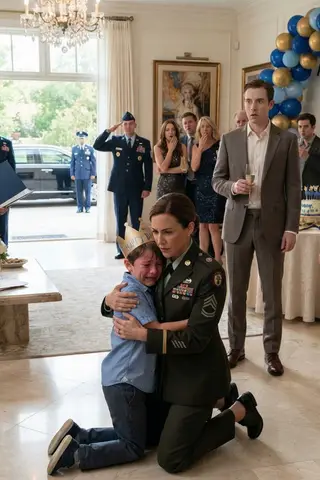
 "You’re Too Embarrassing For My Wealthy Family": He Banned Me From Our Son’s Birthday
Chapter 1
The Midnight Text That Started It All
The digital clock on the nightstand glowed with an aggressive neon blue: 2:07 a.m.
In the master bedroom of our ten-million-dollar estate in Great Falls, Virginia, the air conditioning hummed a steady, quiet rhythm. Beside me, the king-sized mattress remained undisturbed because Ethan rarely slept in the same room when he had a high-stakes investor meeting the next morning. He preferred the quiet of his private study downstairs, surrounded by leather-bound portfolios, scotch glasses, and the heavy burden of keeping up appearances.
My phone buzzed against the wooden surface, vibrating softly enough to wake only me. I reached across the sheets, my fingers sliding over the screen.
“There will be important people there,” Ethan wrote. “Mom thinks the way you dress and talk will embarrass us. Please don't come downstairs for Noah's party.”
I stared at the glowing pixels in the dark. For seven years, I had shared a bed, a last name, and a life with Ethan. For twelve years total, ever since our paths crossed during a brief leave when I was a young Captain and he was an ambitious corporate climber, I had absorbed every subtle slight, every patronizing remark, and every rolled eye from his elite, old-money family.
I calmly typed back, "I understand."
What Ethan didn’t understand—what none of them understood—was that I had spent over a decade letting his family mistake silence for weakness. To Margaret, my mother-in-law, and Richard, my father-in-law, I was simply an inconvenience. They mocked my simple clothes, my faded, dependable old SUV, and my vague, perpetually downplayed “government job.” Margaret had once asked me, right in front of her country-club friends at a Thanksgiving dinner, if I bought my holiday dress at a discount supermarket bin. Richard routinely introduced me to business associates as someone who “does paperwork for the government somewhere downtown.”
I had never corrected them. In my line of work, operational security and personal discretion weren't just habits; they were a second nature. When you operate in the upper echelons of military intelligence and strategic command, you learn to let fools underestimate you. It is a tactical advantage.
But tonight, the insult wasn't really about me. It was about Noah.
Upstairs, down the hall in the quiet sanctuary of the second-floor nursery wing, our son Noah was sleeping soundly. He was seven years old today. All week, his room had been a battlefield of green streamers, helium balloons that were slowly losing their lift, and a giant cardboard pirate ship I had spent three entire weekends building by hand, painting the cannon ports and rigging the sails while Ethan was away at board meetings.
Before falling asleep wrapped in my arms, Noah had made me promise. His small hands had gripped the lapels of my cotton pajamas, his wide, earnest eyes searching mine.
“Front row, Mom?” he had asked, his voice full of the absolute, unshakable trust only a child has in his mother.
“Front row,” I had promised, kissing his forehead.
Then Margaret’s text had chimed in a minute after Ethan’s: "Thank you for being reasonable, Claire. Noah will be busy with his friends anyway. He won’t even notice you’re not there."
That sentence didn't just sting; it cracked something deep inside my chest. It shattered the careful containment I had maintained for years. They weren't just pushing me out of their social circle; they were erasing me from my own son's life, weaponizing his birthday as a tool for their snobbery.
I slipped out from under the duvet, my bare feet touching the cold hardwood floor. I walked quietly down the dimly lit hallway into my private study—a small room tucked away behind a heavy bookshelf, a space Ethan rarely entered because it lacked the ostentatious display of wealth he favored.
I approached the biometric safe bolted into the reinforced concrete of the back wall. I pressed my thumb against the scanner. The green light clicked, and the heavy steel door swung open smoothly.
Inside lay two distinct worlds.
The first shelf held my past and my present: my military identification, my promotion orders to Colonel, my classified clearance credentials, and a formal photograph of me standing tall in my Class A dress uniform, chest decorated with ribbons earned in zones of conflict that Ethan’s family only ever read about in sanitized morning newspapers.
The second shelf held a thick, cream-colored leather folder. Inside were the deeds, the title insurance, the mortgage restructuring records, and the corporate filings proving beyond a shadow of a doubt that the holding company controlling our ten-million-dollar Virginia mansion didn't belong to Ethan, nor his father, nor their crumbling family trust.
It belonged entirely to me.
Five years earlier, Ethan’s real estate development firm had hit a catastrophic liquidity crisis. He had over-leveraged millions on commercial properties just as the market dipped. His father, Richard, had publicly cut him off to protect the family name, letting Ethan twist in the wind to teach him a "lesson in accountability." Ethan had spent three weeks crying on our kitchen floor, terrified of bankruptcy, prison, and public humiliation.
I hadn't yelled. I hadn't lectured. I had simply liquidated a portion of my personal investments, restructured my assets accumulated through years of strategic deployment hazard pay and smart portfolio management, and bought the debt outright. I saved him. I saved the company, I saved the house, and I let him keep believing he had pulled off a miraculous financial miracle through sheer corporate genius.
At 3:41 a.m., I picked up my encrypted satellite phone and dialed my attorney, Howard.
He picked up on the second ring, his voice crisp despite the hour. “Colonel Vance? Is there an emergency deployment?”
“No, Howard,” I said, my voice steady, cold, and quiet. “I need you to review everything connected to the Great Falls property and my personal holdings.”
Howard went quiet for a second. I could hear the rustle of papers on his end. “What happened?”
“My husband just informed me via text message that I am not welcome at my son’s seventh birthday party in the house that I paid for, because his mother thinks my clothes are an embarrassment to their wealthy guests.”
A heavy, stunned silence hung over the phone line. Howard had known me since my days at the Pentagon legal annex. He knew what I was capable of, and he knew the sheer magnitude of the financial leverage I held over the Vance family.
“Do you want me to evict them today?” Howard asked, his tone dropping into a chillingly professional register.
“Not yet,” I replied, looking out the dark window toward the manicured lawn. “Let’s see how the party goes first.”
By sunrise at 6:00 a.m., Howard confirmed what I already knew: legally, the house, the bank accounts, and the corporate shield protecting Ethan’s business were completely under my control. I could pull the rug out from under them with a single signature.
At 4:12 a.m., I made one final decision. My official military leave had ended precisely at midnight, and a secure government transport vehicle was scheduled to collect me from the area for an urgent command briefing at the Joint Base. Normally, to keep the peace and maintain the fragile illusion of our domestic life, I arranged for the pickup to happen three blocks away at a quiet intersection so Ethan’s family wouldn't ask uncomfortable questions about my career.
This time, I sent the dispatcher my exact home address.
The End









