 "Work the Gala?" Ex-Husband Publicly Humiliated Me at a Billionaire Event
Chapter 4
The Commander and the Consultant
The literacy nonprofit shared a brick-walled courtyard with a regional maritime outreach center in downtown Charleston. It was a chaotic, noisy, fiercely alive place filled with social workers, retired harbor pilots, community organizers, and volunteers who cared deeply about things that couldn't be measured on a corporate balance sheet.
I had been sitting on a wooden bench in the courtyard during my lunch break, struggling to swallow a cold sandwich while trying to figure out how to stretch a $5,000 community grant to cover three months of after-school tutoring books, when a heavy canvas satchel dropped onto the gravel beside my foot.
"If you keep staring at that budget sheet with that expression," a deep, gravelly voice had said, "the paper’s going to catch fire."
I had looked up, blinking against the bright South Carolina sun.
Standing over me was a man in civilian clothes—a dark blue polo shirt, worn canvas trousers, and faded boat shoes—with broad shoulders, silver-streaked dark hair, and eyes the color of a stormy Atlantic horizon. He looked like he belonged on the deck of a storm-tossed destroyer rather than a downtown community courtyard.
"Is that a threat or a prediction?" I had asked dryly, not in the mood for small talk.
The man had let out a low, rumbling laugh, sitting down uninvited on the other end of the bench. "A warning. I’m Harrison Cade. I run the maritime logistics outreach program across the hall. And you’re the new consultant who’s been tearing our administrative filing system apart and turning it into something that actually makes sense."
"Evelyn Mercer," I had said, extending a hand. "And your filing system was an archaeological disaster."
"I’ve been told that by three different admirals," Harrison had smiled, shaking my hand with a grip that was firm, warm, and entirely unpretentious. "None of them survived the critique. Want to grab a terrible cup of vending machine coffee and tell me why you look like you’re ready to wage war on a spreadsheet?"
That first conversation had stretched from a twenty-minute coffee break into a two-hour discussion about municipal funding, community infrastructure, administrative inefficiency, and the strange, quiet peace of starting over.
Unlike Richard, who treated every conversation like a negotiation where someone had to win and someone had to lose, talking to Harrison felt like stepping out of a windstorm into a sheltered harbor. He listened. Not in the way Richard used to—nodding while mentally calculating his next corporate move—but with genuine, grounded attention.
As the months passed, our professional acquaintance blossomed into something neither of us had anticipated.
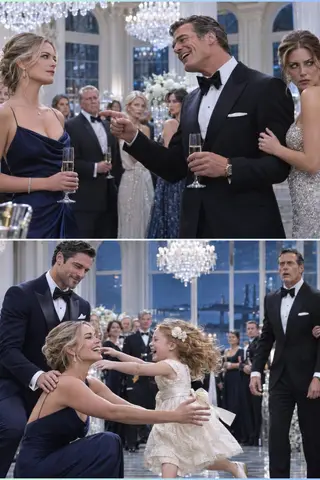
Harrison was a widower. He had lost his wife four years earlier to a sudden illness, leaving him to raise his toddler daughter, Lily, with the help of his sharp-tongued, fiercely loving sister, Claire. He understood loss, institutional burnout, and the quiet agony of rebuilding a shattered life from the foundation up.
We didn't bond over champagne toasts at high-society galas or expensive dinners at waterfront steak houses. We bonded over burnt takeout pizza on my apartment floor, late-night phone calls about grant approvals, muddy trips to the local park with a toddler who refused to wear matching shoes, and quiet mornings watching the sunrise over Charleston Harbor from the back deck of his modest, salt-weathered home on James Island.
When Harrison looked at me, he didn't see a decorative accessory or a domestic liability. He saw a brilliant, resilient, fiercely capable woman who made him laugh, challenged his assumptions, and brought a quiet, steady anchor to his chaotic military and administrative life.
When he asked me to marry him, two years after our first meeting in the courtyard, he didn't do it with a grand, performative speech designed for an audience.
We were sitting on the back porch of his house on a warm autumn evening, shelling fresh shrimp while Lily chased fireflies across the lawn in her pajamas.
Harrison had set his bowl down, turned to me, and wiped his hands on a kitchen towel.
"Evelyn," he had said quietly, the ocean breeze rustling the oak trees above us. "I spent twenty years commanding ships on open water, believing I knew how to navigate any storm the world could throw at me. Then I met you, and I realized I spent my whole life drifting without a compass."
He had reached out, taking my hand, his thumb gently tracing the old, faint scar across my knuckle where I had burned myself years ago in Mount Pleasant.
"Marry me," he had said simply. "Let’s build a home where nobody ever has to perform, and nobody ever has to earn the right to be loved."
I had looked into his stormy blue eyes, smelled the salt air and the sweet scent of summer grass, and realized for the first time in my life what true security actually felt like.
It wasn't a two-hundred-million-dollar valuation. It wasn't a mansion on Sullivan’s Island. It was the absolute, unshakeable certainty that someone would love you just as fiercely when the lights went out and the applause stopped.
The End









