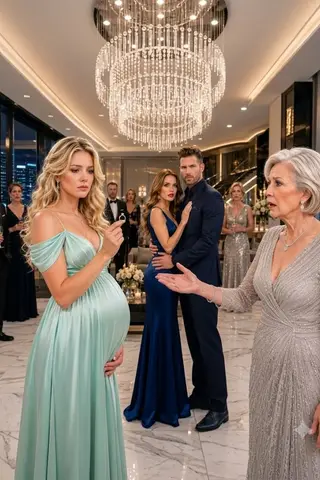
 While He Danced with His Mistress at a $2B Gala, His 9-Months-Pregnant Wife Dropped Her Ring in His Mother's Hand
Chapter 59
The Harbor of Tomorrow
In August, a landmark ceremony took place at the Brooklyn Navy Yard, marking the official opening of the New York Harbor Clean Transport Terminal—a massive infrastructure initiative sponsored jointly by Genesis Ventures and the State of New York.
The terminal, built upon repurposed industrial docks, was designed to power the city’s entire fleet of municipal ferries and harbor tugs using Genesis induction systems.
Emily had insisted that the local labor agreements prioritize training programs for community workers and rehabilitated apprentices from the boroughs. She stood on the grand pavilion overlooking the East River, surrounded by the Governor, the Mayor, and hundreds of dock workers in their clean work uniforms.
"A great city is not measured by the heights of its corporate towers," Emily stated during her keynote address, her words broadcast live across regional networks. "It is measured by the health of the waters that feed it, and the dignity of the hands that keep it running. Today, New York begins a new chapter—one where clean energy belongs to the working men and women who build our future."
Far back in the crowd, standing among the contingent of certified marine mechanics from the Queens logistics depot, Mason Hartwell listened in silence.
He wore his formal gray mechanic’s uniform, clean and pressed, with the brass insignia of a Lead Logistics Supervisor pinned neatly to his collar. He had recently been appointed director of maintenance for the terminal’s fleet of electric support craft—a position earned strictly through four years of flawless technical performance, rigorous exams, and the unreserved recommendations of his fellow machinists.
As Emily concluded her speech to thunderous applause, Mason did not attempt to step forward. He did not seek her glance, nor did he linger to catch her attention when the dignitaries moved toward the ceremonial ribbon-cutting.
Instead, as the crowd began to disperse toward the reception, Mason walked toward the maintenance slipway where the first electric ferry lay moored.
A courier dressed in a simple courier uniform approached him, checking a manifest. "Mason Hartwell?"
"Yes," Mason replied.
The courier handed him a firm, thick envelope made of heavy Maine parchment, embossed with the simple seal of the Bar Harbor Children's Sanctuary.
Mason opened it with steady, reverent fingers.
Inside was a formal certificate from the Bar Harbor Municipal Board, accompanied by an architectural photograph of the newly completed conservatory garden. Across the stone archway of the children's reading pavilion, carved into honest Maine granite, were the words:
*Dedicated to the Unsung Hands Who Choose the Labor of Truth.*
Enclosed with the certificate was a handwritten note from Emily:
*Mason,*
*Your daughters know the truth. They know that when everything fell apart, their father did not remain in the shadows of pride, but chose to build with his hands in the rain. They know your labor has sheltered children who had nothing. You have honored your daughters by remaining silent, and you have honored yourself by doing honest work.*
*Your past is redeemed. Live in peace upon your shore.*
*— Emily Sterling*
Mason stood beside the quiet waters of the East River, the sun warming his face. Two silent, cathartic tears traced the weather-beaten lines of his cheeks. He folded the note, placed it gently in the breast pocket over his heart, and looked out across the river with a spirit that was, for the first time in his life, entirely whole, humble, and free.
***
The End









