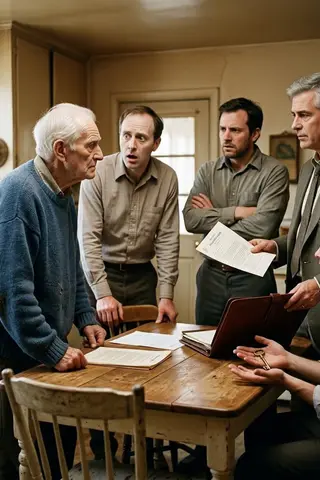
 Two Older Brothers Walked Away From Dad’s $2.1M Debt
Chapter 2
The Price of Loyalty
The next morning arrived with a cold, damp drizzle that plastered dead leaves against our kitchen window. My wife, Sarah, didn't complain when I told her what happened. She simply walked over, kissed my cheek, and whispered, "We do what we have to do."
By 9:00 AM, I was sitting beside Dad in a sterile, glass-walled conference room at the First National Bank downtown. The air smelled of expensive carpet cleaner and anxiety. Across the polished mahogany table sat a senior loan officer named Mr. Vance, whose expression was a mask of practiced corporate indifference.
Vance slid a thick, multi-page guarantor agreement across the table, the papers rustling like dry leaves.
Dad turned his head, his cloudy eyes looking deep into mine. His hand reached out, trembling as it rested over the signature line. "You don't have to do this, Ethan," he murmured, his voice cracking with a sudden, overwhelming vulnerability. "If you sign this, your name is tied to every cent. They can come after your house, your wages, your future."
I looked at the old man. I saw the deep wrinkles carved around his eyes—wrinkles put there by decades of hard work, grief over Mom's passing, and now, the crushing weight of betrayal by his oldest sons.
I picked up the heavy metal pen resting beside the contract.
"You stayed by my bed in the hospital when the doctors said I might not wake up," I said softly, signing my full name across the dotted line in firm, bold strokes. "I'm staying now."
Mr. Vance checked the signatures, stamped the document with a satisfying thud, and told us the restructuring process would take effect immediately. We walked out of the bank into the gray drizzle, and I brought Dad back home with me to our cramped, modest house.
Thus began a year that stripped our lives down to bare bone and gray ash.
I took on every extra shift I could scavenge. By day, I managed inventory at the regional shipping depot; by night, I drove for a delivery service, my eyes burning from exhaustion as I navigated the rain-slicked highways of the city. Sarah canceled our subscription services, cut off our grocery budget to the absolute minimum, and mended our daughter's clothes by hand without a single word of resentment.
To make our monthly payments to the bank, we had to sell my pride and joy—my brand-new commuter motorcycle, the one I had saved three years to buy. Handing the keys over to a stranger for a fraction of its value felt like handing over a piece of my youth.
Some weeks, our dinners were heartbreakingly simple: steaming bowls of white rice, fried eggs, and salted kangkong greens. Every spare dollar, every overtime bonus, and every birthday gift had somewhere much more urgent to go. We lived in perpetual, grinding financial survival mode.
My brothers called occasionally, but never when a payment was due. Their phone calls were brief, performative check-ins designed to soothe their own guilts.
"How’s old Dad holding up?" Marcus would ask, his voice brisk and distracted by background office chatter. "Holding steady? Good, good. Tell him I’m swamped with the corporate expansion this quarter."
At family gatherings—holidays where Sarah and I scraped together enough for a modest roast chicken while Marcus and David brought expensive imported wine—they never asked me how the debt was going. They pretended the $2,160,000 anchor around my neck didn't exist, as if ignoring it would make my sacrifice vanish.
Once, Marcus stopped by our house unannounced to drop off some old children's books. He spotted my old, dented secondhand scooter parked haphazardly in the driveway where the motorcycle used to be.
Marcus raised an eyebrow, a condescending smirk touching his lips. "What happened to your bike, Ethan? You really sold the new motorcycle?"
I wiped grease from my hands onto an old rag, keeping my voice neutral. "Needed the cash flow for household expenses."
Marcus shook his head with a patronizing sigh. "I told you not to get involved. You always had this hero complex, trying to rescue people from messes they created themselves. Well, you made your bed."
Dad had been sitting on the small front porch, watching through the screen door. He had heard every word.
He said nothing at the time. But that night, long after the house had gone quiet, I woke up to get a glass of water and noticed a faint sliver of light coming from the kitchen.
I crept down the hallway. Dad was sitting alone at the kitchen table. In the center of the dim room, resting in the palm of his calloused hand, was an old, heavy brass key with intricate, old-fashioned ridges. It looked like it belonged to a bank deposit box or a very old door.
When he heard the floorboard creak, his head snapped up. In one fluid, defensive motion, he closed his fist tightly around the key, hiding it from view.
"Dad?" I whispered, rubbing my tired eyes. "Is everything okay? Are you having trouble sleeping?"
"Just... thinking, son," he said, clearing his throat. He slid his hand into the pocket of his trousers.
"What's that key?" I asked, pointing gently toward his hand.
"Something from your mother," he replied, his voice dropping into a quiet, distant register.
Then he stood up, walked down the hall to his bedroom, and closed the door.
The End









