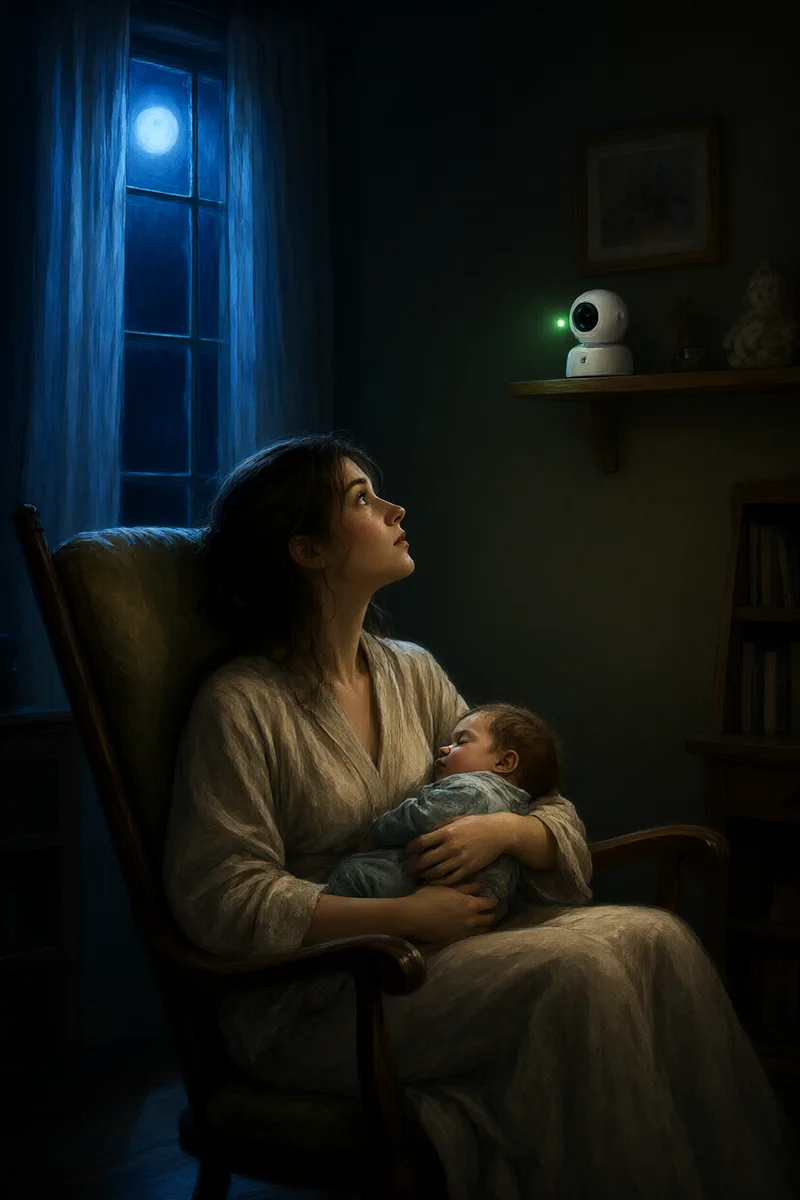
 The Nursery Camera
Chapter 3
Russ
“Cut it from hers in 2021,” he said, as I took it. “In case of a fire. I'm not proud of not telling you.” He looked at his shoes. “Can I come in for a minute? I won't be long. My knee won't let me.”
I made him tea. He sat at our kitchen table where I'd sat with Will the night before and held the mug in both hands like a man warming them at a fire.
Russ Hargreave had been a postal supervisor for thirty years and spoke as if every sentence cost postage. In five years of Sunday lunches I'd heard him say perhaps two hundred words, most of them about the weather or the cricket.
“Will's sister,” he said. “Lorna.”
I knew there was a Lorna. She lived nine hundred miles away and rang at Christmas and on her mother's birthday. There was a wedding photo of her on Patrice's piano, with the husband carefully cut out of it.
“Patrice had a key to their place. Same as you. Rang every day, then twice a day. When the boy came, she was over there every morning before Lorna was up. Tidying. Telling her what she was doing wrong with him. Gareth, Lorna's husband, asked me to have a word.” He turned the mug a quarter turn. “I didn't. I told him she meant well, which she did, and that it was quicker to go along with her, which it was. A year after that they took a job out west and they've been there ever since. I've seen my grandson four times. He's eleven.”
Will had come in from the garden and was standing in the doorway, listening.
“I kept my head down for thirty-eight years because it was quieter,” Russ said, not to me any more but to his son. “I told myself it was keeping the peace. It wasn't peace. It was me letting your mother lose people, one at a time, because I didn't want a row at dinner.” He set the mug down. “Don't you learn that from me, William. I'm asking you.”
Will didn't say anything. He came and sat down across from his father, and after a moment he put his hand flat on the table near Russ's, not touching it.
When Russ had gone, Will and I talked for two hours. Bea napped through all of it, which she had never done once in seven months, as though she'd decided to give us the time.
He told me he'd set up the camera share because saying no to his mother had always felt like a kind of violence to him, and saying yes felt like nothing at all. I told him that the nothing had landed on me. Every time.
“I know,” he said. “I know it did.”
That evening my phone buzzed on the arm of the sofa, and then buzzed again, and kept buzzing.
It was the family group chat. Fourteen people: aunts, cousins, Will's godmother, a great-uncle who only ever posted photographs of sunsets. Patrice had written a long message, carefully punctuated, the way she wrote birthday cards.
She was very sorry to share that she had been cut off from her only local grandchild without warning. She was worried. She had seen Delphine struggling, at night, for months. New mothers weren't always themselves. She thought the family ought to know, in case anyone was able to reach her.
The last line had a little space before it, as though she'd hesitated.
I have spoken to someone this afternoon about grandparents' rights.
The End









