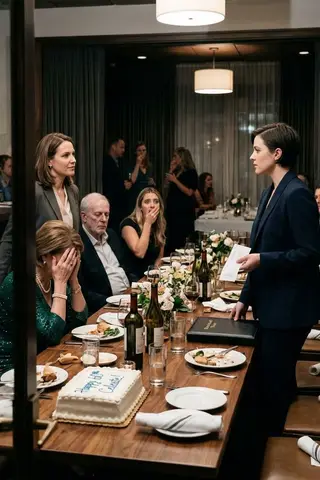
 "This Table Is For Family
Chapter 1
The Walnut Bar and the $3,270 Evidence
The receipt sat on the walnut bar at 8:47 p.m., faceup like cold evidence. The bartender gently pushed the black leather folder toward me while thirty-one people celebrated in the private room behind me, completely unaware that the foundation of their perfect evening was about to shatter into dust.
$3,270.14.
Thirty-one meals. Four bottles of imported wine, aged to perfection. A custom vanilla-bean cake with gold leaf detailing. Private room charges, service fees, and gratuity. A milestone 60th birthday celebration built entirely on my personal credit card, engineered by the woman who raised me to believe I was nothing more than an expensive inconvenience.
Six weeks earlier, my mother, Celeste Hartwell, had called me with her sweetest, most manipulative voice—the one she reserved for when she needed free labor or a favor she was too proud to ask strangers for.
"Maren, darling, you are so wonderfully organized, and you know how particular I am about venues," she had cooed over the phone, spinning a web of false flattery. "Could you handle the reservation for my diamond jubilee dinner at The Alder Room? I want everything to be absolute perfection."
She made it sound like an honor. She made it sound like she trusted me. I knew better, of course. I had spent twenty-six years learning the complex choreography of Celeste’s approval, dancing around her moods and walking on eggshells. But deep down, beneath the cynicism born of a lifetime of conditioning, a small, foolish part of me still wanted to believe I belonged. I still wanted to believe that if I was good enough, compliant enough, and useful enough, she might finally look at me not as a charity case, but as a daughter.
That pathetic hope died the moment I walked into The Alder Room.
The restaurant was an upscale, dimly lit sanctuary of dark woods, velvet upholstery, and soft jazz. As the hostess escorted me toward the back, I saw the long, magnificent mahogany table glowing beneath crystal chandeliers. Lined with sparkling crystal glassware and bespoke menus, it was a masterpiece of social curation. And right there, nestled near my siblings, was an empty chair. A place card written in elegant calligraphy read: Maren Vale Hartwell.
For one blinding, hopeful second, my heart leaped. I thought my mother had finally chosen me. I thought she had carved out a permanent space for me at the center of her world.
Then she touched my arm.
Celeste’s grip was surprisingly firm through the fabric of my blazer. She guided me a few steps away from the table, her smile fixed and terrifyingly bright.
"Maren," she said loudly, pitching her voice so that the neighboring tables and our arriving relatives could hear every syllable, "find another table, sweetheart. This one's strictly for family."
The room seemed to freeze. A cousin stopped mid-sentence with a fork hovering near his mouth. A waiter carrying a tray of champagne flutes paused, his eyes darting between us. Then Celeste emitted a light, musical laugh, and the tension broke as everyone else dutifully followed her lead, chuckling along with the matriarch.
My brother Blake lifted his glass in a mocking toast. My sister Lila didn’t even look up from her phone, completely accustomed to my public demotion. My father Warren stared resolutely down at his menu, studying it with intense fascination, as if he couldn't hear the woman who raised me completely erase my existence with a single sentence.
Celeste leaned in close, her breath smelling of expensive perfume and cheap malice. "Don't make this awkward," she whispered, her voice dropping into a venomous hiss. "You know what I mean."
I did know. God help me, I knew.
I had spent twenty-six years knowing. From the day they brought me home from the adoption agency at age five, I was the trophy orphan. I was the adopted daughter they displayed like fine art whenever they wanted public praise for their boundless philanthropy. I was the charity story in the local glossy magazines, the living proof of their infinite generosity. But whenever the family photo mattered, whenever the important people were watching, or whenever the inner circle gathered, I was gently but firmly reminded that my place in the Hartwell dynasty came with strict conditions.
Conditions that I could never quite meet because, no matter how hard I tried, my blood didn't match theirs.
So, I smiled.
It was a practiced, hollow expression that I had perfected over decades. I didn't cause a scene. I didn't throw a glass of water in her face, as much as every fiber of my being screamed for me to do so. Instead, I nodded, turned on my heel, and walked away from the golden table.
The hostess, looking mortified, guided me to a small, isolated two-top table tucked away near the service corridor, mere feet from the bustling bar. It was dark, drafty, and completely disconnected from the celebration. There, I sat alone, picking at a basket of artisanal bread while their laughter, clinking glasses, and joyful chatter filled the spacious private room.
Nobody checked on me. Nobody came over to see if I was alright. Nobody had the courage, or the decency, to admit what they had just watched happen right in front of them.
At 8:31 p.m., my sister Lila posted a picture of the celebration on Instagram with the nauseating caption: "Nothing like family. Blessed beyond measure."
At 8:47 p.m., the bill arrived at my lonely little table.
The bartender looked apologetic, sliding the black leather folder across the polished walnut surface. "I'm sorry, miss," he murmured quietly. "The party organizers left instructions at the front desk. They told the server your card was already on file for incidental coverage."
My card.
The exact same credit card I had provided weeks ago to secure the reservation deposit, foolishly believing it was just a formality.
I looked across the room toward my mother. She was glowing beneath the warm restaurant lights, the undisputed queen of the evening, surrounded by people who thought they knew her, people who worshipped the ground she walked on.
I opened the black leather folder. I looked at the astronomical total.
Then, I smiled.
Because looking at that bill, I finally understood something vital: this bill was never the real humiliation. It was merely the final, undeniable piece of evidence. It was the last brushstroke on a masterpiece of deception that had been decades in the making.
Six months earlier, my adoptive father Warren had asked me to come to his downtown office to help him organize and digitize decades of old family records for tax preparation. Warren was notoriously disorganized, and as the dutiful daughter who always cleaned up everyone else's messes, I spent hours sifting through dusty filing cabinets in his private study.
While he was out taking a business call, a loose panel at the back of his mahogany desk snagged my sleeve. When I investigated, I discovered a hidden, locked drawer that required a physical key—a key that Warren had carelessly left sitting in a brass dish on top of his desk.
Inside that locked drawer was a thick, dust-free manila folder that was never, under any circumstances, meant for my eyes.
Inside were my real adoption documents. The original court filings. The amended birth certificate. The county welfare records. But tucked right beneath them was something far more explosive: a comprehensive trust agreement dated precisely two days before my adoption was legally finalized, established by my biological maternal grandmother—a woman Celeste and Warren had claimed died penniless in a car accident when I was an infant.
The documents revealed a staggering truth. My grandmother had left a multi-million-dollar generational trust specifically earmarked for any child legally placed under the Hartwell name, intended to fund higher education, medical security, and a substantial independent inheritance upon turning twenty-one.
Mine. Every single penny of it was mine.
For twenty-six years, Celeste had used my adoption as a public relations prop to symbolize her boundless grace, while systematically hiding the existence of the multi-million-dollar account that legally and morally belonged to me. She had treated my future like her own personal piggy bank, siphoning funds whenever she wanted a kitchen remodel, a luxury European vacation, or a down payment on Blake’s sports car.
So, sitting there at the walnut bar at 8:47 p.m., I didn't hesitate.
I didn't argue with the bartender. I didn't call the police just yet.
I picked up the heavy metal pen resting beside the folder. I added a generous twenty percent tip—because I wanted everything documented down to the last cent. Then, I signed my name slowly, pressing down hard so the ink bled through the carbon copy paper.
Maren Vale Hartwell.
The name they used when it benefited their social standing. The name they trotted out to prove what wonderful human beings they were. The name they tried to make me feel small, worthless, and ashamed of.
I closed the folder, slid my credit card back into my wallet, and looked up at the bartender.
"Just a moment, please," I said smoothly, my voice carrying a strange, chilling calmness that made him pause mid-reach.
This time, my voice wasn't muffled by the ambient noise of the restaurant. Something in my tone cut straight through the celebratory din, causing the immediate vicinity to go dead silent.
The bartender stopped. The server holding a tray of dessert plates froze. And out of the corner of my eye, I saw the heavy oak door of the private dining room swing open wider.
Step by step, two figures emerged from the lobby and walked directly toward my small table.
First came the restaurant manager, his face pale and sweating despite the air conditioning. Right behind him walked a sharp, impeccably dressed woman in a charcoal tailored pantsuit carrying a sleek leather briefcase—Ms. Sterling, the senior partner at Sterling & Vance Financial Litigation, whom I had retained earlier that afternoon.
Celeste’s triumphant, glowing smile remained frozen on her face for a split second as she noticed the commotion near the bar. Then, her eyes dropped to the attorney standing beside me.
And for the first time in twenty-six years, I saw true, unadulterated fear flash across my mother's eyes.
The End









