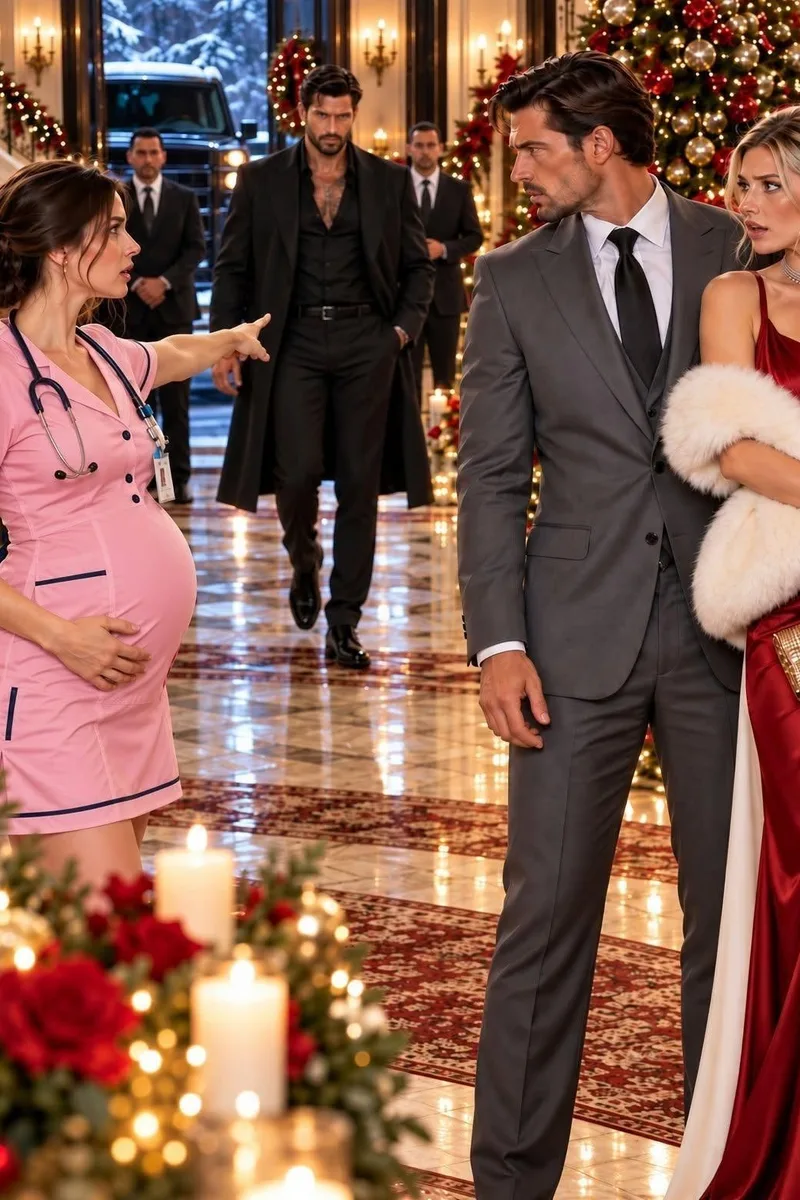
 Thirty-Two Weeks Pregnant, I Watched My Husband Bring His Mistress to Christmas
Chapter 3
A House Without Witnesses
Tessa met me outside the estate gates in her battered Subaru. She had brought a pillow, a bottle of water, and flat shoes in my size. It was the kind of preparation that came from knowing me since nursing school rather than knowing my husband's net worth. I climbed into her passenger seat with a sigh that seemed to reach all the way through my ribs. Behind us, the Dre mansion stood illuminated against the snow, beautiful enough to conceal almost anything.
"You don't have to tell me tonight," she said when she noticed my face. "I know." I told her anyway, but in pieces: the necklace, the hotel receipt, the warning, the detective, Fiona's email. She kept her eyes on the road, asking only practical questions. When I stopped talking, she turned the heater lower because I had begun to feel nauseated. No one had done that without being asked in such a long time that I cried over the dashboard vents.
At her house, I texted Matthias that I was safe and staying elsewhere. I offered no address. He replied with three questions about the police and only afterward asked whether the baby was all right. I answered the last question, then turned my phone over. Tessa set up her ground-floor guest room and left a lamp on in the hall. In the morning I woke to the smell of toast and realized I had slept without listening for a key in a lock.
Lydia joined us by video after breakfast. She explained that my photographs of the hotel records and jewelry receipt were useful to clarify financial questions but did not, by themselves, establish the details of Matthias's relationship. I told her what I'd seen with my own eyes at Christmas. She recommended preserving the messages and considering temporary arrangements for housing and medical appointments. She did not promise an effortless divorce or tell me to forgive him. She asked what I wanted, and the simplest answer frightened me: room to think without being watched.
The estate's investigation remained active. Quinn called to confirm the time I had arrived, where I'd stood, and whom I'd seen near the service corridor. She told me officers had located Mercer for an interview and were checking his explanation with access logs. She couldn't discuss the interview itself. The threat might prove to be part of a dispute over the acquisition rather than a plan to injure people, but she would not say so before the facts supported it. I appreciated her restraint. Everyone else seemed eager to declare the whole thing either a catastrophe or an embarrassing misunderstanding.
Helen called that afternoon. She said the family Christmas party had ended early, with guests sent home and the staff paid in full. Charles had been furious that police were involved but had later admitted the access controls were inadequate. She offered me an apology for not recognizing how alone I'd been at the party. I wasn't prepared to tell her about the affair in detail. Instead I asked whether she'd known Fiona was coming as Matthias's companion. Silence stretched along the line.
"I knew she was invited," Helen said at last. "I didn't know how he intended to introduce her." I waited. She added, more quietly, "I should have asked." The words hurt more than a denial would have. His family had noticed the shape of my marriage changing and chosen not to inquire. Helen asked if she could visit. I said not yet. She accepted it, which left me briefly unsure what to do with the absence of an argument.
Matthias sent flowers to Tessa's address the next morning. That was how I learned he'd located me. Tessa found them on the porch, along with a card saying he needed to talk. The roses were white, the same flowers we'd used at our wedding. I was tempted to believe their arrival meant tenderness had survived somewhere beneath his arrogance. Then I thought about the fact that I hadn't given him the address. My hands went cold.
I called him rather than writing a text I would later reread in anger. "How did you know where I was?" He said a driver had seen Tessa collect me. "I had to know you were safe." "You could have asked me whether I was safe," I replied. "I told you I was." He sounded genuinely confused about the difference. I told him not to send anything else or ask staff to track my movements. He said I was turning concern into an accusation. For once I let the accusation remain where his actions had placed it.
After the call I went to the prenatal appointment I'd scheduled weeks earlier. Tessa waited in the lobby with a paperback while I spoke to the clinician. My blood pressure was checked, my daughter's growth reviewed, and I described the stressful events without turning them into a medical diagnosis. The clinician advised rest, reviewed warning signs, and told me to contact the unit if anything changed. When I heard my daughter's heartbeat, steady and fast, I realized how much of my fear had been about the things I could not control.
I sent Matthias the routine medical update through a new email thread that included only information relevant to our child. He responded with a question about whether he could attend the next scan. I considered it carefully. He had been absent from the last one, but absence wasn't a lifelong sentence. I said I would decide after we had agreed on boundaries and a way to communicate without his staff becoming involved. It was the first time I'd offered him a condition instead of either surrendering or refusing outright.
That evening Quinn called again. Mercer had admitted using an old badge to reach the service entrance but denied knowing about the anonymous warning. The access log showed his credentials had never been properly disabled. More important, the Hensley project files contained a memorandum that used language similar to the phrase on the diagram. The investigators were determining whether someone had altered it to imply a physical threat. She warned me not to circulate the document or contact Mercer. I thanked her, then sat very still after the call ended.
The danger was becoming more specific and less theatrical. Somebody had taken language from a business risk assessment and placed it beneath a diagram of a house full of people. That mattered, even if there had been no explosive or attacker waiting at the gate. Whoever had written the warning wanted a reader to fear for human lives. I wondered whether Matthias had known the phrase existed, whether Fiona had, and whether the people behind the acquisition understood how their words sounded outside a conference room.
I opened a blank notebook and made two columns, Facts and Questions. Under Facts I wrote that the badge had remained active, the document existed, and the police were investigating. Under Questions I wrote who sent it and why. On another page I wrote things I knew about my marriage without needing anyone's testimony: Matthias had lied, he had publicly arrived with Fiona, and I did not feel safe depending on him for ordinary care. Those facts required decisions whether or not the police ever found the sender.
The End









