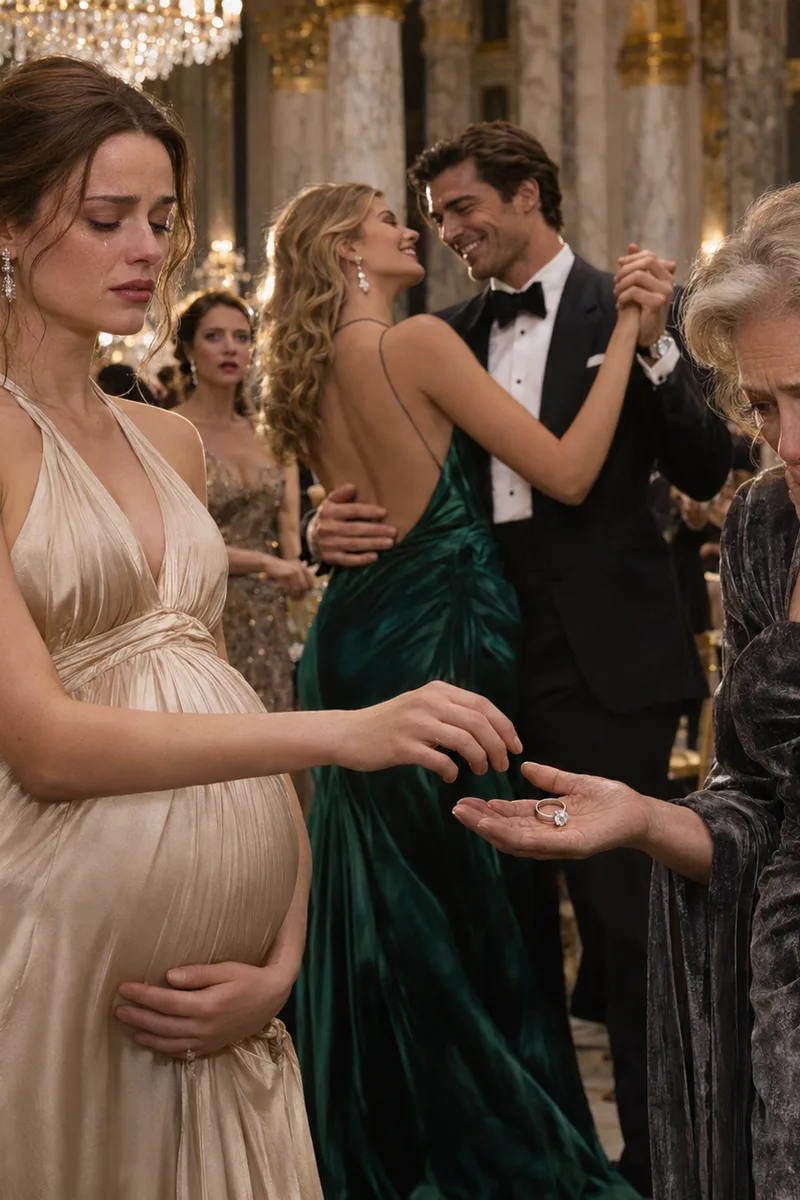
 Thirty-Five Weeks Pregnant, I Left My Husband Dancing With His Mistress and Gave His Mother My Ring
Chapter 3
What Victoria Knew
Victoria chose a quiet café beside a bookstore, far from the people who attended Hartwell fundraisers. She arrived ten minutes early and stood when Emily entered, then seemed unsure whether to hug her. Emily took a seat instead. Nora stayed in the bookstore next door at Emily's request. It wasn't a performance of independence. Emily simply needed to know she could leave a difficult conversation without having to call Mason for transportation.
Victoria laid a narrow jewelry box on the table. Emily kept her hands around a mug of tea. "You can take that away," she said. "I'm not deciding anything about the ring today." Victoria slipped the box back into her bag. Her shoulders lowered with the relief of someone given a small, specific task. "Last spring," she began, "Mason brought Camille to lunch at my house. He said she was helping with a major project."
Emily knew about that lunch. Mason had called her from the car afterward, complaining that his mother asked too many questions about business. Victoria said Camille had seemed confident, familiar with the house, and remarkably comfortable contradicting Mason. Over the following months, she had seen them together twice more, once leaving a private dining room at a benefit and once arriving at Victoria's driveway late in the evening. "He told me they had stopped by to collect papers," Victoria said.
"What did you believe?" Emily asked. Victoria looked down at her untouched coffee. "I believed what was easiest for me to live with," she said. "I noticed how they looked at one another. I asked Mason once if he was being careful with his marriage. He told me not to insult him." The confession hurt Emily more than the sightings themselves. Victoria had always sounded protective when she called, yet had let Emily go on preparing two nurseries, two hospital bags, an entire future.
Emily asked whether Victoria had seen anything that proved an affair. "No," Victoria admitted. "I saw closeness, secrecy, and his anger when questioned. Those are reasons to ask, not proof of every fear." Emily appreciated the precision even as she resented needing it. She didn't want Victoria to invent certainty to make a late confession seem generous. "You should have told me you were worried," Emily said. "Then I could have decided what to believe."
Victoria wiped the rim of her cup with a napkin. She spoke of raising Mason after his father's death, of confusing protection with never letting him face consequences. Emily had heard versions of the story before, often whenever Mason disappointed someone. This time she stopped her gently. "I'm not here to understand why you kept quiet until I feel sorry for you," she said. "I need to know whether you'll keep choosing his comfort over what I deserve to know."
Victoria met her eyes. "I won't tell him where you're staying. I won't tell you to go back. And if you ask me what I witnessed, I'll answer honestly." It was less than an apology could promise and more useful. Emily let the silence sit between them. Then she asked Victoria whether Mason had ever spoken about the babies when Camille was present. Victoria remembered one lunch when Camille remarked that Mason would be too busy to take much leave after the birth. Mason had not challenged her.
That small sentence unsettled Emily. They had discussed parental leave repeatedly at home, and Mason had assured her that the company could manage without him for a few weeks. Emily had let herself imagine him learning the different cries of their daughters, walking the nursery at three in the morning. "Was that his plan or hers?" she asked. Victoria shook her head. "I don't know. I should have asked him when it mattered."
Outside, Nora waited beside the bookstore window, pretending to examine a travel guide. Emily left the café without touching Victoria's ring box. She described the conversation on the walk to the car. Nora listened and asked whether Victoria's information changed anything. Emily thought about it. She had left because of what she'd seen, not because Victoria could confirm or deny a secret history. But now she knew that some people had been managing their doubts around her instead of speaking with her.
At Nora's apartment that afternoon, Emily opened the shared household calendar on her laptop. She wasn't hunting for a dramatic clue; she needed to see what prenatal appointments and delivery arrangements still depended on Mason. His assistant had placed a donor dinner on the evening of her next growth scan, a conflict that hadn't appeared when Mason promised he would attend. Emily took a screenshot, then emailed the practice to confirm that Nora could accompany her if needed. She would stop building plans on assurances that required someone else to remember them.
Mason called after sunset and asked to come over. Emily said no, but offered a video call the following afternoon limited to practical arrangements. He accused his mother of poisoning her against him. Emily almost laughed at the timing. "I watched you dance before your mother said a word," she said. "If we speak tomorrow, I need you to answer questions rather than attack the people helping me." Mason said he would try, a word that could mean anything until she saw the effort.
Before bed, Emily packed a small bag with the medical papers she'd brought from the clinic and two identical knit caps Nora had purchased. They were cream-colored, each with a ridiculous little knot. Nora held one against her palm and asked whether the daughters had names. Emily admitted she and Mason had made a list but hadn't agreed. "You don't have to decide tonight," Nora said. "I know." Emily placed the caps side by side, startled by how much love she could feel for people she hadn't met.
The next day would require her to ask the man she had loved for eleven years questions he might finally answer. Yet Victoria's confession had already changed the terms. Emily wasn't preparing to persuade Mason that what he had done looked bad. She wanted to find out whether he could speak plainly about it, and whether the father of her daughters could learn to respect a boundary even when the boundary was inconvenient to him.
The End









