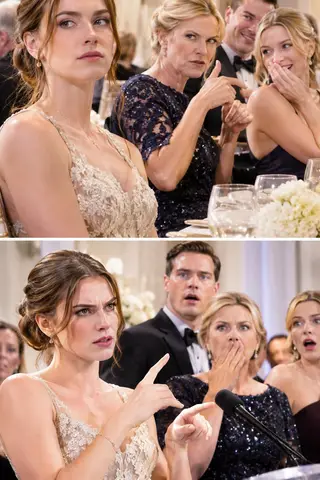
 They Spent A Year Insulting Her In ASL Right To Her Face
Chapter 1
The First Whisper In The Dark
The engagement ring on my finger felt less like a symbol of love and more like a heavy iron shackle wrapped in white gold. Across the mahogany table, illuminated by the cold, pretentious glow of a crystal chandelier that probably cost more than my entire condominium, Vivian Whitmore’s manicured fingers danced through the air.
I was cutting into a piece of seared chicken breast that had been cooked to the texture of a shoe sole, but I kept my eyes fixed on my plate. I didn't need to look directly at her to read her hands. The fluidity of American Sign Language was etched into my bones.
Look at her dress. Discount rack.
Blair, Vivian's twenty-four-year-old daughter who majored in doing nothing and minored in spending her father's money, covered her mouth with a linen napkin to suppress a snicker.
Julian could have married someone with connections. Not a stray off the street.
Across the table, Julian, my fiancé of six months, reached out and placed his heavy hand over my knee. The warmth of his palm felt like a cruel contradiction.
“Everything okay, Amelia?” he asked, his voice low and rich, carrying that practiced public-relations charm that had made him a rising star at his father’s corporate law firm.
“Perfect,” I said, offering him a tight, polite smile.
He glanced briefly toward his mother’s hands, which had already dropped back to her lap, resting innocently beside her crystal water glass. Julian watched her fingers for half a second, long enough for a flicker of recognition to cross his face, before he deliberately looked away.
That was the exact moment the cold truth settled into my stomach. That wasn't the first time he had seen her signing behind my back. It was the first time I realized he was letting them do it. He was allowing his family to humiliate me under the guise of casual conversation, sitting in silence while they stripped away my dignity piece by piece.
I almost confronted him right there in the valet parking lot. I wanted to scream, to shake his tailored shoulders and ask him what kind of man watches his mother call his future wife a garbage-tier gold-digger and says nothing. But as we stepped out into the crisp autumn air, Julian kissed my forehead with practiced tenderness.
“They’re warming up to you, babe,” he whispered, rubbing his thumb against my cheek. “My mother is just protective. Give it time.”
I wanted so badly to believe him. God, I wanted that illusion. Because walking away meant admitting that the last three years of my life—the shared apartment leases, the holiday trips, the quiet Sunday mornings drinking coffee—had all been built on a foundation of sand.
My parents, Helen and Robert, are Deaf. They raised me in a bright, chaotic house in suburban Ohio where the air was constantly filled with flying hands, expressive facial grammar, and laughter so loud and uninhibited I could feel the vibrations through the wooden floorboards. Signing wasn’t a party trick to me, nor was it a secret code. It was home. It was the language of comfort, of safety, of unconditional love.
To the Whitmores, however, ASL was camouflage.
I had never told Julian's family that my parents were Deaf. At first, it simply hadn’t come up during our early dates at coffee shops and art galleries. Later, as our relationship deepened, I hesitated because Julian’s family wore their generational wealth and social pedigree like armor. They spoke in clipped, patrician accents and treated anyone outside their country club circle like background actors. Whenever I suggested bringing my parents down from Ohio for a dinner or a weekend visit, Vivian always found a reason to postpone.
“Oh, darling, not this season,” she would sign—or rather, speak with a sweet, patronizing smile while keeping her hands safely tucked away. “The society galas, the charity auctions... your parents would feel terribly out of place.”
Julian never pushed back against his mother’s exclusions. He accepted her excuses as gospel, and I let him, believing it was just snobbery rather than malice.
The Whitmores knew ASL fluently because Julian's late grandfather, patriarch of the Whitmore empire, had lost his hearing later in life. The entire family had learned sign language to accommodate him before he passed away. Now, they used that family skill like a private VIP hallway in a crowded room—somewhere they could sneer, insult, and plot without ever raising their spoken voices or leaving a trace of audio evidence.
Or so they thought.
For twelve long months, I collected their insults like jagged little stones, stuffing them into the pocket of my coat instead of confronting them.
At Thanksgiving, sitting in their cavernous dining room while silver servers poured wine, Blair had signed across the turkey platter that I had “waitress hands”—rough and stained from working too hard. I had simply asked for more gravy.
At Christmas, surrounded by towering pine trees and imported ornaments, Vivian had signed that my parents were “provincial nobodies from flyover country.” I had smiled, complimented her roast goose, and asked about the stuffing recipe.
During a menu-tasting for our upcoming wedding in June, Julian’s father, Thomas—a towering man with cold silver hair and eyes like polished granite—had crossed his arms and signed to his wife, “She’ll take whatever scraps we give her. The girl has no backbone.”
They didn't know that I didn't need their scraps. I had spent seven grueling years earning my degree in accounting, passing my CPA exam on the first try, and building a thriving boutique firm specializing in forensic accounting. I tracked offshore tax shelters, uncovered corporate embezzlement, and dismantled complex financial fraud for a living. I paid my own bills, owned my chic downtown condo outright, and had never asked the Whitmores for a single dime.
If I had wanted to, I could have shattered their fragile superiority in five minutes with a few sharp, grammatically perfect sentences in sign language. But correcting them early on would have exposed my hand. It would have stopped the stream of unfiltered honesty flowing from their arrogant fingertips.
And I needed to know why. I needed to understand why their contempt seemed to spike every single time money or family assets entered the conversation.
Then came the invitation that changed everything.
It was a Tuesday afternoon when Vivian invited me to lunch at an exclusive women's club downtown. Julian couldn't make it—he was tied up in a deposition. Just me and my future mother-in-law, sipping chamomile tea beneath neoclassical pillars.
“Amelia, dear,” Vivian said, setting her porcelain cup down with a soft clink. “I want to talk to you about the Clear Hands Foundation.”
The Clear Hands Foundation was Vivian’s pet project—a high-profile nonprofit organization she chaired, ostensibly dedicated to providing vocational training, literacy programs, and career placement for Deaf teenagers and young adults across the state. Her name was plastered on billboards, gala brochures, and charity magazines.
“It’s a wonderful cause,” I replied smoothly.
“We are expanding,” Vivian continued, her eyes narrowing into assessing slits. “We are planning to break ground on a brand-new vocational classroom wing next month. State-of-the-art equipment, modern computer labs, specialized acoustic shielding. It’s going to be magnificent.”
“That sounds like a massive undertaking,” I said, keeping my tone neutral.
“It is,” she smiled, a thin, predatory stretching of her lips. “And as part of our founding circle, we are looking for cornerstone donors. People with deep roots, people who want to leave a legacy.” She leaned across the table, lowering her voice. “We were thinking your parents. Helen and Robert. They could make an extraordinary founding gift.”
A cold chill ran down my spine. My parents lived comfortably in a modest, paid-off suburban home in Ohio. They were retired public school teachers. They didn't have founding-donor millions lying around in offshore accounts.
“How extraordinary are we talking, Vivian?” I asked, my heart beginning to hammer against my ribs.
Vivian didn’t hesitate. “Two hundred and fifty thousand dollars. A clean quarter-million. For people who care about the Deaf community, it’s a small price to pay for immortality in our donor registry.”
Before I could formulate a response, Vivian’s phone buzzed on the tabletop. It was a text message notification from Blair. Vivian glanced down at the screen, and a split second later, her fingers twitched beneath the edge of the tablecloth, performing a rapid, silent cadence that she clearly thought was hidden from my line of sight.
The daughter is stupid. The parents will be easier. Once we get the cash transfer, we control the narrative.
I kept my smile firmly in place, lifting my teacup to my lips to hide the sudden, sharp curve of my mouth.
For the first time in twelve months, the insults weren't merely cruel microaggressions. They weren't just petty jabs at my dress, my hair, or my background.
They were a blueprint for a crime. And they had just picked the wrong forensic accountant to steal from.
The End









