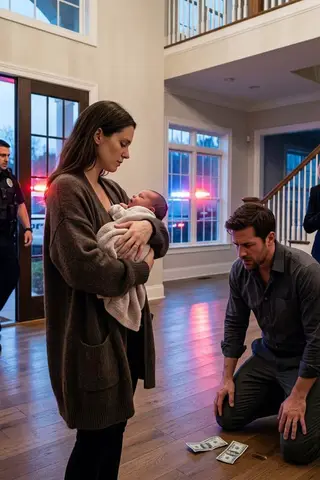
 They Skipped My Husband and Children's Funeral for a Birthday Dinner. Six Months Later, a $18.7 Million Headline Brought Them Crawling Back
Chapter 2
The Empty Pew
The church was entirely too large for three coffins.
They sat in a row before the altar at St. Jude’s—two small, pale caskets draped in white lace and pastel yellow roses for Lily and Noah, and one dark, polished mahogany casket for Ethan. The afternoon light slanted through the stained-glass windows, painting colored patches of blue and red across the polished wooden floors, looking mockingly cheerful against the weight of the room.
Ethan’s parents, Margaret and Arthur Miller, flanked me on either side in the front pew. Margaret cried until her shoulders shook with a dry, painful shudder, her fingers clutching a black lace handkerchief into a sodden knot. Arthur kept one heavy, trembling hand locked firmly onto my right shoulder. He didn't say a word during the entire service; his jaw was clenched so tight I could see the muscles twitching in his cheek, but his grip was the only thing anchoring me to gravity. Without it, I felt like I would simply float up into the vaulted ceiling and disappear.
When the priest began the service, my eyes instinctively drifted toward the left side of the church—the family side.
The oak pews were empty.
Row after row of polished brown wood, stretching all the way back to the heavy double doors, sat vacant. No mother to look at me with pity. No father to stand awkwardly in a suit that was too tight. No sister whispering condolences. Not a single cousin, aunt, or uncle from my side of the family had made the three-hour drive from our hometown.
The only exception was my Aunt Ruth. She sat three rows back, alone, wearing a black wool coat that was too heavy for the spring weather. She had driven six hours through the night after learning about the crash from a neighbor who saw it on the local evening news.
“They aren't coming, are they?” Margaret whispered softly, leaning her head against my shoulder, her voice cracking with a mixture of grief and simmering rage.
“No,” I whispered back, my eyes fixed on the silver handles of Noah’s small white casket. “They have a dinner reservation.”
Margaret let out a low, bitter sound that was half-sob, half-laugh, before burying her face back in her handkerchief.
During the eulogy, as the priest spoke about Ethan’s gentle patience and Lily’s love for painting watercolor flowers, my mind felt remarkably clear. It wasn’t the clarity of peace; it was the cold, clinical clarity of a windowpane shattering during a winter storm. Everything that had been messy, complicated, and blindly loyal in my family relationships instantly froze over.
Growing up, Melissa had always been the sun, and the rest of us were expected to orbit her without complaining. If her grades were good, my achievements were footnotes. If she threw a tantrum, I was the one told to mature and let it go. I had spent thirty-two years bending myself into pretzels to keep the peace, believing that blood meant unconditional support, that family was a safety net that would catch you when you fell off the edge of the earth.
Now, I had fallen off the edge, and my family hadn't even looked down. They were busy cutting a birthday cake.
After the service, as we walked out into the cold drizzle of the church courtyard to watch the caskets being loaded into the hearses, Aunt Ruth hurried over to me, wrapping her arms around my waist in a fierce, bone-crushing hug.
“I’m so sorry, sweetheart,” she whispered fiercely into my hair. “Your mother called me this morning to ask if I had extra recipes for prime rib because she was hosting Melissa’s party. When I asked her why she wasn't at the cemetery, she actually had the nerve to say I was being dramatic about a scheduling conflict. I told her she was dead to me, hung up the phone, and drove straight here.”
I managed a tight, ghostly smile, pressing my cheek against her coat. “Thank you, Aunt Ruth. For coming.”
“I’m staying with you,” she said firmly. “Don’t you dare tell me no.”
Three days after the funeral, as I sat alone in the living room of the house that still smelled faintly of Ethan’s coffee and Lily’s strawberry shampoo, my phone buzzed on the coffee table.
It was a text message from my mother.
Hope you’re managing okay with everything. Melissa felt really hurt that you didn’t call her on her birthday to wish her well, especially given everything. Let’s get lunch next week once things quiet down.
I stared at the screen. I read the words once. Then twice. Then three times, as if reading them enough times might cause them to rearrange into something resembling human empathy.
Nothing changed. It remained an monument of staggering, bottomless narcissism.
Something inside my chest didn't break; it went utterly, permanently quiet. The last flickering candle of obligation, the residual guilt of being a "bad daughter," extinguished itself without a puff of smoke.
I didn't reply. I didn't block them, either. I simply set the phone face-down on the wooden table, walked upstairs to the master bedroom, and closed the door on the past thirty-two years of my life.
The End









