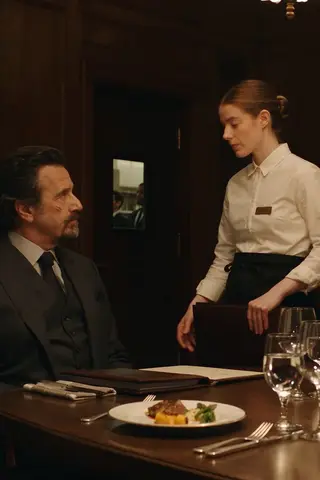
 They Sent Her to Serve Chicago’s Most Feared Crime Boss as a Joke
Chapter 1
The Weight of Double Shifts
The soles of my flats were worn down to paper-thin layers of synthetic leather, crying out for mercy against the imported Italian marble tiles of Le Petit Coeur, one of Chicago’s most exclusive and unforgiving restaurants. I was twenty-seven years old, grinding through back-to-back double shifts just to keep my head above water, pay for rent in a cramped Pilsen apartment, and help cover medical supplies for my younger brother, Leo. My hands were permanently rough, carrying the faint, unmistakable scent of truffle oil, bleach, and raw desperation. After four grueling years of waiting on tech executives, hedge fund managers, and politicians who could drop three months of my grocery budget on a single bottle of Bordeaux, I had grown accustomed to being invisible. To them, I wasn't a person with a name, a family, or an inner life; I was merely an extension of the silverware—a functional object expected to smile, pour water, and vanish.
My coworkers at the restaurant viewed my quiet demeanor as a sign of weakness or eccentricity. I didn't participate in the vicious locker-room gossip about which busboy was hooking up with which hostess, nor did I flirt shamelessly with the wealthy patrons to inflate my tip percentage. When my shift finally dragged to a close, I didn't join them at the dive bar down the block for post-shift tequila shots; I hurried straight home or to the community center. What none of them knew—what I guarded fiercely as my own private world—was that every Wednesday night, I volunteered and studied American Sign Language.
My bond with Leo was absolute. When he lost nearly all of his hearing after a severe childhood bout of bacterial meningitis at age seven, the world tried to lock him away in a chamber of total isolation. I had made a fierce, unyielding vow to myself back then: silence would never, under any circumstances, become a wall that separated him from me or the people who loved him. I learned the grammar, the syntax, the fluid choreography of hand shapes and facial expressions, transforming my fingers into a bridge across the void.
That secret skill, practiced in quiet rooms under fluorescent lights, was about to collide violently with the brutal, high-stakes underworld of Chicago. It happened on a muggy Thursday evening when the dining room was roaring with pre-theater crowds. My shift manager, Brett—a man with slicked-back hair, teeth that looked too white to be natural, and a cruel, petty streak—approached me near the service station. He was wearing that smug, oily little smile I had grown to despise.
“Private room, table four,” Brett said, his voice dripping with condescension. “He requested service, and he’s all yours, Tessa. Don’t mess it up.”
Nearby servers immediately choked back snickers, whispering behind menus and turning away to hide their sadistic grins. I froze, feeling a cold knot twist in my stomach. Even among the exhausted staff, everyone knew who had booked the private sanctuary at the back of the restaurant.
Salvatore Marquetti.
Thirty-three years old. Impeccably tailored suits that probably cost more than my car. A sharp, jagged scar running down the left side of his jawline like a permanent signature of violence. The kind of reputation that made even powerful city aldermen lower their voices, cross the street, or pretend they didn't see him coming. Rumor on the street claimed he controlled half the West Side docks and construction unions through sheer, unmitigated intimidation. Another recurring rumor whispered among the staff was far more sadistic: Marquetti deliberately ignored restaurant servers, refusing to speak a single word, purely because he enjoyed watching them squirm, sweat, and humiliate themselves trying to please him.
Brett and the rest of the floor crew had orchestrated this assignment as a spectator sport. They wanted to watch me crash, burn, and stutter under the icy gaze of Chicago’s most feared criminal. They thought it would be hilarious. Little did they know, they were walking right into a trap of their own making.
The End









