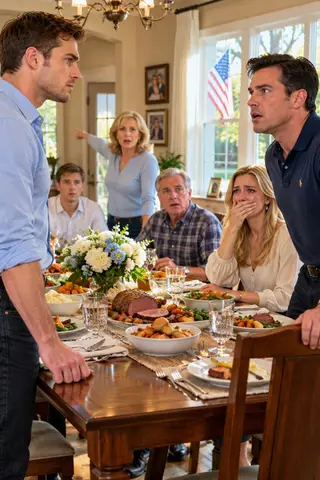
 They Laughed When My Brother-in-Law Called Me a Loser at Sunday Dinner
Chapter 1
The Anatomy of a Scapegoat
The roast beef was slightly overdone, but nobody cared because Todd was speaking.
Todd had that specific kind of confident volume that belongs exclusively to men who sell high-ticket items to hospitals and drive cars they can’t quite afford. He was leaning back in his chair, a custom-tailored cuff link catching the warm glow of the chandelier my mother insisted on cleaning every Saturday morning.
"The supply chain issues are a joke if you know how to work the logistics," Todd said, slicing off another thick, bloody wedge of meat. He looked across the table at my father, Keith. "Keith, you remember how it was back in the nineties. You either adapt or you get left behind."
"Exactly right, son," Dad murmured, nodding with that solemn, reverent expression he reserved exclusively for Todd and local high school football coaches.
I sat three seats down, quietly pushing a potato around my plate with the tines of my fork. My name is Anthony. I am twenty-nine years old, five feet ten inches, and built with the kind of unremarkable posture that makes you invisible in crowded rooms. In the hierarchy of the Miller family, I occupied a very specific ecosystem: the permanent provisional member.
My older sister, Paige, was the crown jewel. She had the sorority photos, the engagement ring with the diamond that caught every beam of light, and the suburban colonial house with the pristine sod. My younger brother, Caleb, was the baby—currently burning through his junior year at Virginia Tech on a partial athletic scholarship and my parents' lingering financial optimism.
Then there was me. I went to a community college for two years before transferring to a mid-tier state school. While Paige was being handed keys to a brand-new sedan for making the dean’s list, I spent my weekends working night shifts at a data center just to cover my textbook fees. Today, I was a senior cybersecurity engineer consulting for enterprise-level financial institutions. I made more money than my father had at the peak of his hardware store management career.
None of it mattered. In this house, I was still the kid who couldn't kick a football straight and took an extra semester of calculus.
"So, Anthony," Todd said, his voice dropping into that patronizing register that always made my teeth itch. "Still playing with firewalls and little blinking lights? Market's getting tight out there. Heard a lot of junior guys are getting squeezed into contract work."
My mother, Linda, immediately stiffened, her hand pausing over the gravy boat. She hated confrontation, but she hated awkwardness even more—and she defined awkwardness as anything that didn't resemble a 1950s sitcom script.
"Anthony's job is very stable, Todd," Mom murmured, not looking up from her plate.
"Oh, I know, Mom," Todd said, flashing a bright, veneers-enhanced smile that didn't reach his eyes. "Stability is great. Some people are built for the fast lane, and some people are built for the breakdown lane. No shame in being a spectator."
Dad chuckled. It wasn’t a loud laugh; it was that dry, raspy chuckle he always gave when Todd made a joke at my expense. It was the sound of a man trading his own son for a better model.
I looked at my father. His hair was graying at the temples, lines crinkling around eyes that had watched me win local science fairs, pull my own car out of a ditch at sixteen, and quietly wire money to help pay for Caleb’s tuition when my parents fell behind. Those eyes slid right past me, settling back on Todd with warm, familial pride.
Something inside my chest didn't break. It just went cold. For years, I had swallowed these little barbs. I had kept the peace. I had told myself that arguing with an insecure salesman wasn't worth the strain on my mother's blood pressure.
I didn't know it yet, but my silence was about to expire.
The End









