 They Called My Kids 'Homeless' For 6 Years
Chapter 1
The Descent from the Ice
The metallic ding of the private elevator echoed through the vaulted, travertine-tiled foyer of my penthouse, but the sound felt distant, muffled by the roaring rush of blood in my ears.
The service elevator.
That single phrase from my father’s whispered voice in Pennsylvania had pierced straight through the soundproofing of my Manhattan fortress. Eleven years spent hunting white-collar criminals, tracing hidden shell companies, and dismantling offshore bank accounts had taught me one fundamental truth: entitlement is a disease that rots common sense. My parents didn't just feel entitled to my success; they believed my entire existence was merely a subsidiary of my sister Paige’s household.
For six long, brutal winters, the narrative had been written in stone. Every November, the phone call would come. My mother, Helen, would clear her throat with practiced theatricality and drop the executioner's axe: “There’s no space for your children, Tasha.”
It wasn't a matter of square footage. My parents’ four-bedroom colonial in suburban Philadelphia was spacious enough to host a small rotary club. But Paige’s twin boys, Brayden and Beckett, held sovereign immunity in that house. Their names were painted in cheerful primary colors on a solid oak door down the hall. Their closets were stuffed with expensive winter gear bought with grandmotherly pride.
My kids—Leo, nine, and Maya, seven—were treated like stray neighborhood cats that occasionally wandered onto the porch. They were fed cheap supermarket crackers on paper plates in the sunroom, forced to sleep on a lumpy, spring-poked pull-out sofa with a broken frame, while my mother fretted endlessly about the twins tracking mud onto her pristine white carpets.
"They're just too energetic for your little ones to handle, Tasha," my mother would rationalize with a shrug that conveyed absolute indifference. "You understand. Paige's boys have sensitive constitutions."
I had swallowed that poison for six years. I swallowed it because I was a single mother grinding through seventy-hour workweeks at a forensic accounting firm, clawing my way up from a cubicle ghost to a senior partner. I swallowed it because I wanted my children to know their grandparents, foolishly believing that blood ties could eventually melt away cold, calculated favoritism.
I was wrong. Blood doesn't always bind; sometimes, it just stains.
When I finally broke the cycle—saving in secret, living below my means in a cramped studio while secretly funneling my bonuses into high-yield real estate syndicates—I didn't do it for revenge. I did it for peace. The seventy-sixth-floor penthouse overlooking Riverside Drive and the Hudson River was supposed to be our sanctuary. A fortress of marble, bulletproof glass, and absolute anonymity.
Yet here my parents were, standing in my lobby, treating my multi-million-dollar investment like a timeshare they could hijack on a whim.
"Tasha?"
The phone was still clutched in my trembling hand. My mother’s voice sputtered through the speaker, no longer bubbly, but laced with a sudden, twitchy panic as she realized my father’s instruction had leaked through the open line.
"Helen, give me that phone!" My father’s gravelly voice boomed from the Pennsylvania kitchen, cutting through the static. "Tasha! Listen to me right now. Your mother and I drove all night in the Buick. Paige's husband got us a discount parking pass downtown, and we checked in with your doorman—what's his name, young Carlos?—and he let us right up the service lift because we told him we were your parents bringing up your old baby boxes. Now unlock this damn penthouse door before I call the property manager and report you for elder abuse!"
A dark, bitter laugh escaped my lips. Elder abuse. My father hadn't changed a bit in forty years. Whenever he was cornered by reality, he spun a new reality where he was the noble victim.
"Dad," I said, my voice dropping an octave into that cool, clinical register I used when confronting corporate executives who thought they could outsmart federal audits. "Carlos is on a first-name basis with every resident in this building, and he knows damn well I don't have any 'baby boxes' left in Pennsylvania. More importantly, my security system logs every single visitor badge scanned at the service dock. So unless you forged a guest pass using a stolen tenant code—which is a Class D felony in the state of New York—you aren't coming up."
A sharp intake of breath hissed through the receiver. For a second, absolute, terrified silence fell over the kitchen line in Pennsylvania.
"You... you little ungrateful snake," my mother gasped, her voice cracking with wounded majesty. "After everything we sacrificed for you? After we let you stay in our basement that one summer after your divorce? You’re locking your own mother out in the cold Manhattan hallway?"
"It's seventy-two degrees in my lobby, Mom," I replied smoothly, my eyes darting toward the private elevator chime, which was now flashing a pulsing blue light. "And as for the basement—you charged me rent and made me clean the gutters. We're square."
I clicked 'End Call' before either of them could scream another syllable.
The private elevator doors slid open with a soft, pneumatic hiss. But it wasn't my kids coming home from school.
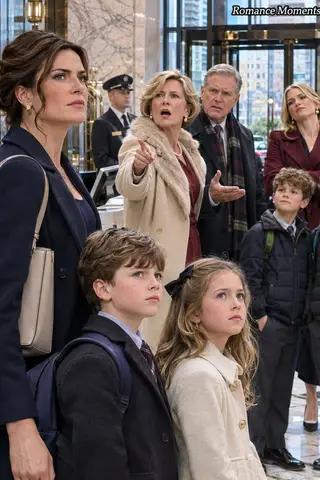
It was Marcus, head of the building’s executive security detail, flanked by two towering guards in sharp charcoal suits. And right behind them, looking bewildered and clutching their school backpacks like shields, stood Leo and Maya.
The End









