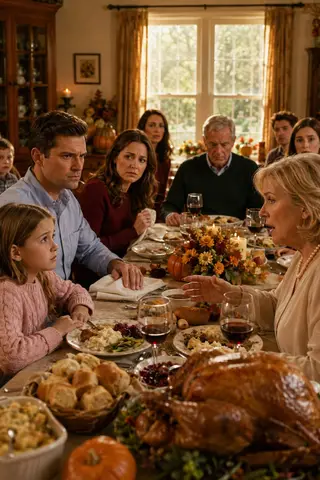
 They Built A Grandchild Wing But Left My Daughter Sleeping On The Couch
Chapter 1
The Anatomy of a Second-Class Grandchild
The drive from Harrisburg to Lancaster always felt like driving backward in time. As the strip malls and highway asphalt gave way to rolling green pastures, white fences, and looming barns, the noise of my daily life as a freight logistics manager began to fade. For most families, this route symbolized homecoming—a peaceful retreat into the warm embrace of extended family, tradition, and unconditional love. But for me, Todd, and more importantly, for my eight-year-old daughter, Norah, those ninety minutes marked the slow countdown to a familiar, quiet humiliation.
Lauren, my wife of twelve years, usually spent the first half of the drive managing logistics of her own—coordinating pie dishes, checking traffic, and running mental checklists of what her mother, Gail, expected. Lauren was caught in the eternal crossfire of a dutiful daughter trying to appease a matriarch who operated with iron-clad precision disguised as Southern-style hospitality, even though we were deep in Pennsylvania Dutch country.
"Did you pack her extra socks?" Lauren asked for the third time, adjusting her rearview mirror to check on Norah in the back seat.
"Packed, zipped, and accounted for, babe," I replied, keeping my eyes on the road. "She’s got her books, her stuffed rabbit, and her winter coat."
In the back seat, Norah was humming quietly, staring out the window at the passing cows. At eight years old, she possessed an uncanny, observant stillness. She wasn't a loud or demanding child; she absorbed her surroundings like a sponge, noticing micro-expressions, tone shifts, and unspoken rules long before adults realized she was paying attention.
And she had been paying attention to the farmhouse for a very long time.
The farmhouse itself was magnificent. A sprawling, renovated six-bedroom property with a wide porch that wrapped around the front, an oversized kitchen island that could seat ten, and endless corners for family memories. When Lauren’s older sister, Janine, started having children, Gail immediately designated the entire upper-level east wing as the "Grandchildren’s Wing." Over the years, that wing evolved into a sacred monument of favoritism.
Janine’s three kids—Olivia, Mason, and Harper—each had their own meticulously decorated bedrooms, complete with matching comforters, personalized wooden nameplates, and custom shelving. When Lauren’s younger brother, Derek, had twins, Caleb and Lily, Gail carved out another room for them, installing glow-in-the-dark stars on Lily’s ceiling and painting the walls a calming sky blue.
Every grandchild had a bed, a room, a designated space to call their own.
Except Norah.
For as long as Norah could remember, her "bedroom" at Grandma and Grandpa’s house was the beige sectional sofa in the formal living room. At first, when she was three or four, it felt like an adventure—camping out in the big room where the Christmas tree stood. We told ourselves she was too young to care. But as she grew older, the reality of the arrangement began to cast a long, cold shadow over every holiday.
I remembered the exact moment six years earlier when I first tried to address it. I had cornered Gail in the kitchen while she was rinsing celery, casually asking if we could clear out the mysterious fifth room upstairs—the one Gail always claimed was packed to the ceiling with Rich’s old woodworking equipment and heavy storage boxes.
Gail hadn’t yelled. She hadn't even looked annoyed. Instead, she had flashed a warm, society-lady smile that didn’t reach her eyes, placed a hand on my forearm, and said in a soothing whisper, "Oh, Todd, honey. It would take months to sort through all of Rich's tools and vintage lumber. Besides, Norah is such an easygoing little girl. She probably loves camping out in the living room. It’s an adventure for her."
Under the table, Lauren had squeezed my arm so hard her fingernails dug through my shirt sleeve. Her silent, desperate plea: Please don’t start.
So I didn’t start. I swallowed the bitter pill, told myself I was overreacting, and convinced myself that keeping the peace for two days out of the year was worth my dignity. I watched year after year as Norah dragged her small pink suitcase past the glorious, personalized doors of her cousins, hauling it down the hallway to the couch, where she would meticulously line up her stuffed animals on the armrest.
Gail was never overtly cruel. She handed Norah her presents, asked about her second-grade teacher, and made sure there were chocolate chip cookies in the jar. But the subtle exclusions piled up like dust. The hallway photo wall featured giant framed portraits of Janine’s and Derek’s children, while Norah’s school picture was buried in a small frame near the basement door. The cousins received handmade Christmas stockings with their names embroidered in gold thread; Norah’s stocking was a generic felt one bought off a clearance rack at a local pharmacy, missing the embroidery entirely.
Gail’s husband, Rich, was a quiet, weathered man who spent his days puttering in his workshop or watching sports with the volume muted. He played catch with Norah in the yard and slipped her extra-large peppermint patties when Gail wasn’t looking, but when it came to household hierarchy, Rich was nothing more than a ghost ship drifting in Gail’s immaculate wake. If Gail decided something was logistically impossible, Rich backed her up with a silent nod.
As we turned down the long, gravel driveway of the farmhouse, crunching over the white stones that lined the property, I felt that familiar, heavy knot tighten in my stomach. The windows of the house were glowing with warm holiday lights, smoke drifted lazily from the massive stone chimney, and cars were already parked haphazardly along the grass.
It looked like a postcard of idyllic family warmth. But as I cut the engine, I looked in the rearview mirror and caught Norah’s eye. She was staring up at the second-floor windows, her expression entirely devoid of the excitement a child should feel on the eve of a holiday.
And then, the quiet before the storm finally broke.
The End









