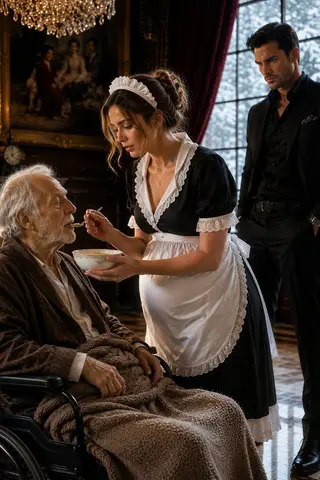
 They Abused a Pregnant Maid in the Attic, Unaware the "Silent" Old Man She Saved Was the Mafia Boss
Chapter 1
The Cold Whispers of the Moretti Mansion
The cold in the Moretti mansion didn't just chill your skin; it seeped into your bones, heavy with the stench of old money and cruel secrets. At twenty-three years old and six months pregnant, I had quickly learned that in this sprawling estate nestled deep in the snowy pine forests of Upstate New York, human empathy was a luxury no one could afford.
My hands were raw, the skin over my knuckles split and bleeding from the harsh bleach water I was forced to use daily. Every time I dipped my rag into the rusted galvanized bucket, a sharp, stinging pain shot up my arms. But I couldn't stop. I couldn't afford to take a break, not even for five minutes.
"Faster, Clara! You move like a dying snail!"
Mrs. Gable's sharp, piercing voice echoed down the marble hallway. She was the head housekeeper, a bitter woman in her late fifties with eyes like frosted glass and a heart made of flint. She stood over me, her polished black leather shoes resting inches from my trembling knees as I scrubbed the white Italian marble floors.
"I'm moving as fast as I can, Mrs. Gable," I whispered, keeping my eyes fixed on the soapy floor. "The doctor said I shouldn't bend over too quickly... because of the baby."
A cruel chuckle escaped her thin lips. "The baby? You think anyone here cares about your bastard child, Clara? You were hired to clean, not to whine. Your deadbeat boyfriend ran off and left you with his gambling debts because you're useless. If you want a paycheck to buy diapers, you'll finish this entire floor before noon, or I'll dock your pay again."
She kicked the side of my bucket, spilling filthy, freezing water all over my soaked apron and shoes. I bit my lower lip so hard I tasted copper, refusing to let her see me cry. Tears didn't work on people like Mrs. Gable. They only made them smell blood.
When Brody left three months ago, he didn't just leave me; he left me with a stack of overdue rent notices, maxed-out credit cards, and two dangerous men in leather jackets knocking on my door at two in the morning. I had no family to run to, no savings, and a precious life growing inside me. Taking this live-in maid position at the isolated Moretti estate was my absolute last resort.
The pay was pathetic, the living quarters were an unheated attic room above the garage, but it meant shelter and food for my unborn daughter.
"When you're done crying over spilled water, take this tray upstairs," Mrs. Gable commanded, shoving a silver platter onto the floor beside me. On it sat a cracked ceramic bowl filled with congealed, grayish oatmeal.
I looked up, wiping a strand of hair from my forehead. "Upstairs? To the West Wing?"
"To Old John," she sneered, tossing her head back. "The useless old bird in the room at the end of the hall. Put it on his lap. Don't waste time talking to him. He's a vegetable anyway. Just make sure he doesn't choke on it so we don't have to deal with a corpse before the boss arrives."
I picked up the heavy silver tray, my abdomen aching from the strain as I forced myself to stand. Stepping around the pool of dirty water, I made my way toward the dark, forgotten staircase leading to the third floor of the West Wing.
The estate was massive, built like a European fortress, but as I walked deeper into the West Wing, the air grew noticeably colder. The grand chandeliers gave way to dim, flickering light bulbs, and the polished hardwood floors gave way to dusty, uncarpeted hallway planks.
I stopped in front of a heavy oak door at the very end of the hall. The bronze brass knob was icy to the touch. I took a deep breath, adjusted the heavy tray in my arms, and pushed the door open with my elbow.
The room was freezing—colder than the hallway outside. Frost covered the inside of the tall, narrow windows, blocking out the winter sunlight. Sitting near the far wall, swallowed by a faded wool blanket, was an old man in a rusted wheel-chair.
He sat motionless, his head tilted slightly toward the blank plaster wall. His silver hair was long and unkempt, sticking out in messy tufts, and his sunken cheeks gave him the look of a ghost stranded in the living world.
"Hi, John," I said softly, my voice barely louder than a whisper as I stepped inside.
The old man didn't flinch. He didn't turn his head. He looked completely abandoned, forgotten by the world outside these heavy oak doors.
I placed the tray on a small side table and walked over to the tall window. The glass was so thick with frost that you couldn't see the heavy snow falling over the pine trees outside. Drawing back the heavy, dust-covered velvet drapes, I unlatched the old wooden window frame and used my sleeve to wipe away the frost.
Immediately, the bright, clean reflection of the snow filled the room.
"There," I said gently, looking back at him. "That's a bit better, isn't it? Nobody should have to look at a blank wall all day."
I approached his wheelchair carefully, kneeling down beside him so I was at eye level. Up close, I could see the faint lines around his face—not just lines of age, but lines of strength, authority, and deep, unspoken sorrow. His eyes were a pale, striking gray, staring blankly ahead.
I reached out and touched his hand. It was as cold as ice.
"They brought you cold oatmeal again, didn't they?" I murmured, looking at the grey lump on the tray. "That's not right. Nobody deserves that."
Without thinking twice about Mrs. Gable's orders, I stood up, took the bowl of gray porridge, and dumped it straight into the small wastebasket in the corner.
"I'll be right back," I told the silent old man, giving his cold fingers a gentle squeeze. "Don't go anywhere."
I snuck down to the secondary kitchen in the basement—the one used by the staff—where I had hidden my own small lunch. It was a thermos of hot minestrone soup and two slices of garlic bread I had saved from two nights ago. It wasn't much, but it was hot, rich, and filled with vegetables.
When I returned to his room, I dragged a small wooden stool next to his wheelchair. I blew on a spoonful of the hot soup and held it near his lips.
"It's minestrone," I whispered softly. "It's warm. Try a little bit, John."
For a long moment, he didn't move. I wondered if he even heard me, or if his mind had long since checked out of his broken body. But just as I was about to lower the spoon, his pale gray eyes slowly shifted.
He didn't look at the food. He looked directly into my eyes.
And in that brief, quiet second, I felt a shiver run down my spine—not from the cold room, but from the sudden, powerful intensity hidden beneath his silent glaze.
The End









