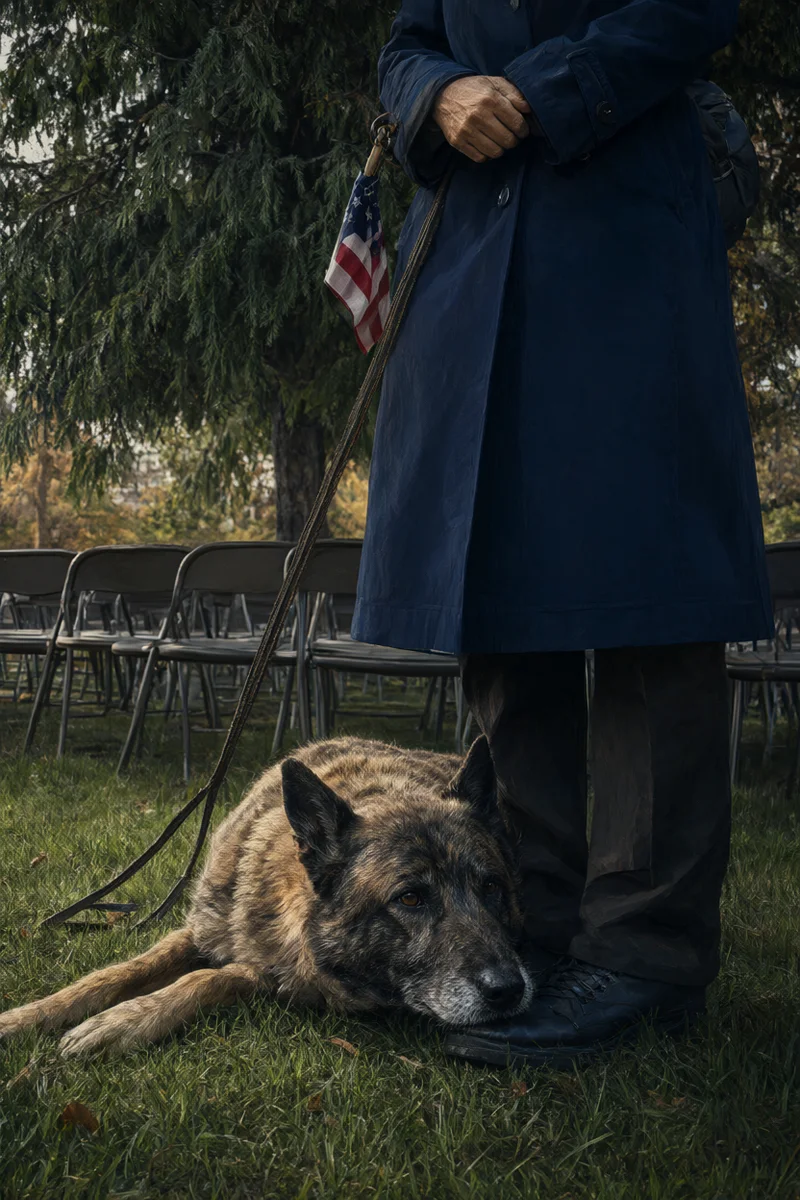
 The Sergeant's Dog
Chapter 3
The Ninth of June
Marian could have recited it in her sleep. She had dusted that frame every week since he hung it.
“For valor on the ninth of June, 2017,” she said. “Following the detonation of an explosive device, Sergeant First Class Rudd, with disregard for his own safety, carried a wounded soldier four hundred metres under fire to the casualty collection point.”
“That's accurate,” Cory said. “I was the soldier. It was four hundred metres and he didn't put me down once. I want you to have that before the rest.”
Somebody had started stacking chairs at the far end of the hall. Tully sighed and resettled across her feet.
“Battalion wrote that citation. The Sergeant wrote his own witness statement the same night, and I've read it, because he gave me a copy. I'll tell you what it says.” She told it flat, like a report.
A route-clearance patrol on a district road. A walled compound with an iron gate standing open. Tully out front on a long lead, working the verge. Rudd behind them on the radio, in an argument with company about why the patrol was forty minutes behind schedule.
“Tully's alert was to lie down. No barking, no pawing. He'd find it, drop flat and stare at it. And when he dropped, my left fist went up, and everybody behind me was supposed to turn to stone.”
“His statement says Tully lay down at the gatepost and my fist went up, and that he had his head turned, arguing, and walked straight past both of us. Three steps past. It says Specialist Vance left her dog, ran forward, got a hand in the drag strap on the back of his vest and hauled him off his feet. Then it went off.”
Caleb had stopped looking angry. He was looking at her left shoe.
“Below the knee,” she said, as if he'd asked. “And the hearing on this side. Tully took metal in the shoulder. The Sergeant had a nosebleed.” The corner of her mouth moved. “He never forgave that nosebleed.”
Marian found she had sat down in the next chair.
“He tried to turn the award down. They told him the platoon had lost enough that month and needed something to be proud of. So he took it home and hung it where he'd have to see it, and I think that was the point.”
“Nine years,” Marian said. “He let me polish it.” Cory did not dispute this. “And the dog?”
“Tully wouldn't work for anybody after. They retired him that winter. I was six months into rehab by then, living on a third floor, learning stairs. I couldn't keep a dog. The Sergeant put in his own papers and said he'd hold on to him till I was on my feet.” A short breath that was nearly a laugh. “He heard it as soon as he'd said it. I didn't let him off, either.”
Caleb crouched and put out his hand toward Tully's collar. The growl came up at once, low and steady. “Af,” Cory said, and it stopped.
Caleb stood. His jaw was working. “You're not taking him. I don't care what he did for you or you did for him. That's the last thing in that house that's still my dad's.”
“I didn't come to take him.”
“Then why won't he get out of your car?”
Cory didn't answer that. She turned to Marian.
“Before anybody decides anything, look at his papers. The adoption file. He'd have kept it somewhere fireproof; he was like that.” She folded the empty paper plate in half, and then in half again. “I'd sooner you got it from him than from me.”
The End









