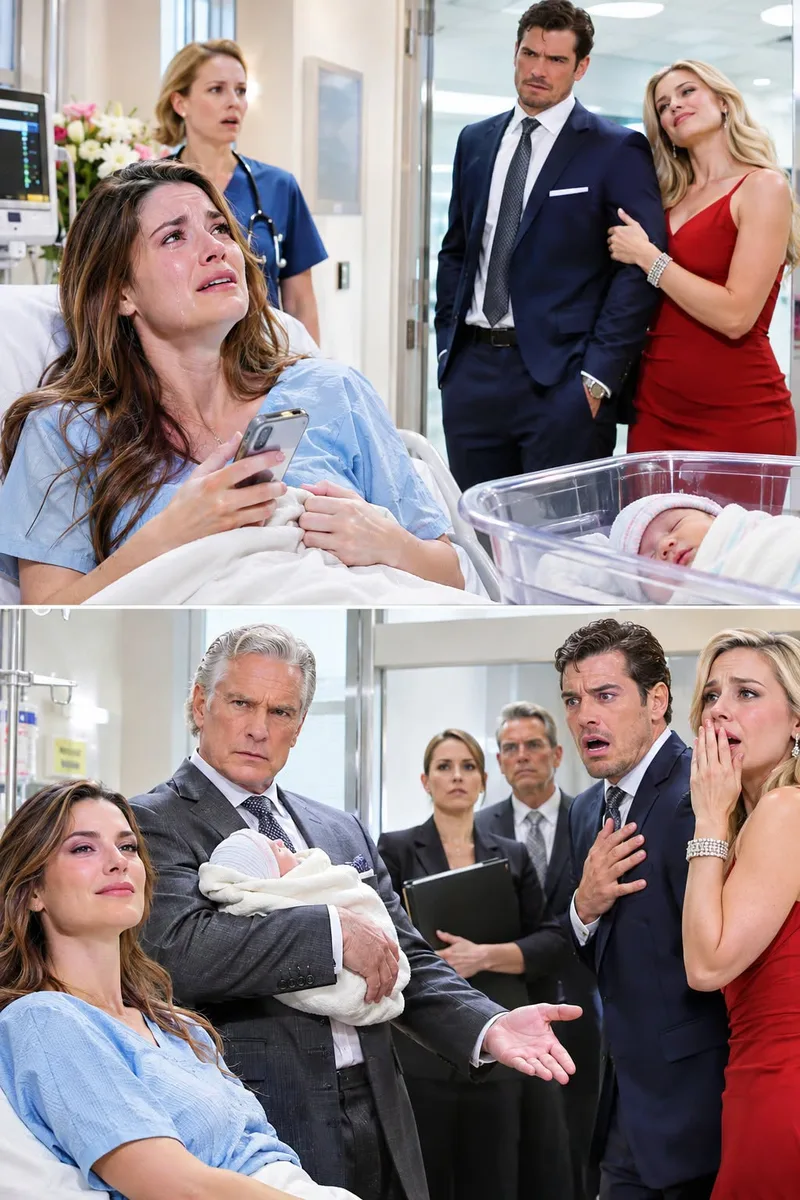
 The Night My Husband Abandoned Our Daughter's Birth, He Found His Billionaire Boss Holding Her
Chapter 2
The Morning He Asked the Wrong Question
At dawn I woke to the sound of Leah fussing in her bassinet. A nurse helped me sit up and checked how I was recovering. The bleeding had been controlled, but I was sore, exhausted and frightened by how abruptly the previous night had changed. Leah needed to feed, and I needed more patience with my body than I could easily summon.
When the pediatrician arrived, I wrote down the update and asked what signs should prompt a call after discharge. There were clear instructions and some things the team would continue watching. I preferred that honesty to a promise that nothing could go wrong.
Dad returned with a sandwich I couldn't yet imagine eating. He had slept for an hour in a waiting-room chair. I asked whether he'd contacted anyone at Sterling Global. He said he had told the company's legal and personnel teams that a potential issue involving a senior officer might require review and that he would not direct the outcome because of his personal connection.
He hadn't forwarded Vanessa's message or ordered Daniel dismissed. I thanked him, knowing that allowing other people to investigate could be more responsible than using the power to pronounce judgment himself.
Daniel asked for a call. I agreed to ten minutes with Dad out of the room and a nurse nearby if I needed assistance. When his face appeared on the screen, his first words were, "Why did you hide that Richard Sterling is your father?" He looked pale and rumpled.
I had seen that expression at the end of exhausting workweeks, and once it would have made me offer comfort before discussing anything else. Today I asked him why he hadn't answered his phone while I was in labor. He looked away.
"I didn't think it was an emergency," he said. I reminded him of the calls, the photograph from the rooftop and Vanessa's message. "I started bleeding," I told him. "Rebecca called the doctor. You weren't here." Daniel said he had believed I was overreacting because I'd been anxious late in pregnancy.
I asked whether he had spoken to a doctor or returned even one call to find out. He had not. The silence after that admission lasted longer than the apology he finally offered.
Then he returned to my father. "You let me make a fool of myself in front of him for seven years." I stared at the screen. He seemed to believe my private family history was the cause of his public humiliation. "You made decisions without knowing whose daughter I was," I said.
"That is the only reason you think the answer should have been different." Daniel protested that I was twisting his words. I told him the call was over and ended it when he tried to continue.
Dad found me crying afterward. He asked whether I wanted to tell him what happened. I gave him the short version and asked him not to call Daniel. It wasn't a kindness toward my husband. It was a way of refusing the familiar pattern in which one powerful man spoke for me to another.
Dad sat beside me while I watched Leah sleep. He did not ask for names or details. When I was ready, he brought the sandwich closer and reminded me to eat what I could.
That afternoon Rebecca helped me walk a short distance and return to bed safely. She praised the progress without suggesting I should be stronger or less upset. A hospital social worker checked my proposed discharge arrangements and asked whether I wanted information about family-law advice. I said yes.
I didn't know whether I wanted a divorce, but I did know I couldn't return to our old routines and pretend the photographs were a misunderstanding. The social worker gave me contact information for independent legal assistance.
I had kept my connection to Dad private partly because I believed Daniel should love me without knowing what influence I possessed. Looking at the marriage now, I saw how that secret had helped me avoid a harder conversation. Daniel knew I came from money, yet I had allowed him to speak as though I contributed nothing because I didn't want to explain why he was wrong.
I had thought refusing to use wealth would protect us from its power. It had also allowed me to hide my own fear of conflict behind the idea of fairness.
I discussed that realization with Dad. He told me I had never needed to justify my worth with his balance sheet. I said that was true, but I had also stopped asking for ordinary respect whenever Daniel called me ungrateful. Dad didn't tell me I should have left earlier.
He asked what I wanted now. I answered that I needed several days without Daniel deciding what I should think, and a place where Leah could settle while I recovered. Dad offered his guest suite. I said I would consider it if he agreed not to treat it as permission to manage my life.
Daniel sent flowers with a card that mentioned the birth but not Vanessa. I accepted the flowers because there was no reason to make the nurses return them, then asked that future deliveries be cleared through the desk. A few hours later he requested a visit. I replied that I would consider an appropriate, scheduled meeting once I had spoken with the care team and understood the arrangements.
It was not an indefinite ban on his role as Leah's father. It was an acknowledgment that my recovery and our daughter's medical care were not items he could settle by arriving unannounced.
That night Dad stepped out to take a call from the company's counsel. When he returned, he said a review of Daniel's conduct at work would be handled through normal procedures and that he would remain separate from decisions involving his son-in-law. He didn't know what the result would be.
I was glad. For the first time in years, uncertainty did not feel like a weakness I needed someone else to correct. It felt like the truth, and I could make choices inside it without pretending I knew the ending.
The End









