 The Motel Manager Kept Room 7 Empty Every Thanksgiving For 18 Years
Chapter 2
The Stranger in the Sleet
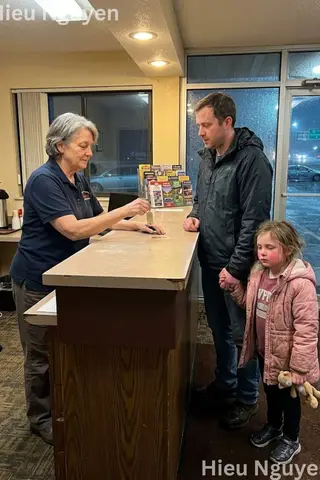
"What’s your name, sweetheart?" Diane asked, her voice softening into a maternal warmth that caught even Melissa off guard.
The little girl blinked against the harsh indoor light, her small fingers clutching the fabric of her father’s wet jacket. "Lucy."
Her father tightened his arm around her, his shoulder slumping in a defeated posture that spoke of a man at the absolute end of his rope. "I’m Ben. We were heading to my sister’s place outside St. Louis for Thanksgiving dinner. Never made it. Our car slid into a ditch about six miles back when a semi cut us off. A state trooper helped us get a tow truck, but when we got to the garage, the mechanic said the radiator cracked clean through."
Ben swallowed hard, his Adam’s apple bobbing painfully. He looked down at the linoleum floor, unable to meet Diane's eyes. "We tried three other places on the strip before this one. All booked solid. One motel manager wouldn't even open the glass door—just shook his head and pointed at a 'No Vacancy' sign."
Little Lucy tugged gently on her father’s wet sleeve, her voice trembling slightly. "Dad, it’s okay. We can sleep in the car. We've got the wool blanket from the trunk."
Ben closed his eyes for a second, a silent agony washing over his features. "No, honey. We can't. It's too cold."
Hearing those words, Diane felt something deep inside her chest crack open. The thirty intervening years since her own dark night vanished in a single, blinding flash.
She wasn't standing in a warm motel lobby in Missouri anymore. She was thirty-four years old once again, sitting behind the wheel of a sputtering, rusted-out sedan with forty-three dollars in her purse, a tank of gas on empty, and a purple bruise she was desperately trying to hide beneath the high collar of her wool coat.
She had fled her home that afternoon on Thanksgiving Day. Not because she had a destination, a savings account, or a backup plan. She had left because she finally realized that the terrifying unknown of the open road was safer than staying another hour in a house where fear ruled the living room.
Her son had been nine years old back then. Her daughter had been six. They had driven for three agonizing hours through a freezing drizzle while Diane forced herself to sing silly radio songs so her children wouldn't hear her weeping behind the steering wheel.
By evening, the drizzle had turned to heavy sleet. Her car’s engine had started making a terrible, metallic screeching sound, billowing white steam from under the hood just as she caught sight of a neon sign flickering through the gray blur: STARLITE MOTEL.
She had pulled into the gravel lot, turned off the engine, and sat in the dark for five full minutes, paralyzed by the realization that she had nowhere else to go in the entire world.
She remembered walking through those exact glass doors, holding both of her children’s sticky, cold hands so tightly their knuckles turned white. The man behind the desk back then hadn't been her. It had been a widower named Walter. He was seventy years old, with thinning gray hair, thick tortoise-shell glasses, and a brown cardigan sweater that was buttoned crookedly, one side riding higher than the other.
Diane remembered asking him the price of a single room for the night. She remembered opening her worn leather wallet, pulling out her last few crumpled bills, and staring at them under the harsh fluorescent light. She did the math in her head with a sinking horror: if she paid for the room, she wouldn't have enough money for gasoline and breakfast the next morning. If she bought gas, her children would sleep in a freezing car parked behind a 24-hour diner.
"I’m sorry," she had whispered back then, her voice hollow and defeated. She had gathered her children’s small coats around their shoulders and turned toward the freezing night outside.
Walter had stopped her with a single, sharp word. "Where do you think you're going?"
"We'll... figure something out," she had lied.
Walter had looked down at her terrified son and daughter. Then, without a word, he had reached beneath the cluttered wooden counter, his hand disappearing among old receipts and ledger books, before pulling out a heavy, tarnished brass key with a small, yellowed plastic tag dangling from a rusted ring.
The number stamped into the plastic was stark and clear: 7.
The End









