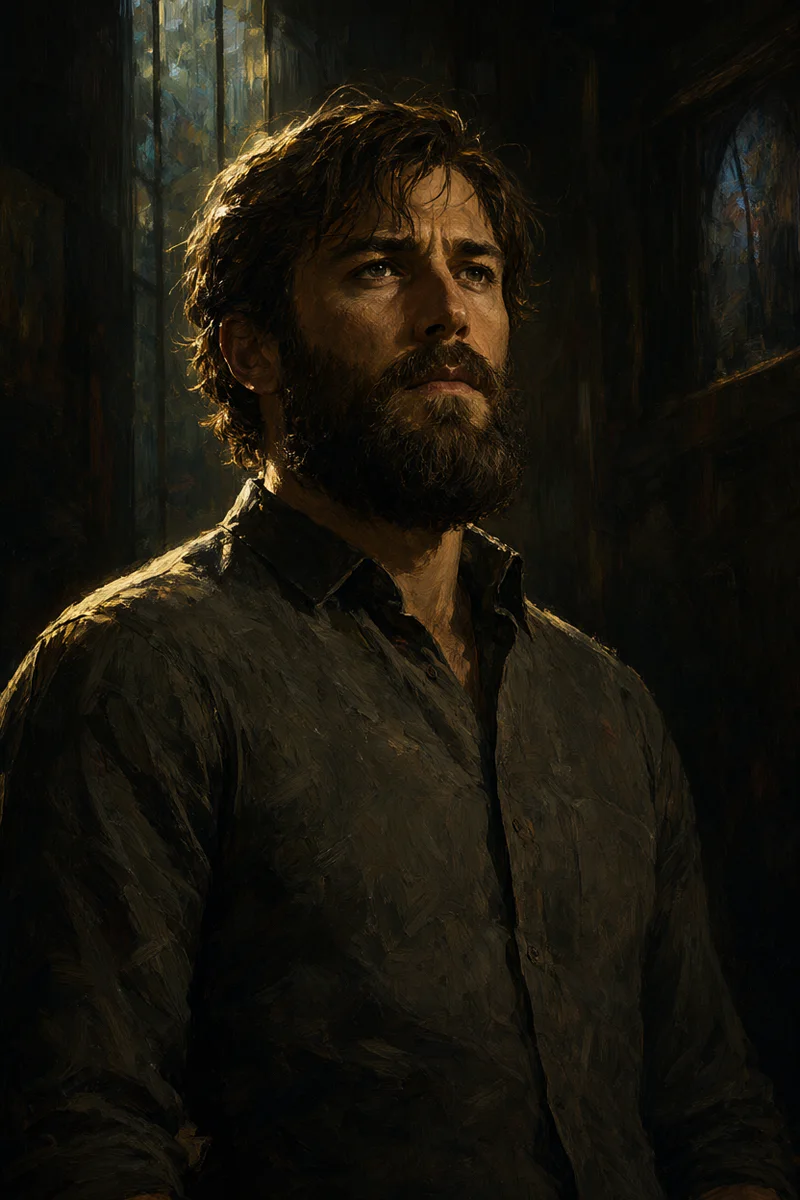
 The Millionaire Drew the Line at the Street Child
Chapter 3
The Ghost in the Equations
That evening, our penthouse apartment felt colder and emptier than usual.
While Sophie sat cross-legged on the plush living room rug, completely absorbed in the dog-eared algebra textbook Maya had left behind, I sat at my minimalist glass desk in the home office. Spread out before me were not financial spreadsheets, but a single sheet of paper where I had copied down some of the mathematical symbols Maya had scratched into the concrete earlier that afternoon.
I am no slouch when it comes to numbers. My undergraduate degree from Northwestern was in applied mathematics before I transitioned into finance and venture capital. Yet, as I stared at the geometric progressions and recursive number theory notes I had hastily jotted down in my notepad, my mind hit a brick wall.
It wasn't standard high school math. It wasn't even standard undergraduate coursework. It was a hybrid of topological number theory and algorithmic pattern recognition—the kind of advanced theoretical math typically researched by doctoral candidates at institutions like MIT or Stanford.
"Who are you?" I murmured to myself, tapping my pen against the glass desk.
My phone buzzed against the surface. It was Marcus, my chief of security and private investigator whom I kept on a permanent retainer for corporate due diligence.
"Boss," Marcus’s gravelly voice came through the speakerphone. "I ran the description you gave me through our downtown transit cameras and local shelter databases. It wasn't easy tracking a teenager in an oversized coat, but we got a hit on a facial recognition ping near the Wabash Avenue transit hub about an hour ago."
"Did you find her?" I asked, leaning forward, urgency creeping into my voice.
"We found where she spends her nights, or at least where she hangs out," Marcus said, sounding hesitant. "Harrison, you're not going to like this. She doesn't go to a traditional shelter. According to our street contacts, she’s been squatting in an abandoned industrial warehouse down near the Chicago River—the old rail yards off Cermak Road. The place is condemned. Unsafe structural integrity, no heat, no electricity."
My grip on the edge of the desk tightened. A brilliant young mind—someone who could effortlessly teach advanced topology to an eight-year-old—living in a condemned warehouse in the freezing Chicago autumn.
"Why isn't she in the foster system?" I demanded. "Where are her parents?"
"That's where things get weird," Marcus replied, rustling papers on his end of the line. "I ran her face through missing persons databases across Illinois, Indiana, and Wisconsin. Zero matches. No social security number pinged in the last three years. It’s like she doesn't exist on paper. But here’s the kicker, boss—while running her facial biometrics through our proprietary database, I cross-referenced her facial structure with historical records from local university archives."
I paused, holding my breath. "And?"
"Ten years ago, there was a brilliant professor of theoretical mathematics at the University of Chicago named Dr. Arthur Vance," Marcus said slowly. "He published groundbreaking papers on non-Euclidean geometry and cryptographic number theory. Tragically, he and his wife died in a mysterious residential fire when their daughter was just six years old. The file was sealed by the city because of ongoing civil litigation involving patent disputes with a major defense contractor."
A chill swept through my office. "What was his daughter's name?"
"Maya Vance," Marcus said clearly. "She would be seventeen years old today."
I sat back in my leather chair, the blood roaring in my ears. The pieces of the puzzle began violently slamming together in my mind, forming a picture far darker and more complex than I could have ever imagined.
If Maya Vance was the daughter of a brilliant, deceased mathematician, why was she living on the streets in an abandoned warehouse? Why was her existence scrubbed from official records? And what did her brilliant, fractured mind have to do with the corporate defense contracts her father was working on before he died?
"Marcus," I said, my voice dropping to a hard, cold whisper. "Get the car ready. We're going to Cermak Road."
The End









