 Him First, Doc
Chapter 5
What She Always Said
Renske knelt down beside the wheelchair, so that their faces were level. It was the way she had knelt in a ditch fourteen years ago, and in a puddle of pickle brine two weeks ago.
She took the slip of paper out of her coat pocket and put it in Ottilie's hands. Then, because the old woman's eyes might not manage the faded pencil, she said it out loud.
“He said, tell Mom I wasn't scared. Tell her I did what she always said.”
Ottilie Quist looked down at the paper. Her thumb moved over the writing, very slowly, back and forth.
“And there's more,” Renske said. “There's something I should have told you a long time ago, and I'm sorry I didn't. There were two of them hurt, Ray and Sergeant Rask. I was going to go to Ray first. Ray stopped me. He told me to help Nolan, because Nolan's babies were coming. And I did what he said. I don't know if it would have changed anything. I'll never know. But it was his choice, and I wrote it down as mine, and you deserved to know it was his.”
Behind her she could hear Nolan breathing. She could hear the river under the bridge, and the band packing up their instruments, a trombone case snapping shut.
Ottilie was quiet so long that Renske began to think she had not understood.
Then the old woman laughed. It was a small, cracked sound, and her eyes were running, and she was laughing anyway.
“Let the other fellow go first,” she said. “That's what I always said. Every time. At the dinner table, at the door, at the water fountain at church. He used to roll his eyes at me so hard I thought they'd stick.” She pressed the paper flat against her knee. “Let the other fellow go first, Raymond. And he did. My stubborn boy. He finally did.”
She reached out and took Renske's face between her two hands. Her palms were dry and very light.
“You carried that for fourteen years,” she said. “Because you thought I'd hate you for it.”
“Yes, ma'am.”
“Well, that was foolish.” She patted Renske's cheek twice, not gently. “It was never yours to carry. It was his, and I'll take it from here. Now get up off your knees, dear. The grass is wet.”
Nolan's twins were born two months after he came home. Their names were Harriet and Raymond, though everyone called them Hattie and Ray. Renske met the boy that afternoon by the bridge railing. He was thirteen, all elbows, and he played the harmonica, badly, and did not seem to know there was anything remarkable about this.
Pascal got along with him at once.
In November, Renske called the VA and made an appointment with a counselor, and this time she went back for the second visit, and the third.
In December she filed a sworn statement with the Army's board for correction of records, three pages long, describing exactly what had happened on a dirt road on a night in 2012. Nolan filed another. They asked that the record of Specialist Raymond Quist's death be amended to show that his final act had been to direct medical care to a wounded comrade at the cost of his own. It took eleven months. The answer came the following autumn, in a plain envelope, with a citation attached.
Ottilie Quist did not live to see it. Renske drove it to Bramwell Falls herself and read it out loud at her grave, with Nolan and Pascal and both of the twins standing behind her.
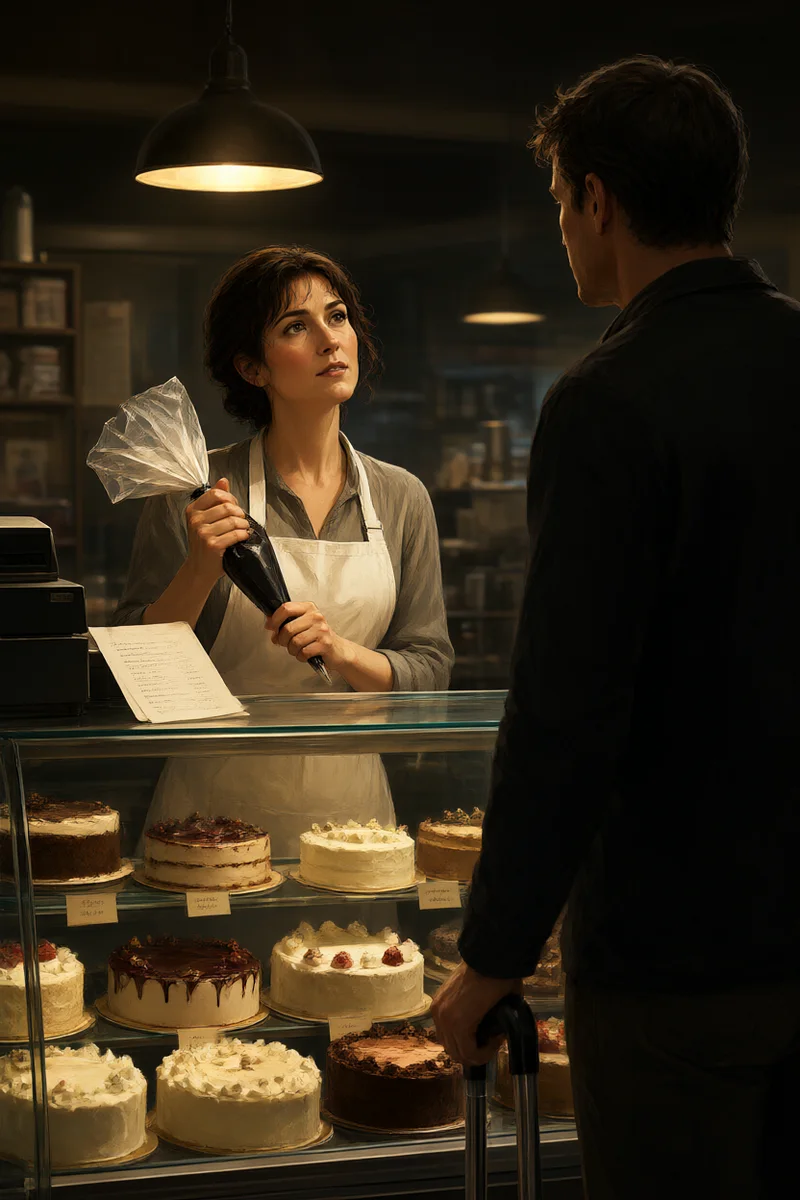
On the way home she stopped at Corley's. She had a cake to finish for the morning, a birthday, chocolate, ten inches.
She piped the name on in blue script and made a rose in each corner. Squeeze, turn, lift.
The End









