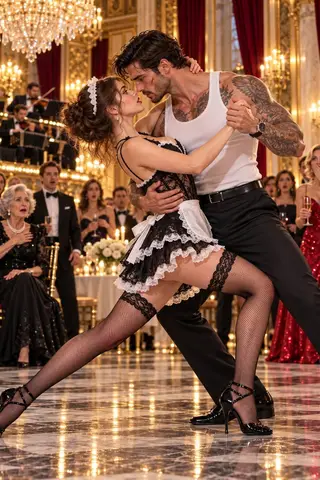
 The Maid’s Secret Tango: How a Humiliated Housekeeper Stunned Chicago’s Most Feared Mafia Boss and Exposed His Family’s Darkest Lie
Chapter 2
The Melody of Memory
The evening progressed through layers of suffocating luxury. Waiters in pristine white jackets circulated through the sea of guests, offering hors d'oeuvres laced with truffle oil and caviar, while string quartets played classical arrangements designed to soothe the sophisticated ears of Chicago's elite.
I stayed near the perimeter, hiding behind a massive marble pillar, using a damp sponge to scrub at the faint pink stain dried into the back of my gray uniform. Every movement felt stiff. My feet throbbed inside my flat, cheap shoes, screaming in protest after fourteen hours of continuous standing, walking, and bowing.
At precisely ten o'clock, the lights in the main crystal chandelier dimmed slightly, casting a dramatic golden glow over the central dance floor. A ripple of whispers washed through the crowd as Grant Whitmore stepped up to the mahogany podium set against the eastern wall. He didn't use a microphone; his natural voice—deep, resonant, and effortlessly commanding—carried easily across the cavernous room, immediately silencing the two hundred wealthy guests.
"Ladies and gentlemen, distinguished partners, and friends," Grant began, his dark eyes sweeping over the crowd with absolute confidence. "Forty years ago, my grandfather built Whitmore Reserve on a simple promise: that power belongs to those who take it, and loyalty belongs to those who survive it. Tonight, we celebrate that legacy. But more importantly, we look forward to a future where our grip on this city becomes absolute."
Polite, thunderous applause erupted. People smiled, clinked their glasses together, and nodded in reverent agreement. To them, Grant was a modern king—untouchable, ruthless, and magnificent.
Beside him, Vanessa beamed, resting her hand possessively on his forearm like a trophy wife claiming her prize.
"And now," Grant continued, his lips curving into a slow, predatory smirk that made the hairs on the back of my neck stand up, "to mark the official opening of the ballroom floor, let the music begin."
The string quartet lowered their violins, stepping back to make way for a special guest ensemble that had been flown in from Buenos Aires: a traditional Argentine tango orchestra.
The moment the first notes drifted through the air, my breath caught in my throat.
It wasn't just music. It was a physical blow to my chest.
It was a bandoneon—a melancholy, passionate accordion-like instrument that wept and groaned with every squeeze. The melody swelled, sharp and rhythmic, carrying a fiery syncopation that had not been heard in Chicago’s high-society circles in decades.
Instantly, the sterile, glittering ballroom vanished. The crystal chandeliers blurred into streaks of light, and I was no longer standing in a stained housekeeping uniform.
I was back in the warm, dust-motes-filled studio of the Brooks Dance Studio on the south side.
I could smell the polished wooden floors, the faint scent of lemon wax, and my father’s aftershave. I could see him clearly: Daniel Brooks, wearing a crisp white shirt with the sleeves rolled up to his forearms, his silver-streaked hair catching the afternoon light as he moved with effortless, breathtaking grace.
Every Saturday morning, before the bills piled up and before the studio was forced into bankruptcy by aggressive corporate buyouts—buyouts orchestrated, as I would later discover, by the Whitmore conglomerate—my father would teach me how to dance.
His voice echoed softly in my memory, cutting through the heavy, oppressive atmosphere of the present:
“A good tango isn't about controlling someone, sweetheart,” he would say, adjusting my posture with gentle, calloused fingers. “It's about listening to the space between the beats. It’s about balance. A true dancer never loses their footing, no matter how fast the world spins around them.”
My feet twitched involuntarily against the marble floor.
Heel.
Toe.
Weight shift.
Pause.
It was muscle memory burned deep into my bones, a secret language passed down from a father who had loved art more than money, in a city where money was the only god anyone worshiped.
I closed my eyes, letting the complex rhythm wash over me, completely forgetting where I was—forgetting the staring guests, forgetting the stained uniform, forgetting the crushing weight of poverty.
I made a single, sharp pivot, my foot sliding smoothly across the floor in a flawless corte.
"Well, well, well," a sharp, venomous voice pierced my trance. "Look at the little maid. The cleaning rag thinks she’s a ballerina."
My eyes flew open.
Vanessa Hale was pointing directly at me, her red lips curled into a cruel, mocking sneer. She had caught my brief movement while turning away from Grant.
Instantly, dozens of heads snapped in my direction.
The low hum of conversation died away, replaced by dead silence. Two hundred pairs of wealthy, judgmental eyes locked onto me. Some people chuckled behind their champagne flutes. Others rolled their eyes in sheer disgust at the audacity of a servant daring to move her body to high art.
My cheeks burned as if someone had pressed a hot iron to my skin. Panic flared in my chest, hot and suffocating. I gripped my silver tray so hard my knuckles turned ghostly white.
Run, every survival instinct screamed. Drop the tray and run to the service stairs before they destroy you.
I turned on my heel, ready to flee into the kitchens and pack my meager belongings.
But a heavy, solid body blocked my path.
I slammed gently into a wall of dark wool and expensive cologne. I looked up slowly, my breath hitching in my throat.
Grant Whitmore was standing right in front of me.
He hadn't walked away; he had strolled over, his champagne glass swirling lazily in his hand, a look of amused cruelty playing across his handsome, ruthless face. The crowd parted around him like worshipers clearing a path for an emperor.
"Going somewhere, sweetheart?" Grant asked, his voice dripping with condescension. He looked down at my gray uniform, letting his gaze linger deliberately on the wine stain across my shoulders. "Wait. What's your name again?"
My throat felt dry as dust. I swallowed hard, forcing my voice to remain steady.
"Emily, sir."
Grant turned to the crowd, flashing a dazzling, charismatic smile that made several socialites sigh audibly. He raised his voice so that every single person in the cavernous ballroom could hear every mocking syllable.
"Emily," he repeated, rolling the name around on his tongue as if tasting something cheap and amusing. Then, he looked back down at me, his dark eyes sparkling with a wicked, sadistic challenge.
He extended his right hand, palm up, right beneath my face.
"Dance this tango with me, Emily," Grant laughed, his voice ringing out across the silent room like a public executioner's bell. "If you can actually dance it without tripping over those pathetic shoes... I'll marry you."
The End









