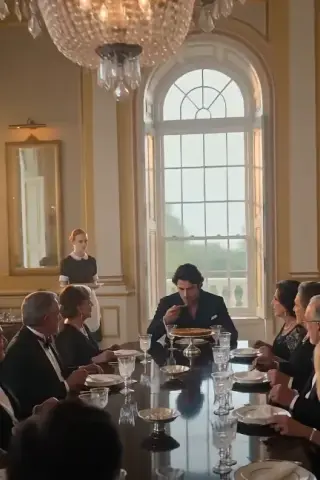
 The Mafia Boss Demands to Know Who Baked the Pie
Chapter 1
The Ghost in the Kitchen
The first time Carmine Orsini truly noticed Nell Brisco, she was standing three feet from him holding a silver tray while fourteen wealthy people pretended she did not exist. Then he took a bite of pecan pie, and the entire room changed forever. It was a cold December evening in New Orleans, the kind that turned the ancient oak trees of the Garden District into black silhouettes against the yellow glow of tall mansion windows. Inside the Orsini estate, warmth gathered beneath enormous crystal chandeliers. White linen covered the polished mahogany dining table. Crystal glasses reflected candlelight. Silverware rested perfectly aligned beside porcelain plates that cost more than most families spent on groceries in a month. At the head of the table sat Carmine Orsini. Thirty-three years old. Dark-haired. Controlled. And feared for something far more unsettling than anger: patience. Carmine rarely raised his voice. He had learned from his father that shouting was often a confession of weakness. Instead, he listened. People filled silence when they were nervous, explaining things nobody had asked them to explain, completely exposing themselves. Four years earlier, Carmine's father had died and left him responsibility for a sprawling network of legitimate companies—trucking firms, construction businesses, warehouses along the Mississippi, restaurants, property holdings—and several other operations respectable families preferred not to discuss. Carmine had inherited enemies with the businesses, but he had also inherited a household that functioned with military precision. Twenty-two years of that precision belonged to Odette Pruitt, the Orsini housekeeper. Odette could remember which guest preferred sparkling water, which senator hated mushrooms, which relative required a downstairs bedroom, and which employee had arrived thirty seconds late three Tuesdays earlier. People did what Odette told them, including Nell Brisco. Nell had worked inside the mansion for three years. She cleaned rooms, polished silver, changed linens, carried laundry, and served meals when necessary. She rarely spoke. Her plain gray work uniform seemed designed to make her disappear against the estate's cream-colored walls. That evening, Carmine had seen her at least six times without actually seeing her at all. Until dessert. He cut another piece of pecan pie, chewed slowly, and stopped. His grandmother Palmira noticed before anyone else did. Palmira Orsini was seventy-eight years old, silver-haired and sharp-eyed, possessing the dangerous freedom of someone too old to be intimidated by anyone, including her grandson. She watched Carmine take another bite. A tiny smile appeared at the corner of her mouth. “If the mixture is too warm, the eggs begin setting before the filling reaches the shell. It turns grainy. If it cools too much, the sugar thickens and doesn't spread evenly.” The room had become completely silent. This was no longer a conversation about pie, and everyone knew it. Nell knew it too. Carmine rested his forearms lightly against the edge of the table. “Where did you learn that?” For the first time, her composure shifted. Only slightly. Her gaze dropped. “My mother.” “Your mother taught you to count exactly seven minutes?” Nell stood. “If you'll excuse me, Mr. Orsini, the third floor still needs finishing.” Odette immediately moved toward her, but Carmine raised one finger. Nell paused. “There is another pie downstairs,” she said quietly. “If your guests want more.” Then she took the tray and disappeared through the service door. For several seconds, nobody spoke. Palmira cut herself another slice. “That girl didn't learn baking from somebody's recipe card.” Carmine looked toward the closed door. “No.” Palmira studied him. “And you didn't ask about the pie because you wanted culinary advice.” Carmine said nothing. His grandmother smiled. “You've started wondering who she is.” Across the table, Odette quietly rearranged dessert plates. But Carmine noticed something else. Her hands were trembling. The next morning, he called Benny Romano. Benny had served as head of security for the Orsini family for eleven years. He was fifty-one, broad-shouldered, permanently unimpressed, and one of the few men who could walk into Carmine's private office without knocking. “I want the personnel file for Nell Brisco.” Benny raised an eyebrow. “The maid?” “Yes.” “What did she steal?” “Nothing.” “What did she break?” “Nothing.” Benny stared. “Then I'm afraid you've confused me.” “She made a pie.” Benny waited. When Carmine offered nothing more, he sighed. “I'll find the dangerous dessert criminal.” The file arrived before noon. It was thin. Too thin. Nell Brisco. Twenty-seven years old. Housekeeping. Two previous cleaning jobs. No college history. No professional training. No emergency contacts except one name: Emmett Brisco, father. Carmine turned the page, then stopped. A legal surname change. Three years earlier. Original name: Eleanor Fontaine. He read it twice. Benny sat across from him. “That got my attention too.” The next page contained a newspaper article about Fontaine Bakery destroyed in an overnight fire. Carmine leaned closer. Fontaine Bakery had operated on Magazine Street for nineteen years. Owner Emmett Fontaine suffered severe smoke inhalation and neurological damage. His daughter Eleanor Fontaine, twenty-four, served as head baker. Investigators concluded that an industrial oven had been left running overnight. Negligence. Insurance denied. Civil claims followed. The building was lost. Debts consumed what remained. Eleanor Fontaine disappeared from public business records months later, transforming into Nell Brisco. Carmine found a photograph attached to the article. A younger Nell stood outside a red-brick storefront wearing a white baker's apron, flour marked on one cheek, her hair loose around her shoulders. Beside her stood an older man—her father—holding a tray of pastries, both laughing. Carmine stared, barely recognizing the woman. There was another article: a local food writer had once called Fontaine Bakery's pecan tart “the best forgotten treasure in the city.” Carmine turned another page to the official fire report: kitchen ignition source, industrial oven, combustible material, probable negligence. Then one sentence caught his attention. Rear exit unable to open during emergency evacuation. Carmine read it again. “Why couldn't it open?” Benny shrugged. “Report doesn't say.” “Was it blocked?” “Doesn't say.” “Damaged?” “Doesn't say.” “Locked?” “Doesn't say.” Carmine looked back at Nell's photograph. A woman who measured seven minutes because the difference mattered had supposedly forgotten to shut down industrial equipment inside the bakery where she had worked nearly every day since childhood. Possible. People made mistakes. But the rear door bothered him. “Find the investigator who signed this.” Benny leaned forward. “Why?” Carmine closed the file. “Because somebody wrote six pages about a fire and forgot to explain the only door that could have saved two people.” Benny studied him for a long moment. “You think the fire wasn't accidental?” “I think I don't know.” “And when you don't know?” Carmine's eyes returned to the old photograph. “I ask questions.” That afternoon, Nell polished the banister on the second floor. She was halfway down the staircase when Odette appeared below. “Mr. Orsini wants you in his office.” Nell froze. The cloth in her hand stopped moving. “Why?” Odette's expression was unreadable. “He didn't say.” Nell descended slowly. Each step seemed louder than the last. Carmine's private office was at the rear of the house. The door stood open. She entered. He was alone. A file rested on his desk. Nell saw the corner of the old newspaper clipping, and all the color disappeared from her face. Carmine noticed. “Nell.” She remained standing. “Or should I call you Eleanor?” Silence. Her fingers tightened around the cleaning cloth. Carmine turned the old photograph toward her. For several seconds, she stared at the smiling young woman she used to be. Then she whispered: “Where did you get that?” “Your personnel file.” “That wasn't supposed to be there.” “Why?” Nell looked toward the door. “Because that woman doesn't exist anymore.” Carmine stood. “You changed your name after the fire.” “Yes.” “Why?” “So people would stop finding me.” “Who?” Nell's breathing changed. Carmine saw fear now. Real fear. Not of him. Of something else. He softened his tone. “Who were you hiding from?” She shook her head. “I shouldn't have made that pie.” “This wasn't about the pie.” “It started because of the pie.” “Nell.” She backed toward the door. “Please, Mr. Orsini. Let this go.” “Was the fire an accident?” Her eyes lifted to his. And in that instant, Carmine had his answer. Not proof, but an answer. “No,” she whispered. Then she added something that made Carmine's expression harden. “My father tried to tell the investigator.” Carmine stepped closer. “What did he say?” Nell swallowed. “He said someone chained the rear door from the outside.” And before Carmine could respond, Benny appeared in the doorway holding his phone. “Carmine.” Something in Benny's voice changed the air. Carmine looked at him. “I found the fire investigator.” Nell went completely still. Benny glanced at her, then back to Carmine. “He disappeared six months after the Fontaine fire.” Carmine's eyes narrowed. “Disappeared?” Benny nodded. “And three days before he vanished, someone deposited eighty thousand dollars into his wife's bank account.”
The End









