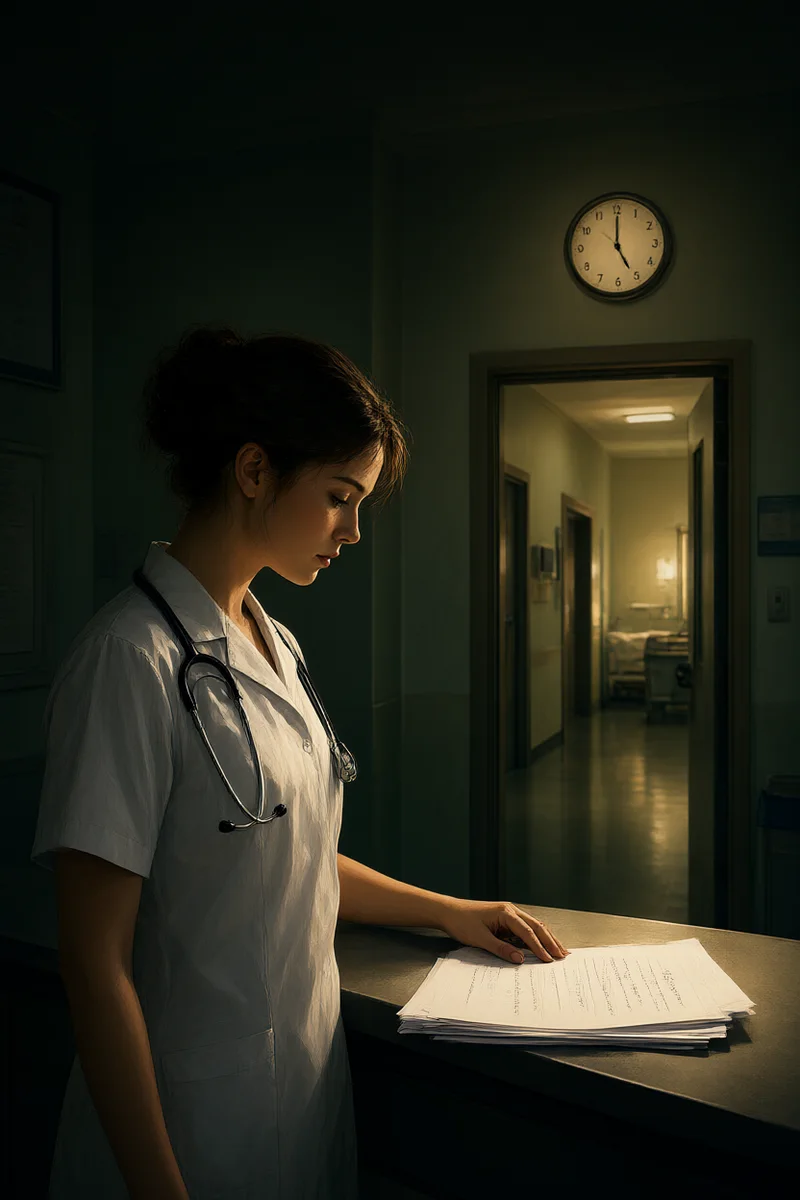
 The Word She Couldn't Find
Chapter 5
Morbidity and Mortality
There was a script for this. Saoirse had learned it in a lecture during orientation week, half asleep: disclosure, apology, explanation, a plan. She had not imagined she would need it in her eleventh week, standing in a hallway with a stranger's sister.
She said, “Yes.”
Paloma pressed her lips together and nodded once, as if that was the answer she had braced for.
“The plan last night was for her to go home this morning,” Saoirse said. “I was worried it was something more serious. I raised it, and the decision was not to scan her. I should have pushed harder than I did, and sooner. Her diagnosis was delayed by about five hours. I'm sorry.”
Footsteps behind her. Kittredge, who must have followed her down from his office, came to stand at her shoulder.
“The decision not to scan was mine,” he said to Paloma. “Not hers. She was right and I overruled her. I'm the attending physician, and I'm the one you should be angry with. I'd like to sit down with you and your family this afternoon and go through every hour of last night, and answer anything you want to ask, and tell you exactly what we're doing to make sure it doesn't happen to anyone else.”
Paloma looked from one of them to the other. Whatever she had been ready to shout, she did not.
“Okay,” she said finally, quietly. “Two o'clock. Bring coffee that isn't this.”
On Thursday at seven in the morning, Saoirse stood at a podium in the Halvorsen auditorium with a clicker in her hand and her notes printed in a font too small to read. The room was full. Kittredge sat in the front row in a red bow tie with his hands folded on his stomach.
She put up the timeline. 23:40, request declined. 00:10, new deficit, not escalated. 04:52, seizure. She told it the way it happened, his part and hers, without adjectives. When she reached the slide that said Discharge documentation intentionally delayed in lieu of escalation, her voice went thin, and she made herself read it out loud anyway.
Afterward, in the question period, a surgeon in the back asked the attending whether he had anything to add.
Kittredge stood up and turned to face the room.
“Only this,” he said. “I've been doing this for thirty-four years. On Monday night an intern eleven weeks out of medical school examined my patient more carefully than I had, and I didn't go and look, because of the length of her coat. Then she didn't ring me back, because of the length of mine.” He sat back down. “Both halves are in the report. That's all.”
Nobody said anything. The surgeon in the back wrote something down. Ondine Mabry, standing by the door in her scrubs, caught Saoirse's eye and tapped her watch, because it was ten to eight and there were patients upstairs.
Odalys Castellanos spent nine days in the hospital and five weeks in rehabilitation. The weakness in her right hand went first. The words came back more slowly, one at a time, in a strange order. Gravity came before spoon. Molecule came before Paloma.
In February a card arrived on the fourth floor addressed to Dr. S. Kearney. Inside was a sheet of graph paper, the kind Odalys's students used, and on it, in a careful, slightly shaky hand, was a single sentence.
I wrote this with a pen. — O.C.
Saoirse pinned it to the corkboard in the workroom, over the computer where she had once sat for five hours not typing. On nights she was senior resident, the interns asked her about it.
She told them the whole story. Then she gave them her phone number and told them to use it, especially at midnight, especially when they weren't sure.
The End









