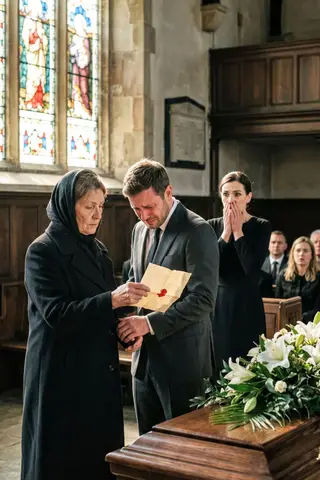
 THE FUNERAL SHOCKER: Stepmom Kicked Out of Front Row
Chapter 1
The Cold Pew and the First Demands
The hardwood pew felt freezing through my black dress. After thirty-seven years with Arthur, after seventeen years of marriage as his second wife, I was holding my breath just trying to make it through the morning. The air in St. Jude’s parish was heavy with the scent of white lilies, damp wool, and the unmistakable metallic chill of impending grief. Outside, the autumn wind whipped fallen leaves against the stained-glass windows, casting fractured patches of ruby and gold across the floorboards.
I sat quietly near the center aisle, hands folded neatly over my purse, wishing for the earth to open up and swallow me. But the earth didn't open; instead, Arthur’s oldest daughter, Sarah, leaned across the aisle. She didn't whisper. She made sure the third row could hear every word, every syllable dripping with calculated disdain.
"You need to move to the back, Elaine. The front rows are reserved for real family."
Her words hit me like physical blows, though I had spent seventeen years preparing for this exact kind of humiliation. From the very first day Arthur introduced me as his new wife, long after his first wife had walked out and vanished into the west coast fog, Sarah and her younger brother David had drawn a line in the sand. To them, I was the eternal interloper, the woman who had somehow usurped their mother’s rightful place in their father’s life, even though their mother had left when David was barely twelve and Sarah was fourteen—years before Arthur and I ever crossed paths at the community library.
I didn't argue. I never argued. For seventeen years, I had mastered the art of making myself small, invisible, and unoffensive whenever Arthur’s grown children were in the room. I quietly stood up, clutched the strap of my black leather purse, and moved six rows back to sit alone near the stained-glass window depicting Saint Jude holding a walking staff.
The silence in the church was deafening, broken only by the low, steady hum of the old cast-iron radiators vibrating against the plaster walls. I stared at the back of Sarah’s impeccably styled blonde hair. She wore a tailored black designer coat that must have cost a small fortune, a gift from David’s prosperous tech firm in Seattle. They had arrived in a sleek black town car, moving with the haughty confidence of people who believed their last name still commanded the town’s highest respect.
Arthur had built this town, or at least a good portion of its working-class backbone. He had spent forty years running the regional railyard, working his way up from a grease-stained mechanic to the district supervisor before his retirement. He was a proud man, a man of calloused hands, quiet dignity, and a stubborn streak a mile wide. But over the last eight years, as Parkinson’s disease slowly invaded his central nervous system, that stubbornness had turned into a heartbreaking vulnerability that only I was allowed to witness.
I looked up toward the altar, where Arthur’s heavy oak casket rested on a velvet-draped bier, surrounded by towering sprays of white and crimson flowers. The organist was softly warming up, the low notes of the prelude vibrating in my chest. I closed my eyes and whispered a silent prayer, asking Arthur for the strength to get through the next two hours without completely breaking down.
I thought about the morning we packed his favorite flannel shirt into the wicker suitcase destined for the hospice center. I thought about the way his blue eyes—usually so sharp and perceptive—had grown hazy and distant in those final hours, yet had still searched the room frantically until they found mine. "Elaine," he had rasped, his voice barely a breath. "Stay close."
And I had stayed close. I had stayed until the heart monitor flatlined into that long, piercing beep that still echoed in my dreams.
I opened my eyes, hoping the worst of the social torture was over, but the universe had other plans. Five minutes later, just as the church doors creaked open to let in a fresh gust of cold air, Sarah walked down the center aisle. She didn't take her seat. She walked with purposeful, aggressive strides right to my row, stopped dead in front of me, and looked down her nose with an expression of pure, unadulterated contempt.
The End









