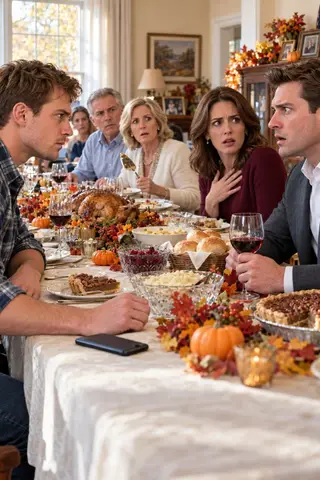
 The Arrogant Boyfriend Tried to Humiliate the "IT Guy" at Thanksgiving
Chapter 1
The Descent of the Apex Predator
The screen door didn't just open; it announced itself. A sharp, unhurried click, followed by the heavy thud of Italian leather against the welcome mat my mom bought at a crafts fair in Culpeper three years ago.
I was sitting at the kitchen island, wiping down the counter with a damp sponge, watching the way my father's knuckles turned white around the handle of the carving knife. We weren't a formal family. Thanksgiving in our house meant fleece pullovers, grease-spotted oven mitts, and the distant, droning roar of a Detroit Lions game that everyone pretended to care about because it filled the empty spaces between political small talk and my mother's nervous pacing.
Then Graham walked in.
He was thirty-two, though he carried himself with the exhausted precision of a forty-year-old partner at a boutique law firm who spent his weekends doing triathlons he didn't enjoy. His camel-hair sport coat looked like it had been tailored within an inch of its life—the kind of cut that cost more than my first two cars combined. A silk pocket square, folded into a crisp, impossibly sharp triangle, peeked from his breast pocket like a white flag of surrender he had no intention of waving.
"Paige, darling, take my coat before I smell like butter," he murmured, his voice pitched just low enough to carry across the linoleum into the living room where my brother Evan was arguing with my uncle about interest rates.
My sister Paige—smart, sharp-tongued Paige, who had spent four years at UVA learning how to look down her nose at people with regional accents—materialized from the hallway as if she'd been waiting in the wings for a cue. She took the coat with both hands, her smile so wide it looked like it hurt her cheekbones.
"Everyone," Paige announced, her voice ringing off the popcorn ceiling with the forced brilliance of a game show host. "This is Graham."
Mom emerged from the pantry, wiping her flour-dusted hands on her apron, her eyes widening slightly as she took in the wool, the leather, and the faint, expensive scent of sandalwood and cedar that seemed to roll off him in waves.
"Oh, it's so wonderful to finally meet you, Graham," Mom said, reaching out instinctively before she remembered the flour. She stopped herself, giggling that high, nervous laugh she only used when the septic tank backed up or when the insurance agent called. "Paige has told us so much about your work in the city."
Graham didn't shake her hand; he leaned down with a practiced, politician's grace and offered a cheek that she didn't quite know what to do with, so she patted his shoulder instead.
"The drive from Georgetown was an absolute beast," Graham said, his teeth flashing white under our fluorescent kitchen lights. "Your little town is charming, though. It’s like stepping into a time capsule. I half-expected someone to pull up in a horse-drawn carriage."
He said it with a chuckle—light, airy, entirely devoid of malice on the surface. But my father's knife stopped moving against the sharpening steel. The scrape-scrape sound died away, leaving only the sound of the television in the other room where Jim Nantz was talking about third-down conversions.
I stayed by the sink, my sponge still pressed against the formica. I was wearing my favorite flannel—red and black check, soft from ten years of autumns—and a pair of jeans with a grease stain on the left thigh from when I'd helped Dad rewire the alternator on his old Ford pickup the weekend before.
Graham turned his head slowly, his eyes scanning the kitchen until they landed on me. His gaze didn't linger; it cataloged, weighed, and dismissed me in the space of three heartbeats.
"And you must be Zach," he said, stepping toward the island. He extended a hand—long-fingered, manicured, the cuff of his French-cuff shirt held together by heavy silver links shaped like little anchors.
I wiped my hand on my jeans and took it.
He didn't just shake my hand; he squeezed it. Not a bone-crushing grip—that would have been crude—but a firm, downward pressure designed to establish an immediate hierarchy. The kind of grip men use when they want you to remember who owns the room before you've even had a chance to sit down.
"Paige's little brother," he said, tilting his head with a condescending little smirk that didn't reach his eyes. "The computer guy. Right?"
"Network administration," I corrected quietly, letting go of his hand before he could decide when the grip was finished. "At a firm in Reston."
Graham gave a small, throaty laugh that sounded like dry leaves sliding across a driveway. "Ah. The digital plumbing. Someone's got to keep the pipes clean so the rest of us can actually build things, don't they? Good for you, buddy. Honest work."
Buddy.
The word dropped onto the kitchen floor between us like a lead weight. It wasn't just the word; it was the cadence. It was the tone an adult uses when a four-year-old hands them a mud pie and says they baked it.
Across the room, Karen—my girlfriend of two years, a woman who spent forty hours a week elbows-deep in surgical steel and frightened rescue dogs at the county veterinary clinic—shifted on her stool. I felt the light pressure of her knee against mine under the counter. A silent warning. Let it go, Zach. Not today.
I smiled. A slow, easy movement of the mouth that didn't touch my eyes either.
"Yeah," I said, looking right into his pale, gray-blue eyes. "Someone's gotta."
The End









