 The 28-Night Symphony: How a Janitor’s Accidental Confession Healed a Billionaire’s Heart
Chapter 1
The Wrong Door
The relentless Boston chill bit through Richard Carter’s thin canvas jacket, but he barely felt it. His mind was a labyrinth of mental math—calculating whether the remaining balance in his checking account could cover both Olivia’s school field trip fee and the exorbitant price of inhalers for Oliver’s asthma without plunging them into overdraft before Friday’s paycheck. At thirty-six, Richard’s existence had been reduced to a fragile choreography of split-second timing and quiet compromises. Since the divorce three years ago, his entire world revolved around the axis of his two children: picking them up precisely when promised, packing lunches with crusts cut just right, and stealing away every evening to visit his seventy-eight-year-old grandmother, Martha, who was slowly recovering from pneumonia in room 412 of Massachusetts General Hospital. He believed in small promises. He believed that if you kept enough of them, the chaotic wreckage of a failed marriage and a stalled life would eventually stop crumbling beneath your feet.
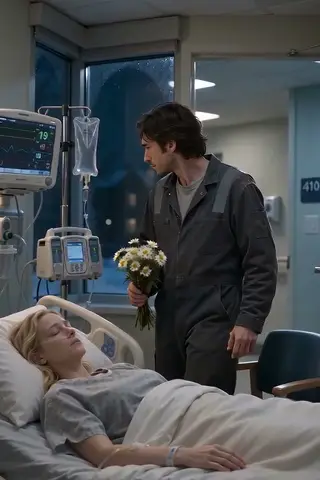
That particular December evening, however, fatigue weighed on his bones like wet lead. He had spent ten grueling hours scrubbing linoleum floors, plunging stubborn toilets, and hauling industrial trash bags as the graveyard-shift janitor, his hands permanently smelling of bleach and industrial pine. Carrying a cheap, plastic-wrapped bouquet of grocery-store daisies that were already beginning to brown at the edges, he pushed through the swinging double doors of the fourth-floor intensive care unit. His boots made no sound on the polished, antiseptic floors. Distracted by a dull throbbing behind his temples, he didn't check the plaque beside the heavy oak door. He just turned the brass handle and walked right in, expecting to find Martha complaining about the hospital's gelatin or watching reruns of old game shows on a small, flickering television.
Instead, the room was shrouded in an eerie, sterile silence, broken only by the rhythmic, mechanical hiss and sigh of a ventilator. Richard froze, the daisies slipping slightly in his calloused grip. The woman lying beneath the stiff white sheets was not his grandmother. She was startlingly young, perhaps in her mid-thirties, with a shock of pale blonde hair fanned out across the pillow like spun silver. Her face was unnaturally translucent, cheekbones carved sharp against skin that looked as though it hadn't seen the sun in months. A maze of transparent tubing, wires, and sensor leads bound her to a bank of monitors that flickered with green and amber data streams. There were no cards propped up on the tray table. No balloons bobbing against the ceiling. No framed photographs of friends, lovers, or family members to anchor her humanity to the room. The space felt hollow, abandoned, and intensely, suffocatingly lonely.
Instinct urged Richard to back out quietly, mumble an apology to the empty air, and find room 412. But as he looked closer, his gaze locked onto her right hand resting motionless atop the coarse blanket. The knuckles were bruised slightly from IV insertions, the fingers limp and vulnerable. A sudden, sharp pang twisted in Richard’s chest. He knew that exact posture of utter isolation. He knew what it felt like to sit in the pitch-black silence of an apartment where the only sound was the refrigerator's hum, leaving the television on just to pretend someone else was breathing nearby. He knew the hollow ache of waking up in an empty bed, wondering if your children would grow up remembering you as a constant presence or just a tired ghost rushing through the background of their lives. Without thinking, he crossed the room, placed the drooping daisies on the narrow windowsill, pulled up the vinyl chair, and sat down. Without a script, without a reason, and without a single witness, Richard cleared his throat and began to sing in a rough, untrained, and thoroughly imperfect baritone. "You are my sunshine, my only sunshine..."
The End









