 “Take Nothing of Mine,” the Cold Mafia Boss Ordered as He Threw Her Out
Chapter 1
The Cold Partition
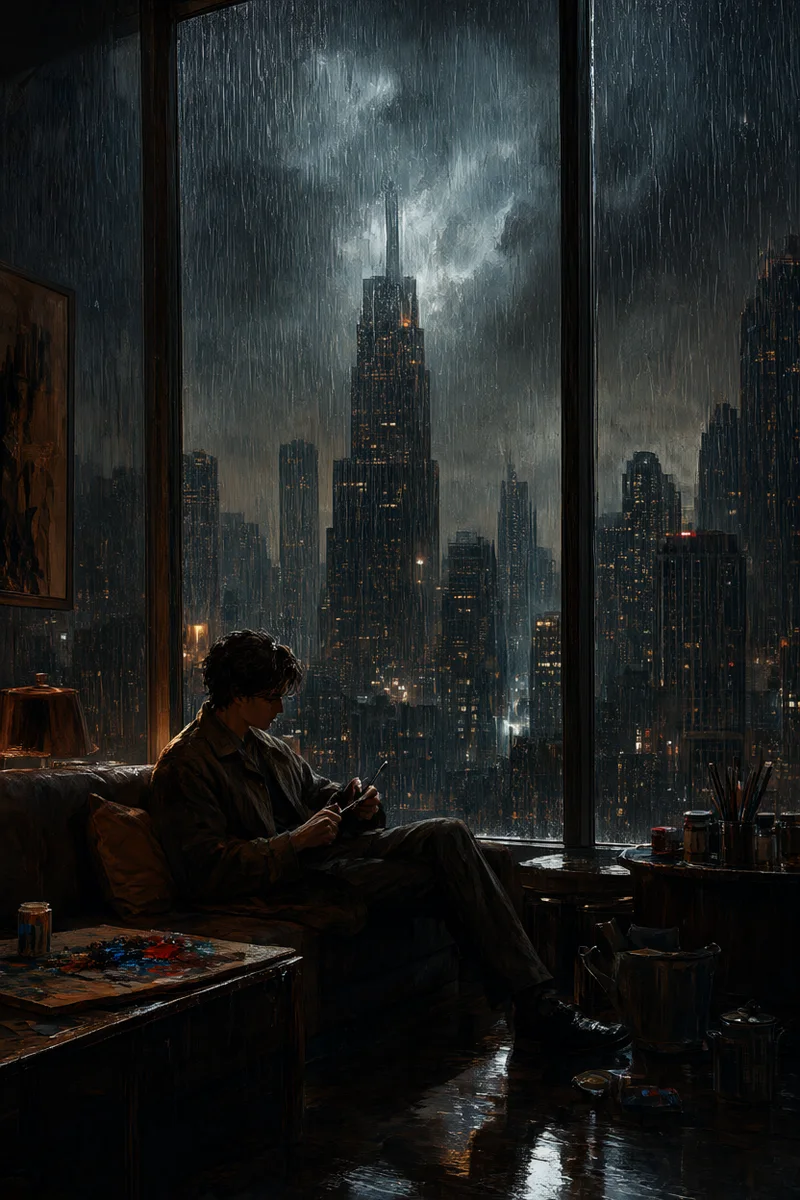
The rain in Chicago smelled like exhaust, cold stone, and wet asphalt that night. It ran in silver lines down the floor-to-ceiling windows of Leo Tomlin’s penthouse while I sat on the edge of the bed with both hands folded in my lap, trying not to touch my stomach. There was nothing to feel yet. Not really. The doctor had called it six weeks and two days. A cluster of cells no larger than a lentil. A heartbeat might become visible at the next appointment. I had spent the entire afternoon walking through the apartment with that knowledge inside me like a lit match I was afraid to breathe on. I had planned to tell Leo after dinner. Then his uncle died. And the entire city around him changed overnight.
Leo stood near the bedroom door fastening one cuff of his charcoal shirt. Thirty-two years old. Tall. Dark hair combed back. Expression controlled with the discipline of a man who had been taught since childhood that visible emotion created leverage. People in Chicago newspapers called the Tomlins a freight family. Logistics. Warehousing. Trucking. Port contracts. Old union relationships. Commercial real estate. That was the legitimate version. The private version was less clean. Cash businesses. Protection arrangements. Politicians who returned Leo’s calls too quickly. Men who came through our apartment after midnight and never gave last names. I had understood enough without asking for every detail. That was one of the compromises I had made for three years. Leo never asked me to participate. He also never pretended the danger did not exist. Until that evening.
“The car is downstairs,” he said. I stared at him. “For what?” “To take you to O’Hare.” I thought I had misheard. “Why?” His gaze finally met mine. Because Uncle Carlo was dead. Because the family board had selected Leo to replace him. Because two cousins believed they should have been chosen instead. Because the Colombian shipping group Leo’s uncle had worked with no longer knew which Tomlin could guarantee old agreements. Because federal investigators had become suddenly interested in three warehouse companies. Because Leo had spent the previous forty-eight hours sleeping in ninety-minute increments while armed men stood outside our private elevator. All of that was in his eyes. What he said was: “You need to leave Chicago.”
“How long?” I asked. He looked toward the window. “That depends.” “On what?” “Natasha.” “Say it.” His jaw tightened. “There isn’t going to be an ‘us’ after tonight.” The sentence reached me slowly. It was too clean. No anger. No argument. No buildup. Three years compressed into a business decision. I stood. “You’re ending this.” “Yes.” “Because Carlo died.” “Because my situation changed.” I almost laughed. “Your situation.” “Don’t make this harder.” “What would make it easier?” He said nothing. I walked toward him. “Three years.” “I know.” “I lived here.” “I know.” “I patched your shoulder after Milwaukee because you wouldn’t go to an emergency room.” His eyes hardened. “Do not bring that up.” “I held you when you woke from nightmares after your father died.” “Natasha.” “You took me to Naples because you said there were places you wanted me to see before you became too busy to be a person.”
“And now I am too busy,” Leo said, his voice flat, stripped of every contour I had spent thirty-six months memorizing. “The men coming for this seat don’t negotiate through proxies. They look for pressure points. You are the easiest line to draw from me to vulnerability. I am cutting the line.” I looked at his hands—the long fingers, the faint scar across the second knuckle from an old altercation in the docks district. Those hands had touched my face an hour before the call came about Carlo. They had rested against my waist while we talked about remodeling the kitchen. Now those same hands were clearing the table.
“And my things?” I asked. “Pack a bag. The rest will be shipped to an address of your choosing within the week.” He reached into his breast pocket, pulled out a heavy black envelope thick with linen paper, and laid it on the dresser. “There is a cashier’s check inside. Six months of baseline living expenses. It’s clean. It won’t trace back to any Tomlin accounts. Use it to disappear, Natasha. Don't look back, don't call my associates, and if anyone asks about us, you were a guest who left before the weather turned.”
I looked at the black envelope. Then I looked down at my coat resting on the armchair. Beneath the lining of that coat, tucked inside the inside pocket where I kept my passport and emergency savings, was a small plastic vial containing my prenatal vitamins and the ultrasound printout from Tuesday morning—a tiny, blurry grey speck that represented everything Leo was trying to protect against while simultaneously destroying.
“Take nothing of mine,” Leo said softly, echoing a phrase his uncle used to use when clearing a warehouse of compromised assets. “Take what you need to survive, but take nothing of mine.” I didn't tell him about the lentil-sized heartbeat. I didn't tell him that he was already too late to erase me. I picked up my bag, zipped it shut, and walked past him without another word.
The End









