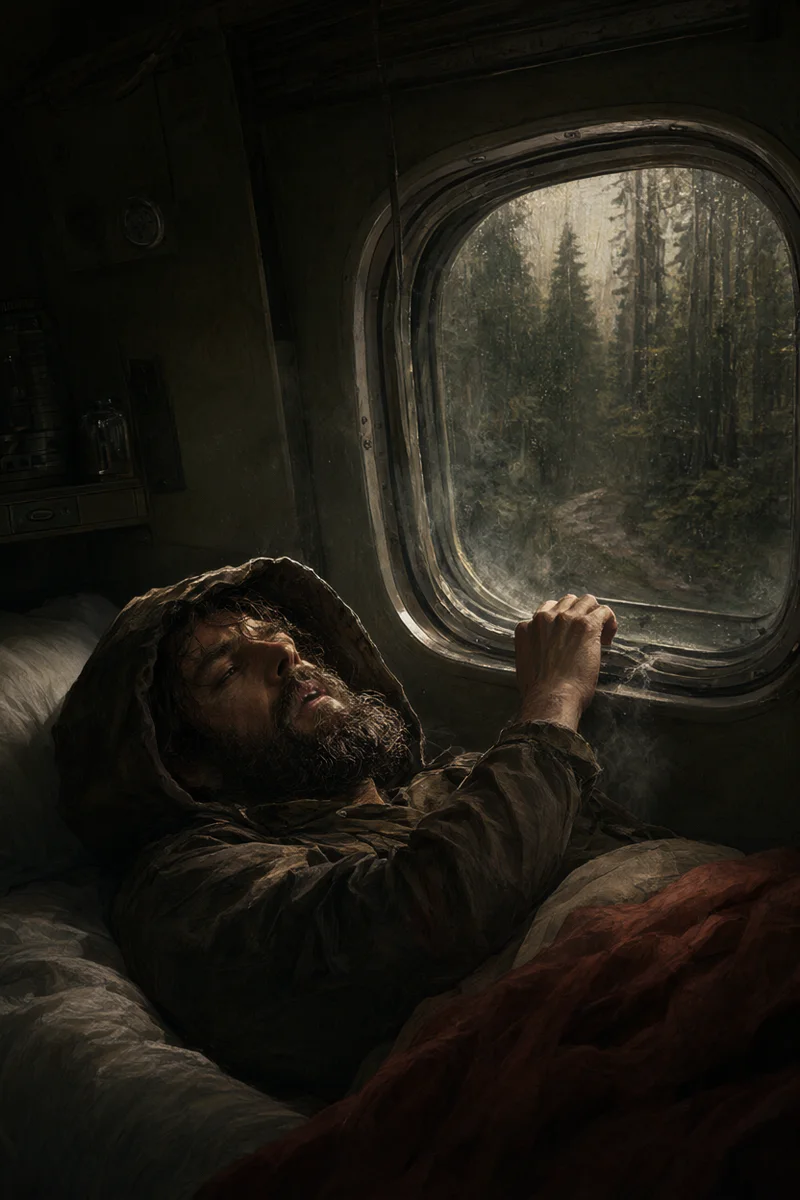
 Stepmother Treated Me Like Baggage and Forced Me into Economy
Chapter 1
The Descent
The hiss of the cabin pressure settling felt less like a transition and more like a vacuum sealing off my old life from whatever slow-motion wreckage my father had decided to finance.
Row 31, seat B. Middle seat. Sandwiched between a snoring businessman whose briefcase smelled faintly of airport terminal tuna and an elderly woman whose knitting needles clicked with the aggressive rhythm of a countdown timer.
Up in first class, six rows ahead and shielded by a heavy navy curtain, Patricia was undoubtedly ordering a pre-departure flute of champagne. I could picture it. Her manicured fingers wrapped around the stem, her eyes scanning the cabin to make sure no one of consequence was looking, her laughter sharp and performative like shattering glass. Mason, my stepbrother—soon-to-be stepbrother? God, the legalities of my father's second marriage were as tangled as cheap fishing line—would be leaning over the armrest, telling her some flat anecdote about how he planned to modernize my father’s hedge fund portfolio by cutting out the "dead weight."
Dead weight. That was me. Two years of professional radio silence following my mother’s stroke, two years of living out of a mid-range studio in Queens while my name quietly vanished from the family holiday cards, two years of letting everyone assume I had burned through my college trust fund on failed indie startups and overpriced therapy.
My phone buzzed against my thigh. A secure, encrypted push notification.
BENNETT AERO HOLDINGS
Entity acquisition complete.
Voting rights: 100%.
Executive directives active.
I slid the phone back into my pocket without opening it. The screen went dark, reflecting my own face—pale, hollow-eyed under the sickly yellow glare of the reading light, hair pulled back into a utilitarian knot that Patricia had sneered at in the terminal. “At least try to look like you belong in a family portrait, Nora. Even if you're standing in the back.”
Three hours earlier, Terminal 4 had been a stage set for their superiority.
We had arrived in two separate vehicles. Patricia and Mason in the back of a chauffeured black Lincoln Navigator; my father riding shotgun, his posture slumped like a man who had long ago traded his spine for a quiet house and a second wife who didn't remind him of his first wife's mortality. I had taken the E train, my single canvas duffel slung over my shoulder, meeting them by the curbside drop-off like an embarrassing cousin they couldn't quite shake off the guest list.
Patricia hadn't even let me through the sliding doors before she shoved her crocodile leather carry-on—a limited-edition Hermès that cost more than my first car—into my hands.
“Careful with the bottom, Nora,” she’d trilled, her voice carrying over the roar of idling engines. “The clasp is custom. If you scratch it, you’ll be paying it off until your hair goes gray. Though, let's be honest, it's already starting.”
Mason had laughed—that dry, wet-paper-towel laugh of his—and held up his phone, recording a boomerang for his Instagram story with the caption: Sherpa duties. Family first.
My father had looked right at us. His eyes, behind their progressive lenses, had caught mine for a fraction of a second. I saw the calculation there. The cowardice. He didn’t want a scene; he didn’t want Patricia’s weekend mood ruined before they even hit the Aspen tarmac; most of all, he didn’t want to admit to his new social circle that his eldest daughter—the one who actually inherited the architectural mind of our grandfather—wasn't a failure at all, but rather someone who had simply outgrown them.
So he turned away. He adjusted his scarf and walked toward priority check-in, leaving me standing on the rubberized floor with three designer suitcases, two garment bags, and a cold hollow in my chest where family loyalty used to live.
Now, sitting in the metal tube of Flight 412, listening to the safety demonstration video drone on through overhead monitors, I pulled out my passport case. Tucked behind my expired library card and a receipt for a bagel was a small, brushed-silver pin shaped like a delta wing with a microscopic sapphire embedded in the center. The insignia of the primary shareholder of Bennett Aero Holdings—the parent company that owned regional fleets, charter lines, and, as of forty minutes ago, the very commercial carrier we were currently sitting on.
The engines whined. The cabin shuddered as the massive Boeing taxied away from the gate toward the active de-icing pads. Outside, the New York slush was turning into a slate-gray sheet of freezing rain.
“Excuse me, miss?” the woman in 31C nudged me with her elbow. “Can you check if the vent above my seat is open? I’m getting a draft.”
“Sure,” I said softly, standing up just enough to reach the plastic dial overhead.
Through the gap in the first-class curtain, I caught a glimpse of a familiar blond bob. Patricia was leaning across the aisle, showing Mason something on her iPad—probably the floor plan of the Aspen chalet, complete with heated driveway specifications.
They thought the trip was about their future. They had no idea they were flying into an audit.
The End









