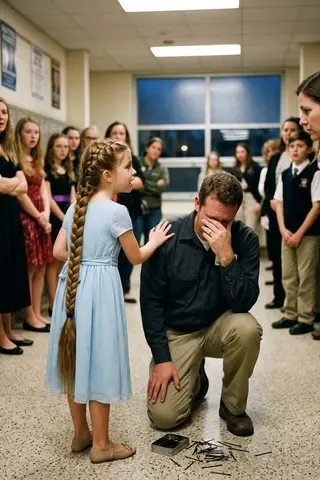
 Single Dad Brutally Cornered At School Corridor For Forcing 9-Year-Old’s Knee-Length Hair
Chapter 1
The Corridor Ritual
The fluorescence of the Lincoln Elementary hallway hummed with a sterile, cold vibration, casting long, sharp shadows against the faded beige lockers. It was four o'clock on a brisk Friday afternoon, precisely thirty minutes before the autumn assembly, and the corridor was already a chaotic ecosystem of nervous energy. Costumes rustled, instruments clattered against metal cases, and parents hovered anxiously with cameras at the ready. Yet, amidst this swirling storm of pre-show anxiety, a pocket of absolute stillness existed near the southern fire exit.
Arthur Vance sat on a worn, orange plastic chair that looked entirely too small for his broad frame. Between his knees stood his nine-year-old daughter, Goldie, her posture rigid as a soldier standing at attention. Across from them, propped precariously against a dented locker, was a cracked, oval makeup mirror salvaged from the passenger seat of Arthur’s battered 2012 sedan.
Arthur’s calloused, grease-stained hands moved with a terrifying, agonizing precision. They were the hands of a senior diesel mechanic—thick-knuckled, scarred by wrenches and engine oil—yet they handled strands of hair as fine and delicate as spun gold with the gentleness of a watchmaker adjusting a Swiss tourbillon. He was building a French braid. Not just any braid, but the architectural masterpiece that had become a local legend and a silent point of contention throughout the entire neighborhood. Starting precisely at her crown, his fingers wove the hair in a tight, seamless pattern that extended all the way down, past her shoulder blades, past her waist, and finally terminated nearly three inches past the back of her knees.
"Hold still for just another second, bug," Arthur murmured, his voice a low, gravelly rumble that barely carried over the din of the hallway. "Almost locked in."
Goldie didn't answer. She rarely answered during the ritual. Her small hands rested flat against her thighs, fingers curled tightly into her skirt. Her eyes stared straight ahead into the cracked mirror, tracking every twitch of her father’s brow, every tiny bead of sweat that gathered at his hairline. She had been sitting like this for twenty minutes. Before that, she had sat in the front seat of his truck for the twenty-minute drive from the rail yards where he worked. Before that, she had sat through seven hours of school, her movements heavily cataloged, restricted, and meticulously calculated to avoid a single catastrophic unspooling of the braid.
From twenty feet away, I watched from the edge of the faculty lounge door, sipping lukewarm black coffee from a paper cup. My own daughter, Maya, was in Goldie’s fourth-grade class, and like every other parent in the district, I had watched this bizarre domestic theater play out week after week, month after month, for as long as any of us could remember.
It wasn't that the hair wasn't stunning. It was. When the afternoon sun caught it through the high corridor windows, Goldie’s hair looked like liquid amber, catching every ray of light, glowing with an ethereal, almost haunting brilliance. People stared at her at the grocery store, at the park, and at every school function. Strangers would stop them in aisles, gasping at the sheer length and health of it, praising Arthur for his patience, marveling at how a blue-collar mechanic possessed the salon-level dexterity to execute a flawless French braid without a single stray flyaway.
Look at that dad, the refrain always went among the mothers. Not every man can even do a braid. Most fathers don't even know where their daughters' hairbrushes are kept.
And for a long time, I had fallen into that comforting, romanticized narrative. I had looked at Arthur Vance through the lens of modern progressive praise—the devoted single father stepping up, bridging the gender divide, mastering the domestic arts out of pure, unfiltered love for his motherless child. It was a heartwarming tableau straight out of a Hallmark movie.
Except, as the months bled into years, the romantic gloss began to chip away, revealing something far more jagged and unsettling underneath.
I watched Goldie now. A group of boys chased each other past the lockers, shouting and laughing, and Goldie flinched—not out of fear of the boys, but out of a desperate, ingrained reflex to protect her braid. Her right hand flew backward, hovering inches from the base of her spine to shield the thick rope of hair from being snagged by a swinging backpack. It was a defensive posture. A constant, low-grade hyper-vigilance that no nine-year-old child should ever have to maintain.
In class, Maya had told me months ago, Goldie couldn't lean back comfortably in her chair because the heavy knot at the base of her neck acted as a fulcrum, pushing her forward. During physical education, while the other girls ran freely with ponytails bouncing and hair whipping wildly in the wind, Goldie ran like a statue, her torso stiff, her left hand perpetually clutching the lower third of her braid against her thigh to keep it from whipping around and lashing her legs. In the cafeteria, she hunched over her tray like a protective mother hen, her elbow shielding her hair from stray drops of tomato soup or splashes of milk.
She wasn't wearing the hair. The hair was wearing her.
Arthur finished the final twist, sliding a black wire bobby pin deep into the anchor point with a firm, practiced click of his thumb. He reached into his jacket pocket, pulled out a small velvet box, and selected a pale yellow satin ribbon, weaving it deftly through the final inches before tying a precise, symmetrical bow at the very tip.
"There," Arthur breathed, a faint, exhausted smile touching the corners of his mouth. He reached out and gently patted her right shoulder. "Good as armor. You're ready, kiddo."
Goldie stood up immediately, her joints popping slightly from the prolonged immobility. She didn't smile back. She didn't check the mirror. She simply turned on her heel and walked down the corridor toward the auditorium doors, where the rest of the fourth-grade class was gathering in their pioneer costumes for the historical pageant. As she walked, the heavy braid swung rhythmically against the back of her cheap cotton dress, a heavy, hypnotic pendulum keeping time with her measured steps.
Arthur stayed behind. He didn't pack up his gear immediately. Instead, he pulled a dirty cotton shop rag from his back pocket and began methodically wiping down the cracked mirror, cleaning off smudges that weren't really there, his shoulders slumped under the invisible weight of a long, back-breaking week at the rail yards.
I lowered my coffee cup, a cold knot tightening in my stomach. The praise was gone. The romanticism had evaporated. All that was left was a burning, uncomfortable question that nobody in the school district had the courage to ask out loud: Why are we all pretending this is okay?
The End









