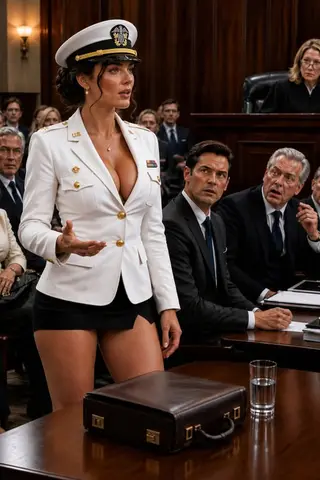
 She Walked Into Court Alone, Broke and Mocked by Her In-Laws
Chapter 1
The Trap Laid by the Hales
The fluorescent lights of Courtroom 3B hummed with an almost rhythmic indifference, casting a sterile white glow over the polished mahogany tables. To my left, the opposition table looked like a corporate boardroom during a hostile takeover. Preston sat comfortably in a tailored charcoal suit, flanked by three senior partners from Voss & Associates. Their workspace was a fortress of leather-bound binders, color-coded tabs, and sleek tablets displaying real-time digital transcripts. They had spared no expense, hiring the most aggressive family law firm in the state to ensure that the dismantling of my life was swift, painless, and entirely one-sided.
Across the aisle, my table was conspicuously bare. A single leather briefcase, a notepad with a black spine, and a plain glass of water. No army of associates. No stack of discovery documents. No expensive consultants whispering in my ear. To anyone walking in off the street, I looked like a lamb being led quietly to the slaughter.
And the Hales were certainly enjoying the view.
My mother-in-law, Vivian Hale, sat in the front row of the gallery, her posture rigid and aristocratic. She wore a cream cashmere coat that practically screamed old money, and her wrist caught the courtroom light every time she raised her hand to cover a smirk. Next to her, my father-in-law, Arthur Hale, leaned back with his arms crossed over his chest, his expression a mix of condescension and absolute boredom. He had made eye contact with me just five minutes before the bailiff called the court to order, letting out a soft, theatrical sigh as if dealing with a stubborn beggar outside a country club.
"Look at her," Arthur had muttered just loud enough for me to hear. "Too proud to ask for a settlement, too broke to hire a real attorney. She’s going to walk out of here with nothing, exactly the way she came in."
Preston hadn’t even looked at me. Throughout our seven-year marriage, he had mastered the art of looking through people as if they were made of glass. When he placed the divorce papers on our breakfast table three weeks ago, right next to my half-eaten toast, his eyes had been completely devoid of warmth. There was no apology for the years I spent managing his social calendar, nursing him through his father’s stroke, and hosting fundraisers that secured his partnership at the firm. There was only cold, calculated legal language.
“You contributed nothing material to the household, Amelia,” he had said when I confronted him. “The house is in my pre-marital trust. The accounts are in my name. Legally, you are starting from zero.”
Now, Judge Rebecca Morrison adjusted her wire-rimmed glasses, looking down from the elevated bench with a mixture of professional weariness and mild curiosity. Her gaze lingered on my empty table before shifting to Martin Voss, the lead attorney representing Preston. Voss was a man whose slicked-back hair and custom-tailored Italian suit suggested he spent more time in high-end golf clubs than courtrooms.
"Mrs. Hale," Judge Morrison’s voice cut through the ambient hum of the room. "You understand you have the absolute right to legal representation in a dissolution of this magnitude?"
"Yes, Your Honor," I replied, my voice steady, carrying a calm resonance that seemed to surprise a few people in the gallery.
"And you are formally choosing to waive that right and represent yourself pro se?"
"Yes, Your Honor."
A murmur rippled through the gallery. Vivian Hale whispered something into Arthur’s ear, and a low chuckle rumbled from his chest. Martin Voss stood up smoothly, buttoning his jacket with practiced theatricality.
"Your Honor, for the record, the petitioner’s counsel is deeply concerned," Voss began, his tone dripping with patronizing sympathy. "This is a complex multi-asset dissolution involving real estate holdings, corporate equity, and pre-marital asset tracing. Proceeding without counsel creates unnecessary procedural complications and places an undue burden on the court’s time. We urge the court to appoint a guardian ad litem or mandate a brief continuance for Mrs. Hale to secure counsel she can actually afford."
It was a brilliant psychological move designed to paint me as unstable, destitute, and incompetent before a single piece of evidence was introduced. The courtroom spectators nodded along. They saw a desperate housewife clinging to the wreckage of a failed marriage.
They didn’t see Captain Amelia Carter.
They didn’t know that for five years before I met Preston—before I traded my service uniform for silk blouses and charity gala gowns—I had stood in military tribunals and federal courtrooms prosecuting complex cases under pressure far more intense than a civil divorce proceeding. I knew every rule of evidence, every procedural loophole, and every dirty trick in Voss’s playbook.
I kept my hands flat against the wooden table, my breathing slow and controlled. Preston looked across the room, finally locking eyes with me. His gaze held a flicker of irritation, as if my refusal to cry or beg was an insult to his ego.
"Counselor," Judge Morrison said, her sharp eyes fixing on Martin Voss. "Mrs. Hale is legally entitled to represent herself if she so chooses, provided she adheres to the rules of civil procedure. Unless she disrupts these proceedings, we are moving forward."
Voss offered a tight, condescending smile, bowing slightly. "As the court pleases. We are fully prepared to demonstrate that the petitioner has zero legal or financial claim to any portion of the Hale estate."
"Very well," Judge Morrison said, striking her gavel once. The sharp crack echoed through the room, silencing every whisper. "Mr. Voss, you may present your opening statement."
As Voss strode forward to begin his rehearsed speech about sacrifice, contribution, and legal precedent, I opened my single leather briefcase. I pulled out a plain manila folder marked with a single red sticker.
Inside was not a frantic plea for alimony.
Inside was the digital undoing of the entire Hale empire.
The End









