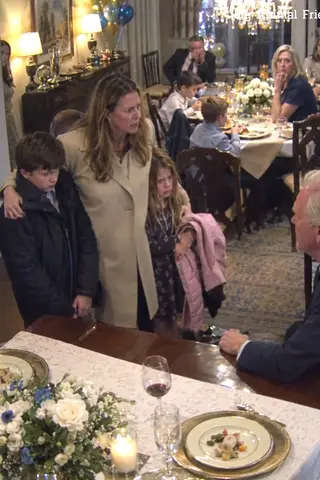
 She Told Me Not to Wear Blue Because of "Wedding Photos," Then I Walked In and Saw Her Mother in a Floor-Length Blue Gown
Chapter 96
The Western District Injunction
The Federal District Court in Madison was an imposing temple of white limestone and dark walnut, its vaulted ceilings echoing with the heavy history of northern jurisprudence. The gallery was filled with state environmental officials, local timber representatives, and twenty young apprentices from the Miller Center who had ridden through the night on a chartered bus, all wearing their dark blue foundation jackets in silent solidarity.
Sitting at the plaintiff’s table was Gregory Vance, a man with silver hair cut with military precision, wearing a three-thousand-dollar charcoal pinstripe suit and an expression of supreme, patrician boredom. Beside him sat two junior associates from Boston, surrounded by red leather appellate briefs.
Grant, Marcus, and I sat at the defense table. I wore my royal blue wool dress, its collar pinned with the antique sapphire brooch that Thomas had given me on our twenty-fifth anniversary.
Judge Evelyn Whitmore, designated by the Seventh Circuit Court of Appeals to sit by special designation due to her comprehensive command of the underlying state probate history, entered the bench with a swift, rustling sweep of black silk.
"This court is in session," Judge Whitmore said, her sharp gaze sweeping the courtroom. "We are here on the emergency petition of Aegis Maritime Holdings for a temporary restraining order and writ of assistance against the Arthur & Thomas Miller Heritage Foundation. Mr. Vance, you have fifteen minutes to justify why this court should not dismiss your petition with prejudice."
Gregory Vance rose to his feet, adjusting his silk tie with effortless confidence. "May it please the court. My client is a foreign institutional assignee holding legal and beneficial title to the riparian bed and littoral access rights of Whispering Pines Lake pursuant to a 1935 Federal Maritime Patent issued under the Rivers and Harbors Act. Furthermore, we hold a valid, executed 1982 testamentary codicil from Thomas Miller confirming that easement. The respondents are currently erecting unauthorized commercial structures on federal-patented lands, causing irreparable harm to our sovereign maritime rights."
"And where, Mr. Vance," Judge Whitmore interrupted coldly, "is the original 1982 codicil upon which your equitable claim rests?"
Vance waved a manicured hand dismissively. "The original was dispatched via courier and is currently in the custody of Special Prosecutor Carver under an unlawful administrative hold. We have submitted a certified copy—"
"The original is not in an administrative hold, Your Honor," Marcus said, rising with iron-clad authority. "The original is currently mounted on the forensic display easel before this bench, having been forensically examined by Dr. Ronald Kendrick of the Wisconsin State Crime Laboratory."
Marcus stepped forward, placing Dr. Kendrick’s certified seventy-page report onto the bench. "This document was printed on Strathmore bond manufactured in 1996. It was typed on an IBM Selectric machine with a defective serif element belonging to convicted federal felon Donald Kingsbury. And the signature was mechanically transferred from a 1978 public deed. It is a brazen, criminal forgery."
Vance’s face darkened, though his Boston composure held. "Even if the testamentary instrument were subject to probate dispute, the 1935 Federal Maritime Patent remains sovereign law! A state court cannot adjudicate federal navigable waters!"
"This is not a state court, Mr. Vance," Judge Whitmore said, her voice dropping into a register of icy rebuke that echoed off the high marble walls. "This is the United States District Court for the Western District of Wisconsin. And if you had bothered to review the 1948 St. Croix Syndicate Covenants unsealed last week in Iron County, you would know that the 1935 patent was extinguished by Arthur Miller and Robert Holcomb under federal timber trust provisions when the St. Croix basin was deeded back to the state in 1952."
Vance blinked, his aristocratic poise crumbling as he looked frantically back at his associates, who were hastily flipping through their briefs in total panic.
"Furthermore," Judge Whitmore continued, "this court finds that this emergency motion is an egregious abuse of process filed in bad faith to advance an offshore money-laundering syndicate. The petition for a restraining order is DENIED. Aegis Maritime is assessed maximum sanctions of one hundred thousand dollars, payable to the Miller Foundation within forty-eight hours. And Mr. Vance, if you or your firm file another document in this circuit without personal verification of authenticity, I will refer you to the federal disciplinary board for disbarment."
She struck the gavel with a single, resounding boom that shook the walnut bench. "Court is adjourned."
***
The End









