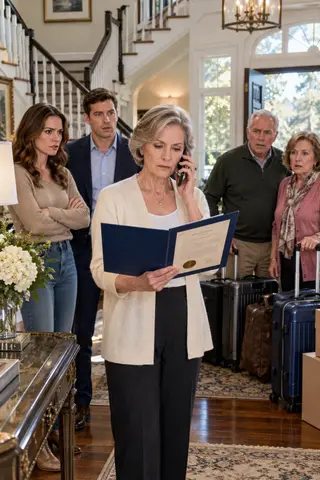
 She Threatened to Take Away Her Grandchildren if She Couldn't Move Her Parents In
Chapter 26
The Shadow Partner
Spring returned to the Lowcountry in a riot of sweet-scented confederate jasmine, wrapping the iron railings of Meeting Street in thick tendrils of green and cream. With Julian Vance thoroughly discredited and facing federal indictments across state lines, our historic home should have been cloaked in unassailable peace. The preservation easement was recorded, the generational trust was locked in ironclad covenants, and Carter and Kendall had blossomed into the bedrock of our family.
Yet Charleston is an old city built over layers of soft silt, marshland, and ancient rivalries. When an arrogant man falls in public disgrace, the tremors often shake loose the silent creatures who funded his descent from the shadows.
The first warning came not in an envelope from a court, but via a handwritten summons delivered to my carriage house design studio. It was penned on heavy ecru cardstock embossed with the private crest of the Sinclair family—one of the oldest, wealthiest dynasties South of Broad.
Mrs. Vance, the note read in sharp, angular calligraphy. A matter of acute municipal concern requires our immediate discussion. I shall call upon you at eleven o’clock tomorrow morning. Do ensure you are alone. Eleanor Sinclair.
Eleanor Sinclair was the uncrowned queen of Charleston society, chairwoman emeritus of the Historic District Zoning Committee, and a trustee of nearly every philanthropic board in the state. She was a woman who made governors wait on the phone and whose quiet displeasure could derail a multi-million-dollar restoration project with a single phone call. Warren had worked on two of her plantations in the 1990s, and he had always warned me that Eleanor viewed the city not as a community, but as her private chessboard.
The next morning, precisely as the steeple bells of St. Michael’s struck eleven, a chauffeur-driven vintage Rolls-Royce glided silently to my curb.
Eleanor stepped through the gate. At seventy-five, she was immaculate—clad in a tailored dove-gray suit, three strands of saltwater pearls resting against her neck, and carrying herself with the rigid posture of someone accustomed to absolute deference.
I opened the heavy front door, remaining squarely on the threshold of my home.
"Eleanor," I said evenly, offering a polite incline of my head. "To what do I owe this unannounced visitation?"
She walked up the wide porch steps without pausing, her pale blue eyes taking in the heart-pine wainscoting and polished brass fixtures with cold, proprietary appraisal. She did not wait for an invitation; she stepped past me into the foyer as if crossing the threshold of a museum she owned.
"Let us dispense with the polite southern charade, Donna," Eleanor began, her voice crisp and clipped, devoid of warmth. "Your little courtroom theatrics with Julian Vance caused an unacceptable amount of financial turbulence. Julian was a clumsy fool, but his consortium was backed by four private family offices. Mine was the largest."
The missing piece of the puzzle snapped into place with terrifying clarity. Julian hadn't returned from Europe on his own resources. Eleanor had supplied the capital, orchestrating a corporate land grab through Julian’s fabricated claim to seize the entire Meeting Street corner block.
"Your investment was an act of bad faith, Eleanor," I said, my voice dropping an octave, radiating cold authority. "Julian attempted to steal this house with a forged covenant and criminal perjury. If you lost money backing a fraudster, your dispute is with the federal penitentiary, not with me."
Eleanor offered a thin, aristocratic smirk that made my skin prickle. She tapped her gloved finger against the carved oak console table.
"You think you’ve won because your clever lawyer dissolved a lis pendens? How charmingly naive. You placed this parcel into a permanent historic preservation easement, Donna. But who do you think appoints the executive directors of the Historic Foundation? Who holds the deciding vote on municipal code compliance for commercial use of historic outbuildings?"
She leaned closer, her eyes flashing with venomous calculation.
"Your carriage house studio operates under an archaic variance Warren secured thirty years ago. Yesterday afternoon, my committee voted to review all grandfathered commercial zoning within the residential grid. Within forty-eight hours, the city will issue a formal revocation of your studio’s occupancy permit, accompanied by twenty-five thousand dollars in retrospective structural penalties. Unless, of course, you sell the carriage house parcel to the Sinclair Cultural Trust for fair assessed agricultural value."
I looked at Eleanor Sinclair—a woman dripping with generational wealth, yet utterly consumed by the disease of entitlement.
"You have thirty seconds to walk off my piazza, Eleanor," I replied, my voice steady as steel. "Before I find out whether your three strands of pearls can protect you from a formal criminal charge for public corruption."
The End









