 She Thought Stealing Our Family Ranch Was Easy
Chapter 1
The Rain, The Porch, And The Phantom Deed
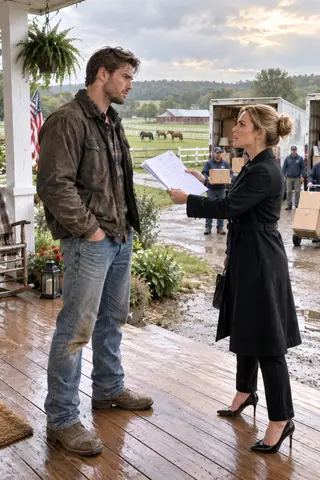
The rain was coming down in sheets, drumming a steady, relentless rhythm against the corrugated metal roof of the back porch. I stood there, twenty-nine years old, boots caked in thick, red clay from mending the east pasture fence, holding a bucket of fresh oats for old Dan. Dan was thirty years old, practically a fixture of the land, blind in one eye and gray around the muzzle. My dad had bought him when I was just a kid learning how to balance in the stirrups.
Behind me, the sound of heavy diesel engines cut through the downpour.
Two massive moving trucks had rumbled up our long, winding gravel drive, their headlights cutting harsh yellow beams through the grey afternoon mist. Mud churned beneath their heavy dual tires, chewing up the soft shoulders of the driveway that my father and I had graded by hand every spring.
I set the bucket down on the worn wooden planks of the porch, wiping my damp hands against my jeans. My muscles ached from a long morning of physical labor, but that physical ache was nothing compared to the cold, tight knot twisting in my stomach.
Clare was already out of her car.
She stood near the foot of the stairs wrapped in an expensive, sleek black trench coat that looked like it belonged on a billboard in downtown Chicago rather than out here in the dust and mud of rural Texas. Water beaded on her shoulders. Her dark hair was slicked back neatly, defying the damp chill in the air. Behind her, two burly movers in orange jumpsuits were already dropping the hydraulic lift gate of the lead truck with a metallic screech.
"Started on what?" I asked, my voice flat, cutting across the wet wind.
Clare smiled. It was that familiar, rehearsed smile she had perfected during her years climbing the corporate and legal ladder in the city—sharp, superior, and entirely devoid of warmth.
"Packing, Jacob," she said, stepping up onto the first wooden step, careful not to let her designer loafers touch the muddy ground. "Renovations begin next week. You should really have your stuff boxed up by Friday so the contractors can get a head start on the master suite."
For a second, all I could hear was the rain ticking against the porch roof and the heavy rumble of the idling diesel engines.
Then I looked past her.
Eighty acres of sprawling pasture stretched out toward the horizon, fading into the misty shroud of the rolling hills. I saw the old red barn with its peeling white trim, the weathered timber fences stretching as far as the eye could see, and the large, sturdy oak tree near the creek where my mother used to sit with her sketchpad while Dad and I fixed tractor engines.
This wasn’t just a $1.2 million piece of real estate on the market.
This was history. This was blood, sweat, and concrete dust. This was where I learned to ride before I learned to ride a bicycle. This was where my mother stood at the kitchen window looking out across the emerald fields every evening as the sun dipped low. This was where my father’s heavy work boots crossed the threshold before sunrise, returning long after dark with calloused hands and a quiet, steady pride.
And now Clare, who hadn't set foot on this property for more than a weekend at a time in over a decade, was standing on my porch telling me to pack my life into cardboard boxes.
Clare had always been entirely different from me.
She was three years older, fiercely ambitious, and entirely devoted to the concrete canyons of the city. While I stayed behind to work the ranch beside Dad—fixing broken fences, feeding the livestock, hauling heavy supplies through freezing winters, and keeping the entire operation running smoothly when my father’s health began its slow, painful decline—Clare chased billable hours and corporate promotions.
When our parents passed away within eighteen months of each other, the grief hit me like a physical blow. The ranch was left solely to me in my father’s final, witnessed will—a document we had drawn up together at the local county courthouse over strong black coffee.
At the funeral, Clare had hugged me tightly, her tears damp against my shoulder.
"We'll get through this together, little brother," she whispered.
Then, the very next week, the comments started.
It began subtly, like small cracks in a foundation.
"Golden ticket," she muttered over Sunday dinner, eyeing the sprawling kitchen as if appraising its resale value.
"Must be nice, not having to pay a mortgage or rent while figuring out your life."
"Jacob needs somewhere to live anyway, I suppose. It's a lot for one person to handle."
Soon, her casual weekend visits turned into unannounced invasions. She would march right through the front door without knocking, carrying measuring tapes, paint swatches, and glossy magazines filled with minimalist interior designs. She would wander from room to room, opening closets, tapping on walls, and talking openly about rental income, zoning laws, and the local real estate boom.
One sunny afternoon, she brought her wealthy, smooth-talking fiancé, Richard, out to the ranch. Richard stood in the hallway, pointed directly toward the back guest bedroom—the very room where our mother had spent her final, peaceful months—and smiled.
"That could easily be a nursery," Richard had said, looking at Clare with an approving nod. "Plenty of natural light. Knock out that dividing wall, and you've got yourself a luxury suite."
That night, alone in the dark house, my gut churned with a sick, unmistakable feeling. My brain tried to make excuses for her—she’s just grieving in her own way, she likes design, she’s proud of our family home—but my stomach knew the absolute truth.
She wasn't visiting.
She was planning an hostile takeover.
Two weeks later, Clare slid a thick stack of papers across my kitchen table while I was halfway through a cup of morning coffee.
"Just routine estate stuff, Jacob," she said smoothly, uncapping a sleek gold fountain pen and laying it beside the papers. "Sign here, here, and initial the bottom of page four. It cleans up the title so we don't have any tax complications down the line."
I picked up the documents and began to read. My high school education was paired with a lifetime of reading cattle contracts, equipment leases, and municipal water agreements. I read enough dense legal jargon to know this was far from routine.
These weren't simple tax cleanups.
They were transfer agreements. Title adjustments. Quitclaim deeds surrendering my primary ownership rights directly to a joint entity controlled by Clare and her fiancé.
Documents she expected me to sign blindly out of grief, loyalty, and intimidation.
I looked up from the papers, my eyes locking onto hers.
"I'm not signing this, Clare."
Her friendly expression vanished instantly, replaced by a cold, hardened stare. But I didn't argue. I didn't yell. I simply closed the folder, pushed it back across the table, and walked out the back door to check on the cattle.
That very afternoon, I picked up my phone and called Marcus, an old high school friend who had gone to law school and now ran a successful real estate practice in the county seat. I drove into town, sat across from him in his cluttered office filled with dusty case files and law books, and stayed awake until three in the morning going through every single option available to protect my home.
Marcus listened carefully, shaking his head at the audacity of the documents Clare had tried to slip past me.
"If she’s trying this now, she’s going to escalate," Marcus warned me, sliding his glasses down his nose. "You need to act fast, and you need to act quietly. Don't give her a single hint of what you're doing."
By the end of that week, following Marcus's exact instructions, I had quietly and legally moved the ranch into a private Limited Liability Company (LLC) registered in my own name, with ironclad asset protection clauses built directly into its corporate charter. The title was shielded, secured, and legally locked down tight.
I didn't tell Clare a single word.
I didn't argue with her on the phone, and I didn't confront her about the forged intent of her papers.
I just went back to mending my fences, feeding my horses, and waiting for her next move.
The End









