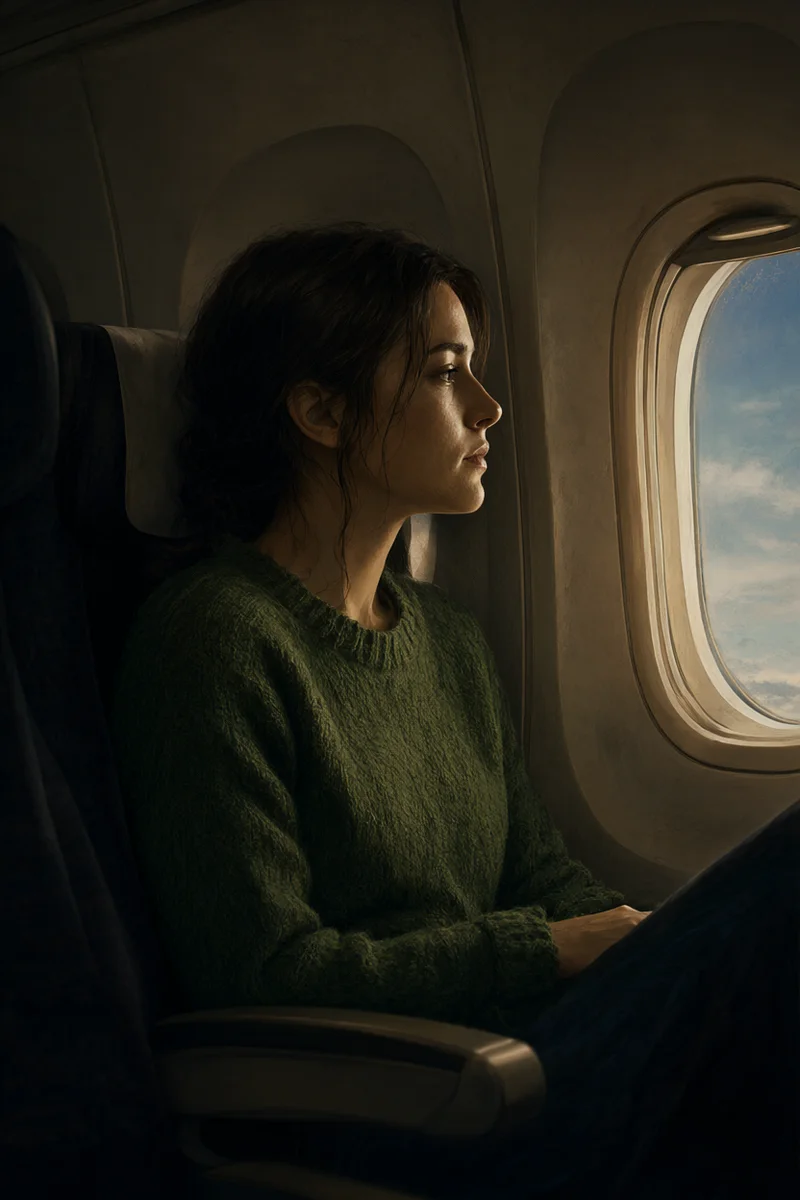
 She Thought She Left Her Past in the Cockpit
Chapter 2
Behind the Reinforced Door
The heavy cockpit door clicked shut behind Laura with a sound that felt less like a latch closing and more like a prison gate locking from the inside.
The atmosphere on the flight deck was a chaotic contrast to the quiet tension of the passenger cabin. Red and amber warning lights flashed across the glareshield like a chaotic arcade game gone wrong. The air smelled sharply of hot ozone and burning plastic—the unmistakable scent of overworked avionics melting down behind the instrument panels.
In the left pilot’s seat sat Captain Marcus Vance—no relation, but sharing the same pale, sweat-slicked expression of a man staring down the barrel of an impossible statistical probability. In the right seat, the First Officer was desperately punching commands into a dead flight management computer while reading off a rapidly depleting list of backup battery margins.
“Captain,” Sarah announced, her voice cracking slightly as she squeezed into the narrow jumpseat space behind the pilots. “I found someone. This is Laura Vance. Former U.S. Air Force fighter pilot.”
Captain Marcus turned his head sharply. His eyes swept over Laura in a fraction of a second—taking in her calm posture, her steady hands, and the utter lack of panic in her eyes. It was the look of someone who had stared death in the face and refused to blink.
“Thank God you’re here,” Marcus said, his voice raspy. “We’ve lost our primary digital fly-by-wire architecture. Both primary flight displays are dead, and our hydraulic pressure on the starboard wing is fluctuating wildly. Civilian autopilot won't even talk to us anymore. It’s fighting every control input we give it.”
Laura stepped forward, placing one hand on the back of the first officer’s seat to steady herself as the massive Boeing gave a sickening lurch to the left.
“Give me the state of the bird,” Laura commanded, her tone dropping instantly into the crisp, authoritative cadence of a squadron commander. No hesitation. No civilian pleasantries.
Marcus blinked, clearly surprised by the sheer force of her presence, but quickly recovered. “We’re at FL360 over the mid-Atlantic. About two hours out from our last waypoint near the Azores. Ten minutes ago, we took a massive static discharge—or a localized EMP-style surge, we aren’t sure yet—and it fried our primary bus bars. The backup generators kicked in, but the software handshake failed. The plane thinks it’s still on the ground, so it’s trying to lock the control surfaces to prevent over-rotation. If we drop below three hundred knots, we’ll stall out before we can manually override.”
Laura’s eyes swept across the central console. Her mind, trained on the complex avionics of a multi-million-dollar fighter jet, immediately began filtering out the noise and focusing on the core mechanics. A Boeing 777 wasn't an F-16, but the fundamental laws of aerodynamics and emergency electronic bypasses remained the same.
“You’re flying on raw mechanical linkages and emergency backup trim,” Laura observed, her eyes narrowing as she studied the erratic twitch of the altimeter. “You’re trying to fight the software loop by wrestling the yoke.”
“We have to!” the First Officer cried, his knuckles white as he pulled back on the heavy control column. “If we let go, the nose drops into a dive!”
“Stop fighting it,” Laura ordered sharply.
The First Officer froze, staring at her in disbelief. “What? If I let go, we die!”
“If you keep fighting a digital lockout with brute force, you’re going to snap the mechanical control cables,” Laura said, her voice cutting through the cockpit noise like a razor blade. She stepped closer, leaning over the center console to examine the hidden circuit breaker panel located beneath the throttle quadrant. “You’re treating this like a mechanical jam when it’s a software feedback loop. The flight computer is stuck in a self-diagnostic protection routine because of the surge.”
Marcus stared at her, watching her fingers hover over a row of unlabelled auxiliary circuit breakers that civilian pilots were trained never to touch outside of a major depot-level maintenance manual. “How do you know about that bypass?”
“Because it’s the exact same architecture they used in the early block-50 F-16 flight control computers,” Laura said coldly. “If you want to fly this bird, you have to kill the brain before it kills you.”
Before either pilot could respond, a shrill, metallic alarm began to shriek through the flight deck—a continuous, high-pitched tone that signaled an impending loss of pitch authority. The nose of the aircraft suddenly dipped violently downward, pressing everyone against the ceiling as negative Gs took over for a terrifying three seconds.
Bags, charts, and loose pens floated in the air before crashing back down as the plane violently corrected itself.
“She’s going down!” the First Officer yelled.
“Move,” Laura said.
It wasn't a request. It was an absolute command backed by a decade of military conditioning.
Without waiting for permission, Laura slipped into the narrow space between the center pedestal and the jumpseat. Her hands moved with terrifying speed and precision. She didn't hesitate. She didn't second-guess. Years of muscle memory took over, overriding the decade of civilian rust she had tried so hard to cultivate.
Her right hand pulled out a small tactical flashlight from her sweater pocket and clicked it on, illuminating the auxiliary override panel beneath the desk. Her left hand reached out and grasped three specific circuit breakers simultaneously—breakers that controlled the primary digital flight computer reset loops.
“What are you doing?!” Marcus shouted, reaching out to stop her.
“Trust me,” Laura said, her voice dropping to a low, hypnotic whisper that brooked no argument. “Unless you want to swim home, hold this yoke steady at three degrees nose-up and do not let it deviate.”
The First Officer swallowed hard, grabbed the heavy control column with both hands, and locked his elbows.
Laura pulled the three circuit breakers with a sharp, synchronized snap.
For one agonizing second, every single screen on the flight deck flickered black. The emergency alarms stopped instantly, replaced by a deafening, unnatural silence that felt heavier than the noise. The plane hung suspended in the freezing night air, drifting blindly through the clouds without instruments, without guidance, and without a safety net.
In the back of Laura’s mind, a voice whispered: You’re back. You swore you’d never do this again.
Then, the main instrument displays flashed back to life with a brilliant, blinding wash of green light.
The digital flight management system rebooted, resetting its software loop and clearing the error code. The automated voice of the synthetic flight director chimed cheerfully through the speakers: “Autopilot engaged. Altitude hold: three-six-thousand feet. Heading: zero-eight-four.”
The Boeing smoothed out instantly, gliding through the smooth night air as if nothing had ever happened.
The First Officer let out a long, shuddering breath and slumped forward against the yoke, his forehead resting against his arms. Captain Marcus stared at the screens, then turned his head slowly to look at the woman standing beside him.
“My god,” Marcus whispered. “You just saved three hundred lives.”
Laura didn't smile. She didn't look relieved. As she slowly withdrew her hand from the console, she noticed her fingers were trembling—not from fear, but from the sudden, terrifying realization of what she had just unlocked inside herself.
The past wasn't dead. It was just waiting for the right moment to wake up.
And as she turned to walk out of the cockpit, she had no idea that her heroism on Flight 408 had just broadcasted her exact location to someone who had spent the last ten years searching the globe to destroy her.
The End









